
Losing a job is stressful enough on its own. But when you're also carrying an adjustable-rate mortgage — one whose monthly payment could climb without warning — the pressure can feel even heavier. The good news is that receiving a severance package doesn't automatically close the door on refinancing. In fact, for many homeowners, this may be the right moment to explore the best options for refinancing ARM mortgage with recent severance package income and move toward a more predictable, stable financial future. This article walks you through what lenders look for, how to position your severance income, and which refinance paths may work best for your situation.
Why Adjustable-Rate Mortgages Create Urgency During Income Transitions
An adjustable-rate mortgage, or ARM, typically starts with a lower fixed interest rate for an introductory period — often three, five, or seven years. After that window closes, the rate adjusts periodically based on a benchmark index. When interest rates are rising, those adjustments can push monthly payments significantly higher.
For homeowners who are currently between jobs or transitioning after a layoff, this rate variability adds another layer of financial uncertainty. If your ARM is approaching its first adjustment date — or has already begun adjusting — your monthly payment could increase at the worst possible time. That's why many homeowners in this position look to refinance ARM mortgage into a fixed-rate mortgage, which offers consistent monthly payments regardless of market conditions.
Refinancing now, even with fluctuating income, may help you lock in a predictable payment and reduce long-term financial risk. The key is understanding how lenders evaluate your income situation and what documentation you'll need to make the strongest possible application.
How Lenders View Severance Package Income During the Refinance Process
One of the most common concerns homeowners have when refinancing ARM mortgage with fluctuating income is whether their severance will count as qualifying income. The honest answer is: it depends on the lender, the loan program, and how the severance is structured.
Most conventional lenders follow guidelines set by Fannie Mae or Freddie Mac, which generally require that income be stable, predictable, and likely to continue for at least three years. Severance, by its nature, is a temporary benefit — which can make it harder to qualify on severance income alone. However, it may still play a role in your application in several ways:
- Bridge income documentation: If your severance is paid out over time (rather than as a lump sum), lenders may count it as income for the months it continues, provided you can document the schedule.
- Asset reserves: Even if severance isn't counted as regular income, a lump-sum payment deposited into your bank account could strengthen your reserves profile, which lenders use to assess risk.
- Anticipated employment: If you have a signed offer letter or documented start date for a new job, some lenders may allow you to use that future income to qualify — especially if employment begins before your first loan payment is due.
It's important to speak directly with a mortgage advisor who can review your specific severance agreement and help you understand how it fits into the lender's income calculation framework.
Best Options for Refinancing ARM Mortgage with Recent Severance Package Income
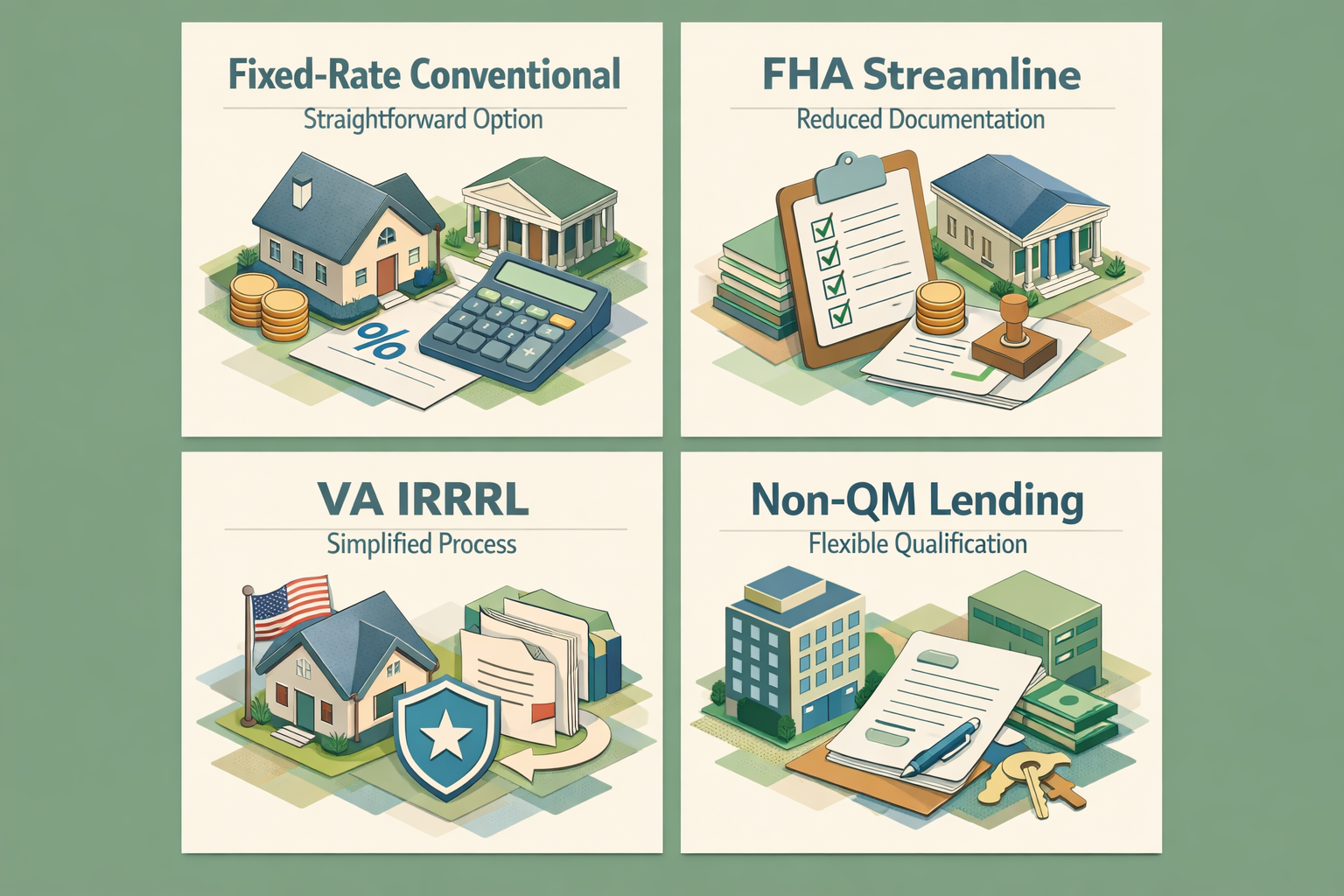
There isn't a single path that works for everyone, but several refinancing strategies may be worth exploring depending on your credit profile, equity position, and income documentation.
Fixed-Rate Conventional Refinance
If you have strong credit, significant home equity, and either ongoing severance payments or a new job lined up, a conventional fixed-rate refinance could be your most straightforward option. Lenders typically look for a credit score of 620 or higher, though better scores often unlock more favorable rates. A debt-to-income ratio within acceptable limits — generally below 45 percent for conventional loans — will also be important.
FHA Streamline or Rate-and-Term Refinance
If your current mortgage is FHA-backed, an FHA Streamline Refinance may allow you to refinance with reduced documentation requirements. In some cases, income verification may be less stringent, though you'll still need to demonstrate the ability to repay. This could be a useful path if your income situation is temporarily disrupted.
VA Interest Rate Reduction Refinance Loan (IRRRL)
For eligible veterans and service members with an existing VA loan, the VA IRRRL — sometimes called a VA Streamline Refinance — offers a simplified process with limited income documentation requirements. If you currently hold a VA ARM, this could be one of the most efficient ways to move into a fixed rate.
Non-QM or Asset-Based Lending
Non-qualified mortgage (Non-QM) programs are designed for borrowers who don't fit traditional income verification models. Asset-depletion loans, for example, allow lenders to calculate income based on your total liquid assets divided over a set number of months. If your severance resulted in a substantial cash reserve, this approach might help you qualify even without active employment income.
Strengthening Your Application When Income Is Temporarily Reduced
Even if your income has recently changed, there are meaningful steps you can take to improve your refinance prospects. Lenders assess multiple factors beyond income, and a well-prepared application can go a long way.
- Check and improve your credit score: A strong credit score may offset some concern about income disruption. Pay down revolving balances, avoid new credit inquiries, and resolve any errors on your credit report before applying.
- Build up your cash reserves: Lenders often feel more comfortable approving a refinance when the borrower has several months of mortgage payments held in reserve. Your severance funds, if managed carefully, could help you meet this threshold.
- Document everything thoroughly: Gather your severance agreement, bank statements, any new employment offer letters, and prior tax returns. The more clearly you can tell your financial story, the better positioned you'll be.
- Reduce your debt load: If possible, pay off or pay down credit card balances or installment loans before applying. This lowers your debt-to-income ratio and can meaningfully improve your chances of approval.
- Consider a co-borrower: If you have a spouse, partner, or family member with stable income, adding them as a co-borrower could strengthen the application considerably.
Timing also matters. If you're expecting to start a new job within the next few weeks or months, it may be worth waiting until you have a few pay stubs to show before submitting your application. A mortgage advisor can help you weigh the timing trade-offs carefully.
Understanding Rate Environments and Locking In at the Right Time
When you decide to refinance, one of the most important tactical decisions is when to lock your interest rate. Mortgage rates can move daily based on economic data, Federal Reserve signals, and broader bond market conditions. If you're refinancing an ARM in a rising-rate environment, locking quickly after approval may make sense — but it's worth understanding your options.
Most lenders offer rate locks ranging from 30 to 60 days, with longer locks sometimes available for a fee. Once locked, your rate won't change even if market rates climb before closing. If rates fall, however, some lenders offer float-down options that allow you to capture a lower rate — though these typically come with conditions.
It's also worth calculating your break-even point before committing to a refinance. This is the number of months it takes for your monthly savings to offset the closing costs of the new loan. If you plan to sell the home or pay off the mortgage within a short period, the cost of refinancing may outweigh the benefit. A mortgage professional can run these numbers with you to make sure the refinance makes financial sense in both the short and long term.
Working with the Right Lender for Your Unique Situation
Not all lenders are equally flexible when it comes to non-traditional income situations. Some larger institutions follow rigid automated underwriting guidelines, while smaller community lenders or mortgage brokers may have access to a wider range of loan programs — including Non-QM products designed for borrowers with fluctuating income.
When you're evaluating lenders, consider asking these questions:
- Do you offer loan programs for borrowers with temporary income gaps or severance income?
- How do you handle asset-depletion calculations for income qualification?
- What documentation will you need to verify my severance agreement and future employment?
- Do you work with Non-QM lenders or portfolio loans for situations like mine?
A mortgage broker, in particular, may be able to shop your profile across multiple lenders to find the one most likely to approve your application under favorable terms. This can save significant time compared to applying individually at multiple banks.
It's also worth reviewing lender reviews, checking licensing, and confirming any quotes in writing. Transparency and communication quality matter greatly during a refinance — especially when your income situation requires extra explanation.
●Conclusion
Navigating the best options for refinancing ARM mortgage with recent severance package income requires careful planning, honest documentation, and the right lending partner. While severance income presents unique challenges in the mortgage qualification process, it doesn't have to be a dealbreaker. Whether you pursue a conventional fixed-rate refinance, an FHA or VA streamline option, or a Non-QM asset-based program, there are realistic paths forward for homeowners in transition.
The most important step you can take right now is to consult with a knowledgeable mortgage advisor who understands non-traditional income scenarios. At LoanWise, our team is here to help you evaluate your options, understand your documentation requirements, and move confidently toward a more stable mortgage — even during a period of income change. Reach out today to start the conversation.