
Relocating for a new job is already a major life event — but when a relocation bonus lands in your bank account at the same time you're carrying an adjustable-rate mortgage, things can get both exciting and complicated. You may be wondering whether that bonus income can actually help you qualify for a refinance, and which loan programs are best suited for your situation. The good news is that lenders do have ways to evaluate bonus income, and there are several strong paths forward for homeowners in your position. This article walks through the best options for refinancing ARM mortgage with recent job relocation bonus income, so you can make a confident, informed decision.
Understanding Why Homeowners Want to Exit an Adjustable-Rate Mortgage
An adjustable-rate mortgage, commonly called an ARM, starts with a fixed interest rate for an initial period — often five, seven, or ten years — and then adjusts periodically based on a market index. During the fixed period, payments are predictable. But once the adjustment phase begins, your rate and monthly payment can rise significantly, sometimes creating financial stress for homeowners.
For someone who just relocated for a new job, this uncertainty is even more pressing. You may have moved to a higher cost-of-living area, taken on new expenses, or simply want the peace of mind that comes with a fixed monthly payment. Refinancing your ARM into a fixed-rate mortgage can provide that stability, and a recent job relocation bonus could actually strengthen your application — if you know how to present it properly.
It's also worth noting that ARM refinances are often driven by timing. If rates are currently favorable compared to where your ARM is projected to adjust, refinancing sooner rather than later may save you money over the life of the loan. A licensed mortgage professional can help you run the numbers and identify the right window to act.
How Lenders Typically View Job Relocation Bonus Income
One of the most common questions homeowners ask is whether a relocation bonus counts as qualifying income for a mortgage refinance. The short answer is: it depends on how the bonus is structured and documented. Lenders generally want to see that income is stable, consistent, and likely to continue. A one-time relocation bonus may not meet the continuity requirement on its own, but it can still play a meaningful role in your refinance.
Here's how bonus income may be factored into your file:
- Two-year history of bonus income: Conventional lenders typically want to see at least a two-year track record of receiving bonus pay before they'll count it toward your qualifying income. If this is your first relocation bonus, it may not be included in your debt-to-income ratio calculation.
- Employer verification letter: Some lenders may accept a letter from your employer confirming that the bonus is expected to continue in future years, which could help make the case for including it.
- Use as assets rather than income: Even if the bonus doesn't count as qualifying income, the funds sitting in your bank account can strengthen your application by demonstrating cash reserves. Lenders often view strong reserves favorably, especially for refinances.
- Non-QM and portfolio lenders: These lenders may use more flexible underwriting standards and could be more willing to consider bonus income or alternative documentation for borrowers with non-traditional income profiles.
The key takeaway is that a relocation bonus doesn't have to be invisible to your lender. Working with an experienced mortgage advisor who understands how to document and present your full financial picture can make a meaningful difference in your outcome.
Conventional Refinance: A Solid Starting Point for Many Relocating Homeowners
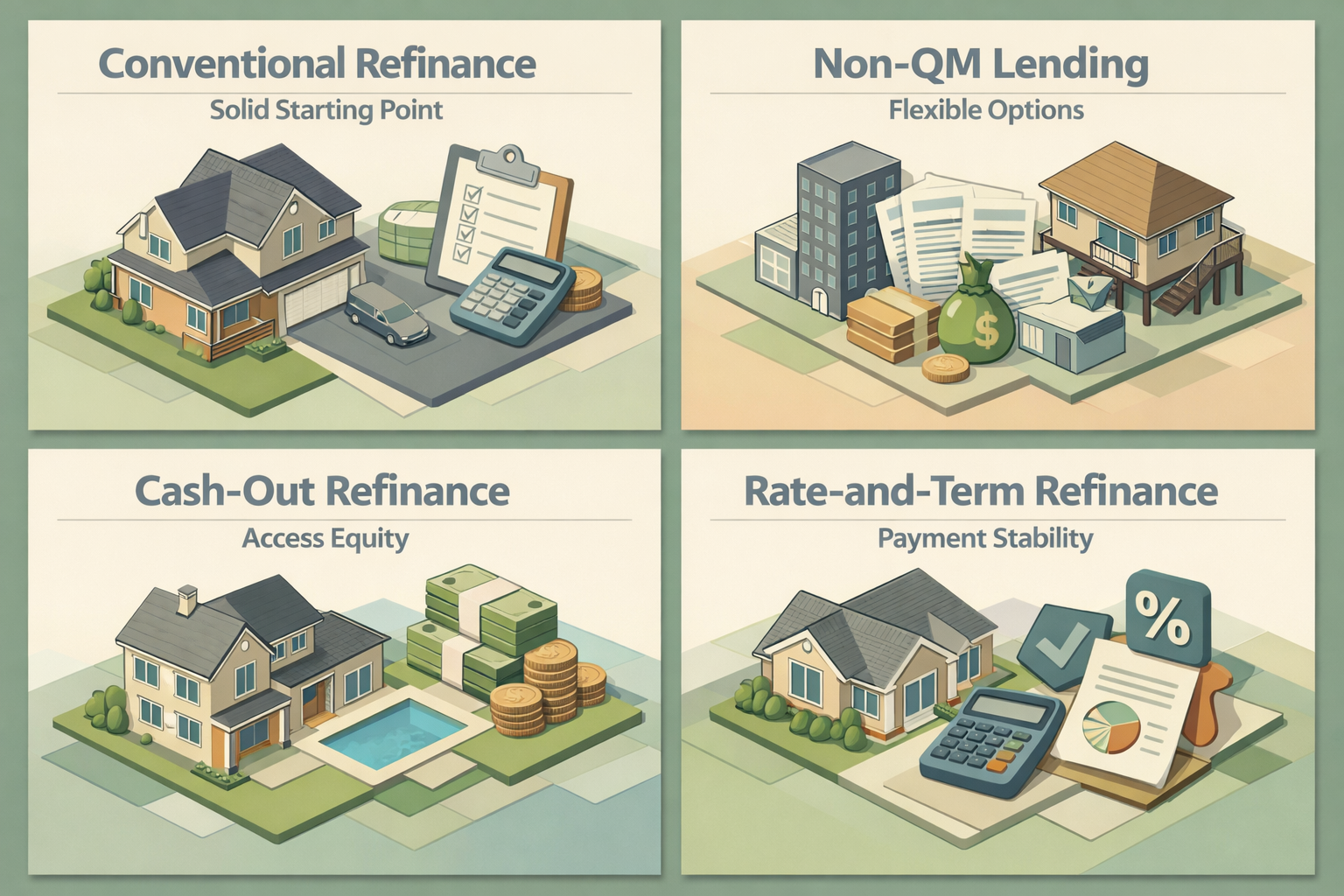
For most homeowners with solid credit and adequate home equity, a conventional refinance into a fixed-rate loan is often the most straightforward path. Conventional loans backed by Fannie Mae or Freddie Mac offer competitive rates and flexible term options, including 15-year and 30-year fixed mortgages. If your ARM is adjusting soon or has already started increasing your payments, locking into a conventional fixed rate could reduce long-term cost and stress.
To qualify, you'll generally need:
- A credit score of at least 620, though higher scores typically unlock better rates
- A debt-to-income ratio that falls within acceptable guidelines, usually below 45 to 50 percent
- Sufficient home equity, typically at least 20 percent to avoid private mortgage insurance
- Documentation of stable employment and income history
If you've recently started a new job due to relocation, lenders will want to verify that your employment is in the same field or a related one, and that your income is consistent. A new job offer letter combined with your first paystub from the new employer can often satisfy documentation requirements, especially if there's no gap in employment. This is where understanding your lender's specific guidelines matters, as they can vary.
Your relocation bonus, while potentially not counted as qualifying income in a conventional scenario, may still be used to pay down the loan balance before refinancing, help you avoid private mortgage insurance by bringing your equity above 20 percent, or simply serve as a financial cushion that reassures underwriters.
Exploring the Best Options for Refinancing ARM Mortgage with Recent Job Relocation Bonus Through Non-QM Lending
Non-qualified mortgage programs, often called Non-QM loans, are designed for borrowers whose income or employment situations don't fit the traditional underwriting box. If your relocation bonus is significant and you'd like it to be a larger part of your qualifying picture, a Non-QM lender may offer the flexibility you need.
These programs can include:
- Bank statement loans: Instead of tax returns and W-2s, lenders review 12 to 24 months of bank statements to assess cash flow. If your bonus was deposited in recent months, this could work in your favor.
- Asset depletion loans: Lenders calculate a monthly income equivalent based on your total liquid assets, including that relocation bonus. This can be particularly useful if your base salary alone doesn't fully support the refinance.
- DSCR or income-based portfolio loans: Some portfolio lenders design their own programs with flexible income documentation, making them worth exploring if conventional options fall short.
Non-QM loans may carry slightly higher interest rates than conventional loans, and terms can vary widely between lenders. That said, they represent one of the most accessible refinance ARM bonus income strategies for borrowers whose financial profile is strong but unconventional. It's worth comparing offers from multiple sources to ensure you're getting fair terms.
Cash-Out Refinance vs. Rate-and-Term Refinance: Which Fits Your Goals
When exploring your refinance options after a job relocation, you'll want to decide between a rate-and-term refinance and a cash-out refinance. Each serves a different purpose, and your relocation bonus may influence which one makes more sense for you.
A rate-and-term refinance simply replaces your existing ARM with a new loan — typically at a fixed rate — without changing the loan balance significantly. This is ideal if your primary goal is payment stability and you're not looking to pull equity out of the home. If you've used your relocation bonus to increase your cash reserves and simply want to lock in a better rate and a predictable payment, this approach is often the cleaner and lower-cost option.
A cash-out refinance allows you to borrow more than you currently owe and receive the difference in cash. This could be useful if you need to cover moving expenses, home improvements in your new area, or other costs associated with relocation. However, it typically requires more equity in the home and may come with a slightly higher interest rate. Lenders also apply stricter debt-to-income requirements for cash-out transactions.
The right choice depends on your equity position, your current financial needs, and how long you plan to stay in the home. A mortgage advisor can help you model both scenarios and determine which one offers the best long-term value given your situation.
Job Relocation Mortgage Options: Navigating Employment Gaps and New Employer Documentation
One concern many relocating homeowners have is how a recent job change affects their ability to refinance. Lenders do take employment stability seriously, but a job change for relocation purposes is often viewed differently than an unexplained gap or career shift. Here's what typically matters:
- Continuity of field: If you moved into a similar role in the same industry, lenders are generally more comfortable. A software engineer who relocates to a new tech company is likely to be viewed more favorably than someone switching careers entirely.
- No employment gap: If you transitioned directly from one employer to the next, most lenders won't penalize you for the move. Even a short gap may be acceptable with a valid explanation letter and supporting documentation.
- New employer offer letter and paystubs: These documents are often sufficient to verify income for borrowers who've recently started a new role. Some lenders may also accept a verification of employment directly from your new HR department.
- Union or government employment: If your new role is government or union-based, lenders may find it especially straightforward to verify stability and income continuity.
Understanding your job relocation mortgage options means knowing that lenders aren't necessarily looking to disqualify you because you moved — they're looking for confidence that your income is reliable going forward. Documentation is your strongest tool in that conversation.
●Conclusion
Navigating the best options for refinancing ARM mortgage with recent job relocation bonus income is genuinely achievable with the right guidance and preparation. Whether you pursue a conventional fixed-rate refinance, explore a Non-QM solution, or use your bonus to strengthen your equity position before applying, there are real paths forward for homeowners in your situation. The most important step is to connect with a knowledgeable mortgage advisor who can review your full financial picture — including how your bonus income is documented, how your new employment is structured, and which loan programs align with your goals. At LoanWise, we're here to help you find clarity and move forward with confidence. Reach out today to explore your refinance options.