
Getting promoted at work is exciting — and it can open doors you didn't expect, including better mortgage options. If you currently have an adjustable-rate mortgage (ARM) and you've recently received a bump in salary along with bonus income, now may be a smart time to explore a refinance. However, navigating the best options for refinancing ARM mortgage with bonus income from recent promotion isn't always straightforward. Lenders have specific rules about how they count irregular income, and bonus pay often falls into a gray area. This guide breaks down what you need to know — from how lenders evaluate your new earnings to which loan programs might be the right fit for your situation.
Why Homeowners With ARMs Consider Refinancing After a Promotion
An adjustable-rate mortgage can be a great tool early in your homeownership journey, especially when rates are low and you're focused on keeping monthly payments manageable. But ARMs come with built-in uncertainty. After the initial fixed-rate period ends — often five, seven, or ten years — your interest rate adjusts periodically based on a benchmark index. That means your payment could rise significantly over time.
When a promotion comes along, your financial picture changes. You may now have a higher base salary, plus bonus compensation that adds to your overall earnings. This improvement in income could strengthen your mortgage application considerably. Refinancing from an ARM into a fixed-rate mortgage locks in a predictable monthly payment, which many homeowners find more comfortable as they plan long-term budgets and financial goals.
Beyond payment stability, refinancing after a promotion could also allow you to:
- Qualify for a larger loan amount if you need to pull out equity for home improvements or other goals
- Shorten your loan term from 30 years to 15 or 20 years, potentially saving significantly on interest
- Access better interest rates if your credit profile has improved since you first took out the ARM
- Eliminate private mortgage insurance (PMI) if your home has gained equity since you purchased it
That said, refinancing isn't free. Closing costs typically range from 2% to 5% of the loan amount, so it's important to calculate your break-even point before moving forward.
How Lenders Evaluate Bonus Income During the Refinance Process
One of the most important things to understand when exploring ARM refinance with promotion bonus is how lenders actually count that extra pay. Not all income is treated equally in the mortgage underwriting process. Bonus income is typically considered variable or supplemental income, which means lenders apply more scrutiny to it than they would a steady base salary.
In general, most conventional loan guidelines — including those set by Fannie Mae and Freddie Mac — require that bonus income be documented over a two-year history before it can be used to qualify for a mortgage. This is a critical point for recently promoted borrowers: if your bonus is new or tied to a position you've only held for a few months, a lender may not be able to count it fully in your debt-to-income (DTI) ratio calculations.
What Documentation Lenders Typically Ask For
If you're hoping to use bonus income to strengthen your refinance application, be prepared to provide:
- Two years of W-2 forms showing your total annual compensation, including bonus pay
- Your most recent pay stubs showing year-to-date earnings
- A written verification of employment from your employer that confirms your new role, salary, and the bonus structure going forward
- A promotion letter or offer letter if your role recently changed
Lenders will typically average your bonus income over the two-year period shown on your W-2s. If your bonus grew substantially in the most recent year, some lenders may apply a more conservative average. It's wise to ask your loan officer how they specifically handle this before submitting a full application.
When the Two-Year Rule May Work in Your Favor
If you've been in a role that paid bonuses for two or more years and your recent promotion simply increased the amount, you may be in a stronger position than you think. As long as your employer confirms that the bonus structure will continue, lenders could be willing to count a portion — or even the full averaged amount — of that income in your qualification figures.
Refinancing ARM with Irregular Income: Loan Programs Worth Considering
When you're refinancing ARM mortgage with irregular income, the loan program you choose matters as much as the lender you work with. Different programs have different standards for income documentation, and some are more flexible than others when it comes to variable pay.
Conventional Loans (Fannie Mae and Freddie Mac)
Conventional loans remain the most common refinance option for borrowers with solid credit and documented income. Fannie Mae and Freddie Mac guidelines do allow bonus income to be counted, but as mentioned, they typically require a two-year history. If your credit score is strong — generally 620 or higher, with better rates above 740 — and your DTI is within acceptable limits, a conventional refinance could offer competitive rates and flexible terms.
FHA Streamline or Rate-and-Term Refinance
If your original ARM was an FHA loan, an FHA streamline refinance could be a simpler path. This program often requires less documentation than a full conventional refinance and may not require a new income verification in some cases. However, eligibility rules apply, and you'll still need to meet certain payment history requirements. FHA loans also carry mortgage insurance premiums, which is a cost to factor into your decision.
VA Interest Rate Reduction Refinance Loan (IRRRL)
Eligible veterans and active-duty service members with a VA-backed ARM have access to the VA IRRRL, also known as a streamline refinance. This program is known for its reduced documentation requirements and the ability to refinance without a new appraisal in many cases. If you qualify, this could be one of the most cost-effective ways to move from an ARM to a fixed-rate VA loan.
Non-QM (Non-Qualified Mortgage) Loans
For borrowers whose income doesn't fit neatly into conventional guidelines — such as those with very recent bonuses, fluctuating pay, or complex compensation structures — non-qualified mortgage (Non-QM) loans may offer an alternative path. Non-QM lenders often use bank statements, profit-and-loss statements, or asset depletion methods to assess income rather than relying solely on W-2s and tax returns. Interest rates on Non-QM loans are typically higher, and terms vary widely by lender, so careful comparison is essential.
Strengthening Your Application: Credit, Equity, and Debt-to-Income Ratio
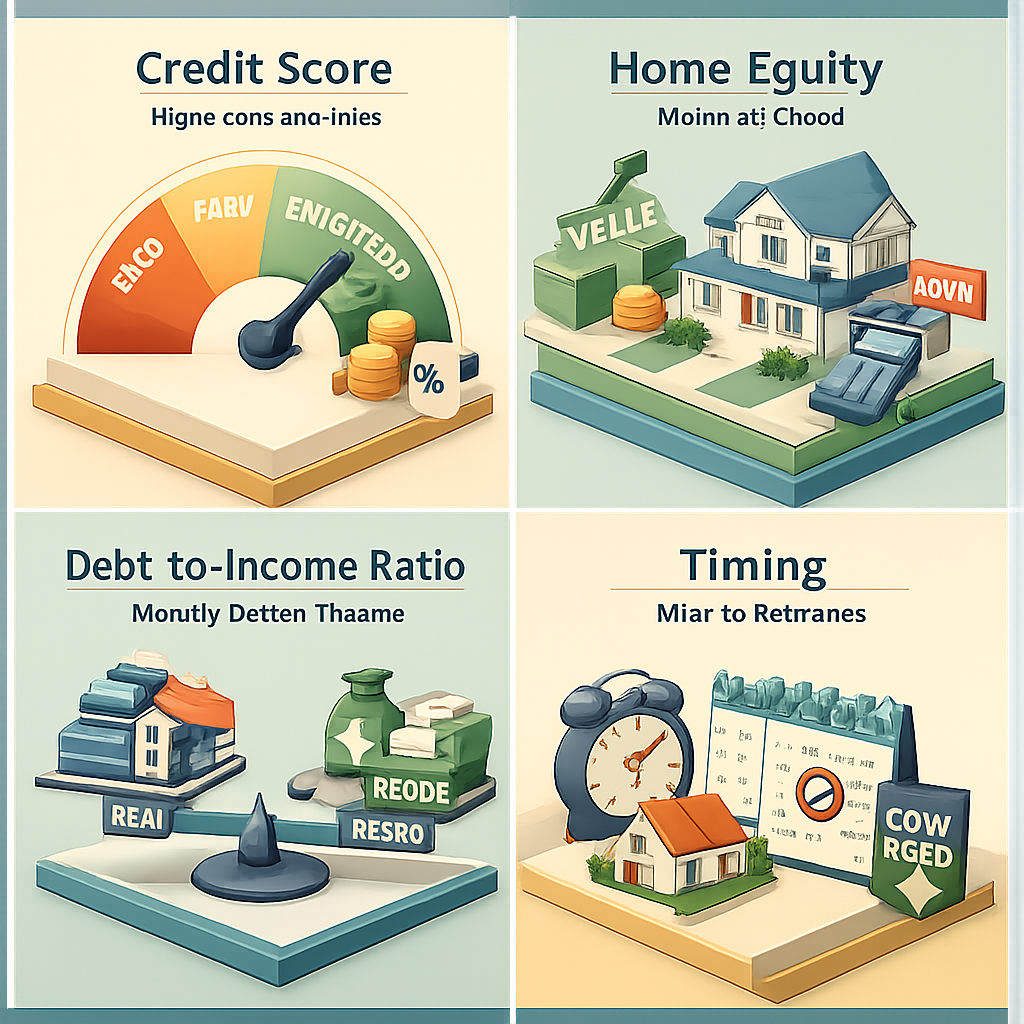
Beyond income documentation, lenders weigh several other factors when reviewing a refinance application. Understanding these elements — and how to optimize them — can make a real difference in the rates and terms you're offered.
Credit Score
Your credit score is one of the most influential factors in the refinance process. A higher score typically translates to a lower interest rate, which directly affects your monthly payment and the total cost of the loan over time. If you've recently been promoted and have had more financial stability, it may be worth reviewing your credit report for errors and paying down high-balance credit cards before applying. Even a modest improvement in your score could move you into a better rate tier.
Home Equity
Equity is the difference between what your home is worth and what you still owe on your mortgage. Lenders generally want to see at least 20% equity in a refinance to avoid requiring PMI. If your home has appreciated since you purchased it — which has been the case in many markets in recent years — you may have more equity than you realize. A new appraisal during the refinance process will establish your current home value, and strong equity can help you qualify for better terms.
Debt-to-Income Ratio
Your DTI ratio compares your monthly debt payments to your gross monthly income. Most conventional lenders prefer a DTI of 43% or lower, though some programs allow higher ratios with compensating factors. If your promotion increased your base salary, this alone could lower your DTI and make your application more attractive — even before accounting for bonus income. Paying off smaller debts before applying could further improve this ratio.
Timing Your Refinance: When to Move and When to Wait
Timing a refinance involves balancing personal financial readiness with market conditions. Interest rates fluctuate, and the spread between your current ARM rate and available fixed rates will determine how much you stand to gain from refinancing at any given moment.
If your ARM is approaching the end of its fixed period and rate adjustments are coming soon, acting proactively could protect you from payment increases. On the other hand, if rates are currently elevated and you still have several years of fixed-rate protection remaining on your ARM, it might make sense to wait and monitor the market.
For borrowers who recently received a promotion, it's also worth considering how long you've been in the new role. If your bonus income is brand new, waiting six to twelve months — and ideally completing a full calendar year — before applying could help you document that income more effectively. Some lenders may also want to see that your employment situation has stabilized after the change in position.
A mortgage professional can help you run the numbers on your specific scenario, including calculating your break-even point based on estimated closing costs versus the monthly savings from a lower or more stable rate.
Working With a Loan Officer Who Understands Variable Compensation
Not all loan officers have deep experience with borrowers who receive variable compensation such as bonuses, commissions, or performance pay. Finding a lender or mortgage broker who regularly works with professionals in this situation can make a meaningful difference in the outcome of your application.
An experienced loan officer can help you:
- Identify which lenders are most favorable toward bonus income documentation at your career stage
- Structure your application to present your income history clearly and compliantly
- Compare loan programs side by side to find the best fit for your income profile and refinance goals
- Anticipate potential underwriting questions before they arise, reducing delays in the approval process
It's also a good idea to shop multiple lenders. Rates, fees, and underwriting flexibility can vary significantly from one institution to another. Getting loan estimates from at least three lenders gives you a clearer picture of the market and negotiating leverage.
At LoanWise, our team works with homeowners at every stage of the financial journey — including those navigating the best options for refinancing ARM mortgage with bonus income from recent promotion. Whether you're just beginning to explore your options or ready to move forward, we're here to help you make an informed decision.
●Conclusion
Refinancing an adjustable-rate mortgage after a promotion is a meaningful financial move — one that could bring greater payment stability, improved loan terms, and long-term savings. The key is understanding how lenders view your bonus income, which loan programs align with your situation, and how to present your application in the strongest possible light. Whether you're looking at conventional, FHA, VA, or non-QM options, each path has its own set of benefits and trade-offs worth carefully evaluating. Take the time to review your credit profile, assess your home equity, and work with a knowledgeable mortgage professional who can guide you through the nuances of refinancing ARM with irregular income. Your promotion opened a new chapter — your mortgage strategy should reflect it.