
If you're sitting on a sizable crypto portfolio while carrying an adjustable-rate mortgage, you're likely facing two pressing questions at once: how do you lock in a more stable rate before your ARM adjusts higher, and how do you convince a lender to count your digital assets toward your qualification? The good news is that the lending landscape is evolving. More lenders are beginning to recognize cryptocurrency as a legitimate financial resource, even if the path to approval still requires careful planning. This article walks through the best options for refinancing an ARM mortgage with significant cryptocurrency holdings, so you can approach the process with confidence and a clear strategy.
Why ARM Refinancing Becomes Urgent — and What's at Stake
An adjustable-rate mortgage, or ARM, starts with a fixed interest period — often five, seven, or ten years — before the rate begins adjusting periodically based on a benchmark index. When that fixed period ends, your monthly payment could rise substantially, sometimes by hundreds of dollars depending on current market conditions.
For homeowners who took out ARMs during a low-rate environment, the adjustment phase can feel like a financial cliff. Refinancing into a fixed-rate mortgage before that cliff arrives is a common and often smart move. It brings predictability to your budget and protects you from rate volatility that the ARM was always designed to pass along to you.
The urgency is real. Once your rate adjusts upward, your debt-to-income ratio (DTI) may shift, which could actually make it harder to qualify for a refinance down the road. That's why acting during — or even before — the fixed period ends is often the better approach. For crypto holders, the challenge is that digital assets don't always translate neatly into the income or liquid reserves that traditional lenders want to see.
How Lenders View Cryptocurrency as a Financial Asset
Traditional mortgage underwriting is built around documented, stable income and verifiable assets. Cryptocurrency introduces complexity on both fronts. Most conventional lenders following Fannie Mae or Freddie Mac guidelines have strict rules about which assets can be counted toward reserves or a down payment.
As of recent Fannie Mae updates, cryptocurrency may be used as a source of funds — but typically only after it has been converted to U.S. dollars and deposited into a verified bank or financial account. The converted funds must be documented with account statements showing the exchange transaction, and there's usually a seasoning or paper trail requirement to confirm the funds weren't borrowed.
This means that simply owning Bitcoin, Ethereum, or another digital asset doesn't directly satisfy a lender's reserve requirement while it remains in a crypto wallet. You may need to liquidate a portion of your holdings, convert them to fiat currency, and let those funds settle in a bank account before applying. This is a critical step many crypto holders overlook early in the refinance process.
It's also worth noting that crypto gains may be treated as capital gains income for tax purposes, which complicates how lenders calculate qualifying income. If you've realized significant gains through trading, a lender may or may not count that as stable, recurring income — and this varies by loan program and lender.
Conventional Refinance Programs and Their Crypto Compatibility
Conventional refinance loans backed by Fannie Mae or Freddie Mac remain the most widely available option for ARM refinancers. They typically offer competitive rates, broad lender access, and flexible term options — from 10-year to 30-year fixed-rate products.
For crypto holders, the key to using a conventional refinance is preparation. If you've already converted your crypto holdings into a traditional bank account and those funds have been seasoned for at least 60 days, they may qualify as verified reserves under conventional guidelines. Lenders want to see that money is stable and accessible, not speculative.
Your credit score, DTI ratio, and loan-to-value (LTV) ratio will still be the primary qualification factors. Crypto wealth doesn't compensate for a weak credit profile or a debt-heavy financial picture. However, if your converted holdings create a strong reserve cushion — say, enough to cover six to twelve months of mortgage payments — that can meaningfully strengthen your application.
It's worth speaking directly with a loan officer who has experience handling non-traditional assets. Not all underwriters interpret crypto-sourced funds the same way, and getting pre-qualified with a lender familiar with this profile could save you time and frustration.
Non-QM and Portfolio Lenders: A More Flexible Path for Crypto-Heavy Borrowers
For homeowners whose financial profile doesn't fit neatly into conventional boxes, non-qualified mortgage (non-QM) loans and portfolio lenders may offer the most practical route. These lenders hold their loans in-house rather than selling them to Fannie Mae or Freddie Mac, which means they can set their own underwriting guidelines.
Non-QM products are especially relevant when your income is irregular, heavily investment-based, or primarily derived from self-employment or digital asset activity. Some non-QM lenders offer what's called an asset depletion or asset dissipation loan, where they calculate qualifying income based on the value of your liquid assets rather than a traditional income stream. If your crypto holdings are substantial and have been converted or are otherwise liquid, this approach might allow you to qualify based on wealth rather than a W-2 paycheck.
Exploring the best options for refinancing an ARM mortgage with significant cryptocurrency holdings often leads borrowers toward this category. While non-QM loans may come with slightly higher interest rates than conventional products, they can provide the approval pathway that conventional programs simply don't offer for crypto-rich, income-complex borrowers.
Portfolio lenders — often community banks, credit unions, or private lenders — may also be open to custom underwriting conversations. If you have a strong banking relationship or significant assets on deposit, these institutions may view your overall financial picture more holistically than a national bank following rigid guidelines.
Jumbo Refinance Options for Higher-Value Properties
If your home's loan balance exceeds conforming loan limits — currently set at $806,500 in most U.S. markets for 2025, with higher limits in designated high-cost areas — you'll be looking at jumbo refinance territory. Jumbo loans are not backed by Fannie Mae or Freddie Mac, so lenders have more flexibility in their underwriting standards.
This flexibility can actually work in favor of crypto holders. Many jumbo lenders are accustomed to working with high-net-worth borrowers who have complex financial profiles, including significant investment portfolios, variable income, or non-traditional asset structures. They may be more willing to consider documented crypto wealth as part of your overall financial strength.
That said, jumbo lenders typically require stronger credit scores — often 700 or higher — and larger reserve requirements than conforming loans. The tradeoff is that they may also consider a broader definition of assets and income. If your crypto holdings are well-documented and substantial, a jumbo lender might view them more favorably than a conventional underwriter would.
Working with a mortgage broker who specializes in jumbo and non-conventional lending could help you identify lenders with the most favorable policies toward digital asset documentation.
Practical Steps to Prepare Your Crypto Assets for a Refinance Application
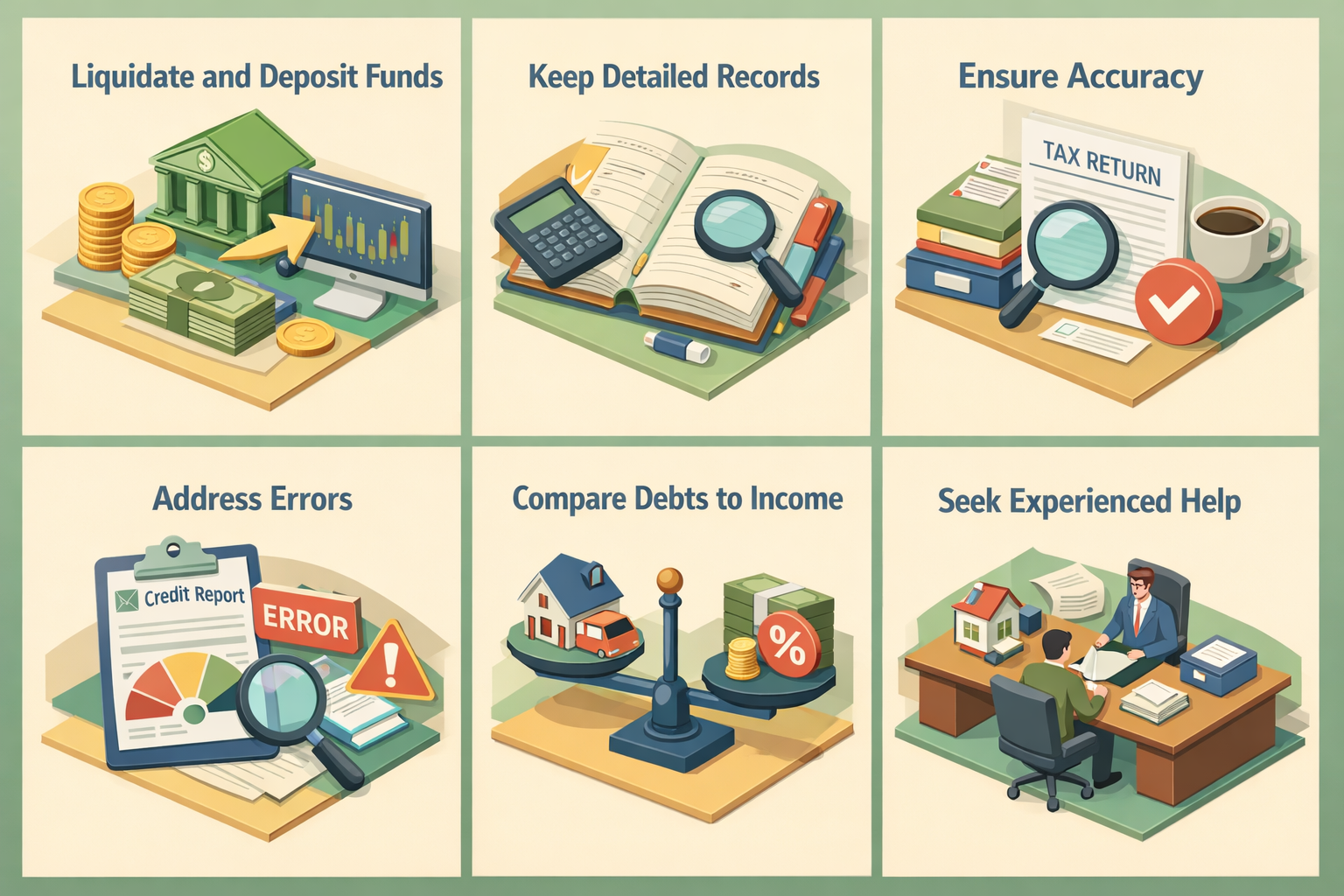
Preparation is everything when you're navigating a crypto asset mortgage or variable income refinance scenario. Here's a practical checklist to help you get your financial profile in the best possible shape before applying:
- Convert and season your crypto funds: Liquidate the portion of your holdings you intend to use for reserves or closing costs, deposit them into a bank account, and allow at least 60 to 90 days for the funds to season. The longer the paper trail, the cleaner the documentation.
- Document everything: Keep records of every exchange transaction, including screenshots, exchange statements, and bank wire confirmations. Underwriters will want to trace the source of funds from wallet to bank account.
- Review your tax returns: If you've realized crypto gains, your tax returns will reflect that income. Make sure your returns are filed and accurate. Lenders will typically review two years of tax history.
- Check your credit profile: Pull your credit reports from all three bureaus. Address any errors or delinquencies before applying. A strong credit score remains one of the most powerful tools in securing favorable refinance terms.
- Calculate your DTI ratio: Add up all your monthly debt obligations and compare them to your gross monthly income. Most conventional lenders prefer a DTI below 43 to 45 percent. Non-QM lenders may allow higher ratios in some cases.
- Work with an experienced loan officer: Not every loan officer has encountered crypto-holding borrowers before. Seek out professionals who understand non-traditional asset documentation and can advocate effectively with underwriters on your behalf.
Timing Your ARM Refinance Strategically in a Shifting Rate Environment
Beyond asset qualification, timing matters enormously when refinancing out of an ARM. Interest rates fluctuate based on Federal Reserve policy, economic data, and bond market movements. Locking in a fixed rate during a favorable window could save you significantly over the life of your loan.
If your ARM's fixed period is within 12 to 18 months of expiring, it's generally wise to start the refinance process now rather than waiting. Rate locks are typically available for 30 to 60 days, sometimes longer with an extended lock fee, so beginning your application early gives you time to navigate the documentation process without feeling rushed.
Crypto market conditions may also influence your timing. If your holdings have appreciated significantly, converting now might trigger capital gains taxes that reduce your net proceeds. On the other hand, waiting for the market to shift could mean your fixed ARM period expires before you're ready to close. Balancing these two timelines — your ARM adjustment date and your crypto tax situation — may require input from both a mortgage professional and a tax advisor.
For homeowners with complex financial situations, a coordinated approach between your lender, financial advisor, and tax professional is often the most effective way to optimize both your refinance outcome and your overall financial position.
●Conclusion
Refinancing an ARM mortgage when you hold significant cryptocurrency assets is genuinely more complex than a standard refinance — but it's far from impossible. The lending market is gradually adapting to the reality that wealth increasingly comes in digital forms, and borrowers who prepare thoughtfully can often find a viable path forward. Whether you pursue a conventional refinance with seasoned crypto proceeds, explore a non-QM asset depletion loan, or work with a jumbo lender familiar with complex financial profiles, the best options for refinancing an ARM mortgage with significant cryptocurrency holdings are available to those who know where to look. At LoanWise, we're here to help you navigate the nuances, connect with the right loan programs, and move from uncertainty to a stable, fixed-rate future. Reach out today to speak with a lending specialist who understands your unique financial picture.