
If you're carrying a jumbo mortgage on a high-value home, even a modest drop in your interest rate could translate into significant monthly savings. Unlike conventional loans, jumbo mortgages cover loan amounts that exceed conforming loan limits — which means the dollars at stake during a refinance are considerably larger. Understanding the benefits of refinancing a jumbo mortgage to a lower rate can help you make a well-informed financial decision, whether you're looking to reduce your monthly payment, shorten your loan term, or build equity faster. This guide walks you through what you need to know before you take action.
What Makes Jumbo Mortgage Refinancing Different
Jumbo loans are mortgage products that exceed the conforming loan limits set by the Federal Housing Finance Agency (FHFA). Because these loans are larger — often starting above $766,550 in most U.S. markets as of recent guidelines — they carry a unique set of lender requirements and risk considerations. When you refinance a jumbo loan, the process shares similarities with refinancing a conventional mortgage, but the standards are typically more stringent.
Lenders offering jumbo refinance products often look for borrowers with strong credit profiles, substantial reserves, and well-documented income. Debt-to-income ratios may be evaluated more carefully, and home appraisals on high-value properties can be more complex. That said, qualifying borrowers who meet these benchmarks may find that the financial rewards of securing a lower rate are well worth the effort.
It's also worth noting that jumbo mortgage rates don't always move in perfect lockstep with conventional loan rates. They're influenced by secondary market conditions, investor appetite, and broader economic factors — which means timing your refinance strategically could make a meaningful difference in the rate you're offered.
The Real Financial Benefits of Refinancing a Jumbo Mortgage to a Lower Rate
The most direct advantage of a jumbo refinance is the potential for lower monthly payments. Because jumbo loan balances are large, even a reduction of 0.5% or 0.75% in your interest rate could reduce your monthly obligation by hundreds of dollars. Over the life of a 30-year loan, this type of savings could compound into tens of thousands of dollars — or more.
Here are some of the key financial advantages homeowners may gain:
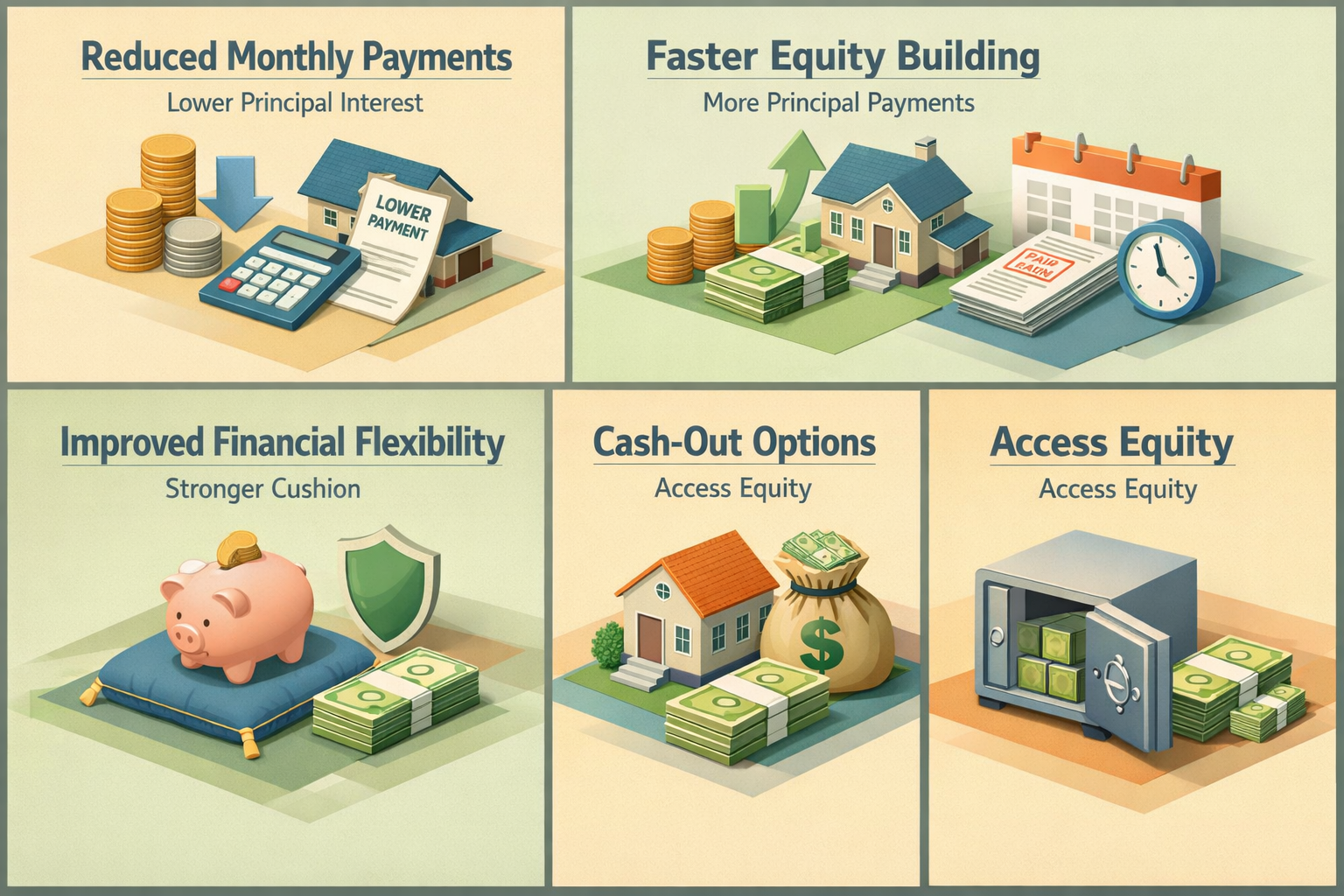
- Reduced monthly cash flow pressure: A lower rate decreases your principal and interest payment, freeing up money for other financial goals or investments.
- Faster equity building: If you choose to maintain your current payment level after refinancing to a lower rate, more of each payment goes toward principal rather than interest.
- Shorter loan term: Some homeowners refinance from a 30-year to a 15-year or 20-year loan. While the monthly payment may remain similar, you could pay off your home significantly sooner and pay far less in total interest.
- Improved financial flexibility: Lower required payments can give you a stronger cushion during periods of economic uncertainty or unexpected expenses.
- Cash-out options: If your property has appreciated, a cash-out jumbo refinance may allow you to access equity for home improvements, investments, or debt consolidation — potentially at a lower interest rate than other borrowing options.
These benefits of refinancing a jumbo mortgage to a lower rate are most compelling when the rate differential between your current loan and available market rates is meaningful. Even so, every borrower's situation is different, and it's important to weigh potential savings against refinancing costs before committing.
Using a Jumbo Mortgage Refinance Calculator to Estimate Your Savings
Before reaching out to a lender, one of the smartest first steps is running the numbers using a jumbo mortgage refinance calculator. These tools are designed to help you estimate how much you might save by comparing your current loan terms with a hypothetical new loan at a lower rate.
A reliable jumbo loan refinance savings estimate typically factors in the following variables:
- Your current outstanding loan balance
- Your existing interest rate and remaining loan term
- The new interest rate you may qualify for
- Your proposed new loan term
- Estimated closing costs and lender fees
By entering these figures, the calculator can show you your potential new monthly payment, the total interest savings over the life of the loan, and — crucially — your break-even point. The break-even point is the number of months it takes for your cumulative savings to offset the upfront costs of refinancing. If you plan to stay in your home beyond that point, refinancing may make strong financial sense.
Keep in mind that a jumbo loan refinance savings estimate is just a projection. Actual savings will depend on the rate you're quoted, the closing costs negotiated, and how long you hold the loan. Use the calculator as a starting point for conversation with a mortgage professional rather than a definitive answer.
How to Get a Lower Jumbo Rate: Qualification Strategies That Work
If you're wondering how to get a lower jumbo rate, the answer largely comes down to strengthening your financial profile before you apply. Lenders reserve the most competitive rates for borrowers who present the lowest risk. Here's what typically matters most:
- Credit score: A score of 720 or higher is often the baseline for competitive jumbo rates, though some lenders may prefer scores of 740 or above. Reviewing your credit report and addressing any errors or outstanding balances before applying could meaningfully improve your positioning.
- Loan-to-value (LTV) ratio: The more equity you have in your home, the lower your perceived risk. Borrowers with LTV ratios of 75% or lower often see better rate offers. If your property has appreciated significantly, this may already be working in your favor.
- Debt-to-income (DTI) ratio: Keeping your total monthly debt obligations low relative to your gross monthly income is a key factor. Many jumbo lenders prefer a DTI below 43%, and some have even stricter thresholds.
- Reserves and assets: Demonstrating that you have substantial liquid assets — often 12 to 18 months of mortgage payments in reserves — can give lenders added confidence and may contribute to a better rate offer.
- Income documentation: Having clean, well-organized income documentation speeds up underwriting and positions you as a lower-risk borrower. Self-employed homeowners may benefit from working with lenders familiar with non-QM or bank statement products if standard documentation is challenging.
Shopping multiple lenders is also a proven strategy. Jumbo mortgage rates can vary more widely between lenders than conventional rates do, so comparing offers from banks, credit unions, and non-bank mortgage lenders could yield a more favorable result.
Identifying the Best Time to Refinance Your Jumbo Mortgage
Timing plays a meaningful role in any refinance decision, and the best time to refinance a jumbo mortgage is typically when several conditions align in your favor. There's no single universal trigger, but the following signals are worth watching:
Favorable rate environment: If current market rates have dropped at least 0.5% to 1% below your existing rate, the savings potential could justify the costs of refinancing. For jumbo borrowers, even smaller rate drops can translate into significant dollar amounts due to the large loan balances involved.
Improved personal financial profile: If your credit score has improved significantly since you first took out your loan, or your income has grown, you may qualify for rates that weren't available to you before — even if broader market rates haven't shifted dramatically.
Rising home equity: If your home's value has increased, your LTV ratio may have improved enough to qualify you for better pricing. This is especially relevant in markets that have seen strong appreciation in recent years.
Planned long-term occupancy: Refinancing makes most financial sense when you intend to stay in the home long enough to pass the break-even point on closing costs. If you're planning to sell within a year or two, the math may not work in your favor.
Rate lock opportunities: Mortgage rates can shift quickly. When you find a favorable rate, locking it in early in the process — typically for 30 to 60 days — can protect you from rate increases during underwriting.
Understanding Closing Costs and the True Cost of a Jumbo Refinance
One important consideration that's easy to overlook is the upfront cost of refinancing. Jumbo refinance closing costs often run higher than those for conventional loans, simply because the loan amounts — and therefore the percentage-based fees — are larger. You might typically expect closing costs to range from 1% to 3% of the loan balance, though this varies by lender, location, and loan complexity.
Common closing costs on a jumbo refinance may include:
- Origination fees or points charged by the lender
- Appraisal fees, which may be higher for luxury or complex properties
- Title insurance and title search fees
- Attorney or settlement agent fees (in states that require them)
- Prepaid interest, homeowners insurance, and property tax escrow
Some lenders offer no-closing-cost refinance options, where fees are rolled into the loan balance or offset by a slightly higher interest rate. This can be appealing if you want to minimize upfront expenses, but it's worth evaluating the long-term trade-off carefully. Rolling costs into the loan means you're paying interest on those fees for the life of the loan.
Using your jumbo loan refinance savings estimate alongside a clear understanding of closing costs will give you the most accurate picture of your true financial outcome.
●Conclusion
The benefits of refinancing a jumbo mortgage to a lower rate can be substantial — from meaningfully reduced monthly payments and long-term interest savings to accelerated equity growth and improved cash flow. But realizing those benefits requires thoughtful preparation, the right timing, and a clear understanding of both your financial profile and the costs involved. Start by running a jumbo mortgage refinance calculator to get a baseline savings estimate, then consult with a knowledgeable mortgage professional who specializes in high-balance lending. With the right strategy, a jumbo refinance could be one of the most impactful financial moves you make as a homeowner. LoanWise is here to help you explore your options and find a refinance solution that fits your goals.