Buying a home is one of the most exciting milestones in life, but navigating the world of mortgage financing can feel overwhelming. If you've been researching loan options, you've likely come across the term FHA loan. For many first-time homebuyers and those with less-than-perfect credit histories, FHA loans may offer a more accessible path to homeownership. But what exactly is an FHA loan, and is it the right mortgage option for your situation? In this guide, we'll break down everything you need to know — from how these loans work to who might benefit most from them.
Understanding What an FHA Loan Actually Is
An FHA loan is a type of mortgage that's insured by the Federal Housing Administration, a government agency that operates under the U.S. Department of Housing and Urban Development (HUD). The FHA doesn't lend money directly to borrowers. Instead, it provides insurance to approved lenders, which reduces the risk those lenders take on when extending credit to borrowers who might not qualify for conventional financing.
Because lenders face less financial risk when issuing FHA-backed mortgages, they're often more willing to offer financing to borrowers with lower credit scores, smaller down payments, or shorter credit histories. This makes the FHA loan program particularly popular among first-time homebuyers and individuals who are working to rebuild their financial footing.
It's worth noting that FHA loans are available through a variety of private lenders — including banks, credit unions, and mortgage companies — as long as those lenders are FHA-approved. The terms and conditions will vary from lender to lender, so it typically pays to shop around before committing to a specific loan offer.
Key Eligibility Requirements You Should Know
While FHA loans are generally considered more accessible than conventional mortgages, borrowers still need to meet certain qualification standards. Understanding these requirements ahead of time can help you determine whether an FHA loan might be within reach.
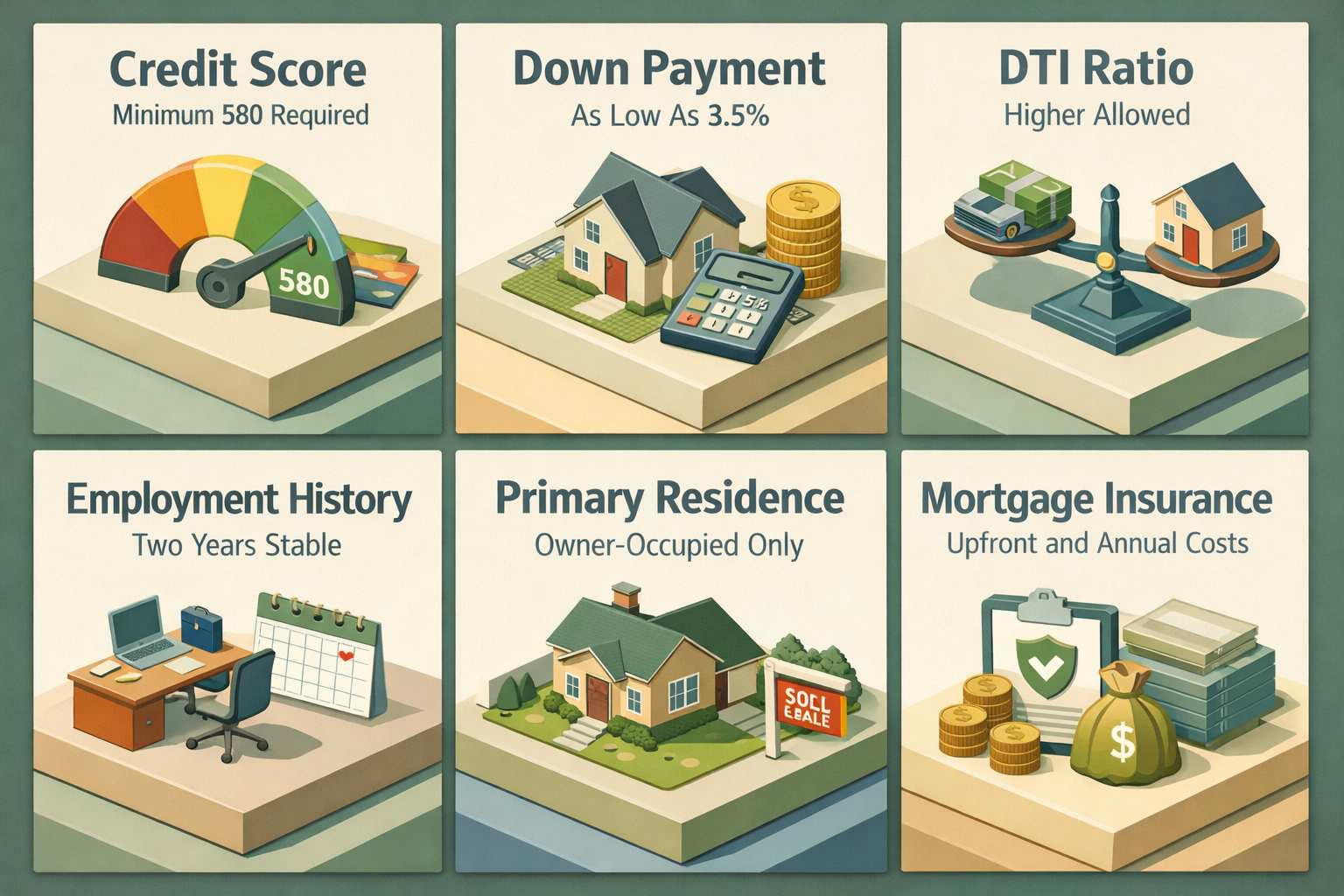
- Credit Score: Borrowers with a credit score of 580 or higher may qualify for an FHA loan with a down payment as low as 3.5%. Those with scores between 500 and 579 may still be eligible, but they're typically required to put down at least 10%. Lenders may also impose their own minimum credit score requirements above the FHA's baseline, so it's important to confirm the standards with your specific lender.
- Down Payment: One of the most appealing aspects of an FHA loan is the relatively lower down payment options. A 3.5% down payment on a $300,000 home, for example, would be $10,500 — significantly less than the 20% commonly associated with conventional loans.
- Debt-to-Income Ratio (DTI): Lenders will assess your monthly debt obligations relative to your gross monthly income. FHA guidelines may allow for a higher DTI ratio compared to conventional loans, though individual lenders may set stricter limits.
- Employment and Income Verification: Borrowers generally need to demonstrate a stable employment history, typically spanning at least two years, along with consistent income to support the loan repayment.
- Primary Residence Requirement: FHA loans are intended for owner-occupied properties. You must plan to live in the home as your primary residence — investment properties and vacation homes don't qualify.
Meeting these requirements doesn't guarantee approval, but understanding them can help you assess your readiness and identify any gaps you may want to address before applying.
How Mortgage Insurance Factors Into Your Costs
One of the most important cost considerations with an FHA loan is mortgage insurance. Because the FHA is taking on additional risk by insuring loans for borrowers who may have lower credit scores or smaller down payments, it requires borrowers to pay for mortgage insurance protection.
FHA mortgage insurance comes in two forms:
- Upfront Mortgage Insurance Premium (UFMIP): This is a one-time fee that's typically charged at closing. It's generally calculated as a percentage of the loan amount and can often be rolled into the loan, meaning you don't necessarily have to pay it out of pocket on closing day.
- Annual Mortgage Insurance Premium (MIP): In addition to the upfront cost, borrowers pay an ongoing annual premium that's divided into monthly installments. This charge is included in your regular mortgage payment and continues for a set period depending on your loan term and down payment amount.
It's worth comparing the total cost of FHA mortgage insurance against other loan options, particularly if you're considering a conventional loan with private mortgage insurance (PMI). In some cases, borrowers with stronger credit profiles might find conventional financing to be more cost-effective over the long term. Speaking with a knowledgeable mortgage professional can help you run the numbers for your specific situation.
The Real Benefits of Choosing an FHA Loan
Despite the added cost of mortgage insurance, FHA loans offer several genuine advantages that may make them the right choice for many homebuyers. Let's look at some of the most compelling benefits.
More Flexible Credit Standards
For buyers who've faced financial setbacks — such as a past bankruptcy, a period of unemployment, or a stretch of missed payments — qualifying for a conventional mortgage can be a challenge. FHA loans may be more forgiving of imperfect credit histories, which could open the door to homeownership sooner than you might expect.
Lower Down Payment Requirements
Saving for a down payment is one of the biggest hurdles aspiring homeowners face. The ability to put down as little as 3.5% can be a meaningful advantage, especially in higher-cost housing markets where even a modest percentage represents a significant dollar amount.
Competitive Interest Rates
Because FHA loans are government-backed, lenders may offer competitive interest rates compared to some other low-down-payment options. That said, the rate you're offered will still depend on factors like your credit score, loan term, and the current lending environment, so results can vary.
Assumable Loan Feature
FHA loans are assumable, which means that if you sell your home in the future, a qualified buyer may be able to take over your existing mortgage — potentially including your interest rate. In a rising-rate environment, this feature could make your home more attractive to prospective buyers down the road.
Potential Drawbacks to Consider Before You Apply
No mortgage product is perfect for every borrower, and FHA loans do come with certain trade-offs worth considering carefully.
Long-Term Mortgage Insurance Costs
Unlike conventional loans where PMI can typically be removed once you reach 20% equity in your home, FHA mortgage insurance requirements may persist for the life of the loan in certain situations. This can add up over time, particularly if you plan to stay in the home for many years. Refinancing into a conventional loan later on could potentially help you eliminate this cost once you've built sufficient equity.
Loan Limits Apply
FHA loans are subject to borrowing limits that vary by geographic area. In high-cost regions, these limits may be raised, but in most parts of the country, there's a ceiling on how much you can borrow under the FHA program. If you're purchasing a more expensive property, you may find that an FHA loan doesn't fully cover your financing needs.
Property Condition Standards
The FHA requires that the home you're purchasing meets certain safety, security, and structural soundness standards. If you're interested in a fixer-upper or a property in need of significant repairs, you may encounter complications during the appraisal process. An FHA 203(k) rehabilitation loan could be one potential solution, but it adds a layer of complexity to the transaction.
Who Might Benefit Most from an FHA Loan
While FHA loans are available to a broad range of borrowers, certain homebuyers tend to find them especially useful. You might be a strong candidate for an FHA loan if:
- You're a first-time homebuyer who hasn't yet had the opportunity to build substantial savings or a lengthy credit history.
- You have a credit score in the 580–640 range and may not qualify for the best terms on conventional financing.
- You have a limited down payment saved and want to enter the housing market without waiting years to accumulate a larger sum.
- You've experienced a past financial difficulty such as a bankruptcy or foreclosure and are working toward reestablishing your creditworthiness.
- You're purchasing a moderately priced home that falls within the FHA loan limits for your area.
On the other hand, if you have a strong credit profile, a sizable down payment, and are purchasing a higher-value property, a conventional loan may ultimately offer better long-term value. The best approach is to compare both options side by side with the help of an experienced mortgage professional before making a decision.
Steps to Take If You're Ready to Explore an FHA Loan
If an FHA loan sounds like it might be a good fit for your home financing goals, here are some practical steps to help you move forward with confidence.
Check Your Credit Score
Before applying for any mortgage, it's a good idea to review your credit report for errors and understand where your score currently stands. If your score is lower than you'd like, even a few months of focused effort — such as paying down credit card balances or catching up on any late accounts — could potentially improve your position.
Calculate What You Can Afford
Use an online mortgage calculator to estimate monthly payments based on different loan amounts, interest rates, and down payment scenarios. This can give you a clearer sense of what price range aligns with your budget before you begin shopping for a home.
Gather Your Financial Documents
Lenders will typically request documents such as recent pay stubs, W-2 forms, federal tax returns, bank statements, and proof of any other income sources. Having these ready in advance can help streamline the application process.
Shop Multiple FHA-Approved Lenders
Interest rates, fees, and lender requirements can vary meaningfully from one FHA-approved lender to another. Getting quotes from at least a few lenders can help ensure you're getting a competitive deal. Don't be afraid to ask questions and compare loan estimates carefully before making a choice.
Get Pre-Approved Before You Shop
A pre-approval letter shows sellers that you're a serious and qualified buyer. It also gives you a realistic picture of your borrowing capacity so you can focus your home search on properties within your financial reach.
●Conclusion
An FHA loan can be a powerful tool for homebuyers who might otherwise struggle to qualify for conventional financing. With more flexible credit requirements and lower down payment thresholds, it opens the door to homeownership for a wide range of buyers — including first-timers, those rebuilding their credit, and anyone working with a smaller savings cushion. At the same time, it's important to weigh the full cost picture, including mortgage insurance premiums and loan limits, to make sure the product truly aligns with your financial goals. Whether an FHA loan turns out to be the right fit or not, understanding how it works puts you in a stronger position to make an informed, confident decision on one of the biggest investments of your life. Ready to explore your options? Connect with a LoanWise mortgage specialist today to find the loan program that's right for you.