
Buying a high-priced home is an exciting milestone, but it often comes with a financing challenge that many buyers don't anticipate — the loan you need may be too large for a standard mortgage. That's where a jumbo loan comes in. Whether you're purchasing a luxury property, a home in a high-cost market, or simply a larger residence than average, understanding how jumbo loans work could be the key to making your real estate goals a reality. This guide breaks down everything you need to know, from what qualifies as a jumbo loan to how lenders evaluate borrowers who apply for one.
Understanding Jumbo Loans and How They Differ from Conventional Mortgages
A jumbo loan is a type of mortgage that exceeds the conforming loan limits set by the Federal Housing Finance Agency (FHFA). These limits define the maximum loan amount that government-sponsored enterprises like Fannie Mae and Freddie Mac are permitted to purchase or guarantee. When a mortgage surpasses that threshold, it's considered a non-conforming loan — most commonly referred to as a jumbo loan.
For most parts of the United States, the conforming loan limit sits at a specific dollar amount that's adjusted periodically to reflect changes in the housing market. In high-cost areas, such as parts of California, New York, and Hawaii, the limit may be significantly higher. Any loan amount that goes beyond those ceilings — regardless of location — falls into jumbo territory.
Because jumbo loans can't be backed by Fannie Mae or Freddie Mac, lenders take on greater risk when offering them. That added risk typically translates into stricter qualification standards and, in some cases, slightly different interest rate structures compared to conventional conforming mortgages. Homebuyers and real estate investors considering properties in premium price ranges should understand this distinction early in the planning process.
Who Typically Needs a Jumbo Loan
Jumbo loans aren't just for luxury buyers living in sprawling estates. While that's certainly one profile, the reality is that many everyday homebuyers find themselves needing jumbo financing simply because of where they want to live. In competitive urban markets and coastal cities, even a modest single-family home can carry a price tag that eclipses the conforming loan limit.
Here are some of the most common borrowers who may benefit from a jumbo loan:
- Move-up buyers who are upgrading to a larger or more expensive home and need financing that exceeds conforming limits
- Luxury homebuyers purchasing properties in high-end neighborhoods or resort areas
- Real estate investors acquiring high-value residential properties as part of their portfolio
- Homebuyers in expensive metro areas where average home prices regularly surpass conforming thresholds
- High-income professionals such as doctors, attorneys, or executives who have strong earnings but may carry complex income structures
If you're unsure whether the home you're targeting requires jumbo financing, a quick conversation with a mortgage lender can clarify whether your loan amount falls within or outside conforming limits for your area.
Key Qualification Requirements for Jumbo Loan Approval
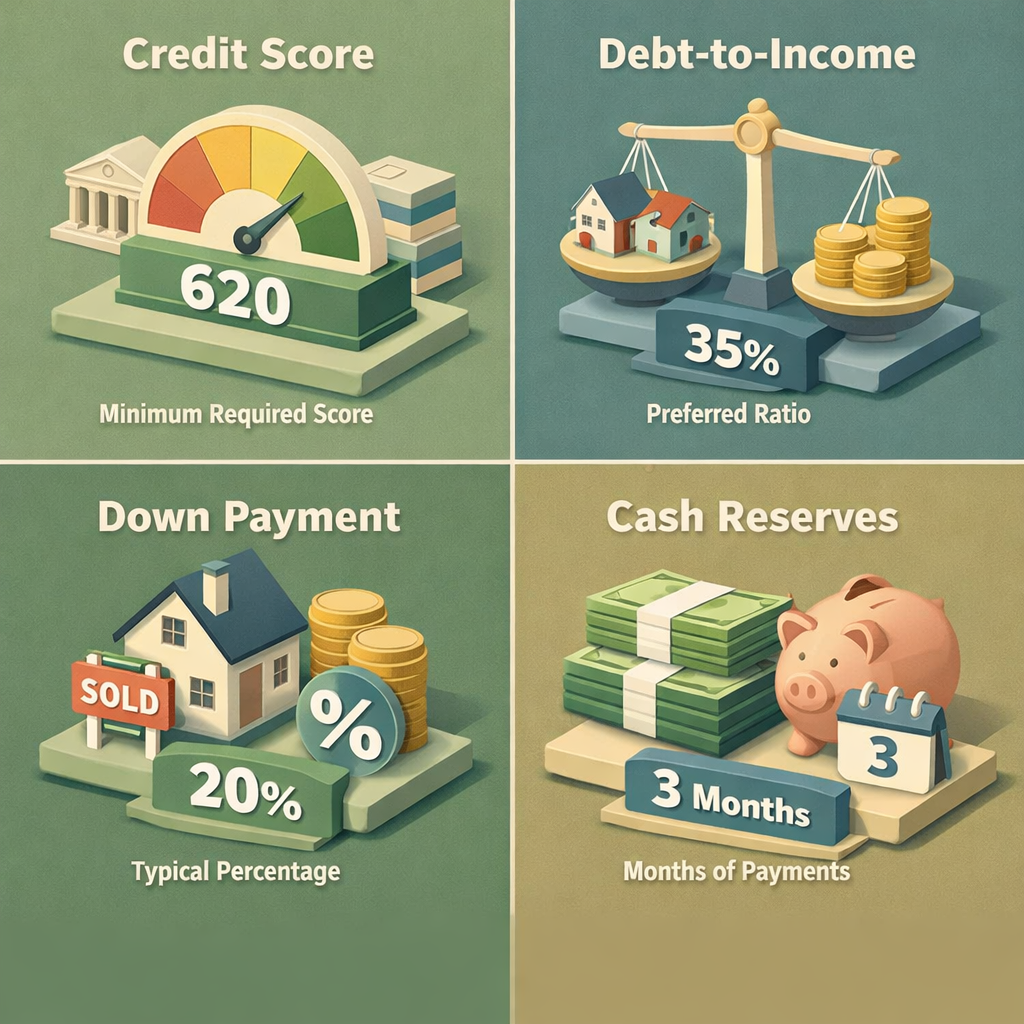
Because lenders bear more risk with jumbo loans, they tend to apply more rigorous underwriting standards than they would for a conventional conforming mortgage. While requirements can vary by lender and loan program, there are several benchmarks that most borrowers will need to meet.
Credit Score Expectations
Most lenders typically require a credit score of at least 700 for jumbo loan eligibility, though many prefer scores of 720 or higher. A strong credit profile signals to lenders that you have a consistent history of managing debt responsibly — which becomes especially important when the loan amount is substantial. Borrowers with higher scores may also have access to more competitive interest rates.
Debt-to-Income Ratio
Your debt-to-income ratio (DTI) — the percentage of your gross monthly income that goes toward debt payments — plays a major role in jumbo loan approval. Lenders often prefer a DTI of 43% or lower, though some may allow slightly higher ratios depending on other compensating factors like significant cash reserves or exceptional credit.
Down Payment Requirements
Jumbo loans typically require larger down payments than conforming loans. Many lenders ask for at least 10% to 20% down, and some programs may require more depending on the loan size and borrower profile. A larger down payment reduces the lender's exposure and can also improve your overall loan terms.
Cash Reserves
One distinguishing feature of jumbo loan underwriting is the emphasis on cash reserves. Lenders may want to see that you have several months — sometimes six to twelve — of mortgage payments available in liquid or semi-liquid assets even after closing. This requirement helps demonstrate financial stability beyond just income.
Jumbo Loan Interest Rates: What to Expect
One of the most common questions homebuyers ask about jumbo loans is whether the interest rates are higher than conventional mortgages. The answer has become more nuanced in recent years. Historically, jumbo loans carried a notable rate premium due to the increased risk lenders assumed. However, the gap between jumbo and conforming rates has narrowed over time, and in some market conditions, jumbo rates have been competitive with — or even slightly lower than — conforming loan rates.
That said, your individual rate will depend on several factors, including your credit score, down payment size, loan term, lender, and the overall interest rate environment at the time you apply. Borrowers with strong financial profiles are generally better positioned to secure favorable terms.
It's also worth noting that jumbo loans are available in both fixed-rate and adjustable-rate formats. A fixed-rate jumbo mortgage offers payment predictability over the life of the loan, which many buyers prefer. An adjustable rate mortgage payment (ARM) may start with a lower rate but carries the possibility of rate adjustments after an initial fixed period — something worth carefully evaluating given the large loan balances involved.
The Application Process: What High-Value Homebuyers Should Prepare
Applying for a jumbo loan follows many of the same steps as a standard mortgage application, but with added layers of documentation and verification. Being well-prepared can significantly streamline the process and improve your chances of a smooth approval.
Here's what you'll likely need to gather:
- Tax returns — typically the last two years, especially important for self-employed borrowers or those with variable income
- Pay stubs and W-2s — to verify employment and consistent income
- Bank and investment account statements — to confirm assets, reserves, and down payment funds
- Documentation of other assets — retirement accounts, brokerage holdings, or real estate equity
- Explanation of any credit anomalies — such as past late payments, inquiries, or account changes
For borrowers with complex income — such as business owners, freelancers, or investors with multiple income streams — the documentation process can be more involved. In some cases, a lender may offer a non-QM jumbo program that uses alternative income verification methods, such as bank statements or asset depletion, rather than traditional W-2 documentation. This can open the door for self-employed high earners who might not qualify under conventional income guidelines.
Comparing Lenders and Finding the Right Jumbo Mortgage Fit
Not all lenders offer jumbo loans, and those that do may have meaningfully different programs, rates, and requirements. Because jumbo mortgages are held in portfolio by lenders rather than sold to the secondary market, each institution sets its own guidelines. This means there can be considerably more variation between lenders than you'd typically find with conforming loans.
Shopping around and comparing multiple lenders is especially valuable in the jumbo space. Even a small difference in interest rate on a large loan balance can translate into significant savings over the life of the loan. For example, on a substantial loan amount, a fraction of a percentage point difference in rate can amount to tens of thousands of dollars over a 30-year term.
When evaluating lenders, consider the following:
- Whether they specialize in or have deep experience with jumbo lending
- The range of loan amounts and property types they'll consider
- Their underwriting flexibility for complex borrower profiles
- Their timeline and communication during the approval process
- Any overlays or additional requirements beyond standard guidelines
Working with a knowledgeable mortgage broker or advisor who has access to multiple jumbo lenders can also be a strategic advantage, particularly if your financial situation doesn't fit neatly into a standard box.
●Conclusion
A jumbo loan can be a powerful financing tool for homebuyers and real estate investors who need to borrow beyond conventional limits. While the qualification bar is higher and the documentation more thorough, these loans provide access to the financing necessary to purchase high-value properties in competitive markets. Understanding what lenders look for — from credit scores and down payments to cash reserves and income documentation — puts you in a much stronger position to approach the process with confidence. If you're considering a home purchase that may require jumbo financing, connecting with an experienced mortgage professional early can help you map out a clear path forward and identify the best loan options for your unique situation.