If you're shopping for a home or exploring your mortgage options, you've likely come across the term conventional loan. It's one of the most widely used financing tools in the U.S. housing market — and for good reason. Conventional loans offer flexibility, competitive rates, and a straightforward path to homeownership for borrowers who meet standard credit and income requirements. But what exactly is a conventional loan, and how do you know if it's the right fit for your situation? This guide breaks it all down so you can move forward with confidence.
Understanding What Makes a Conventional Loan Different
A conventional loan is a type of mortgage that isn't backed or insured by a federal government agency. Unlike FHA loans, VA loans, or USDA loans — which carry a government guarantee — conventional loans are offered and funded by private lenders such as banks, credit unions, and mortgage companies.
Because there's no government safety net, lenders tend to apply stricter eligibility standards. However, this also means borrowers who qualify can often enjoy more favorable terms, fewer restrictions on property types, and greater flexibility in loan structure.
Conventional loans fall into two broad categories:
- Conforming loans: These meet the guidelines set by Fannie Mae and Freddie Mac, including loan limits established annually by the Federal Housing Finance Agency (FHFA). Most conventional mortgages are conforming loans.
- Non-conforming loans: These exceed conforming loan limits or don't meet standard guidelines. Jumbo loans are the most common example and are typically used to finance higher-priced properties.
Understanding this distinction helps you know which product applies to your purchase price and financial profile from the start.
Core Requirements to Qualify for a Conventional Mortgage
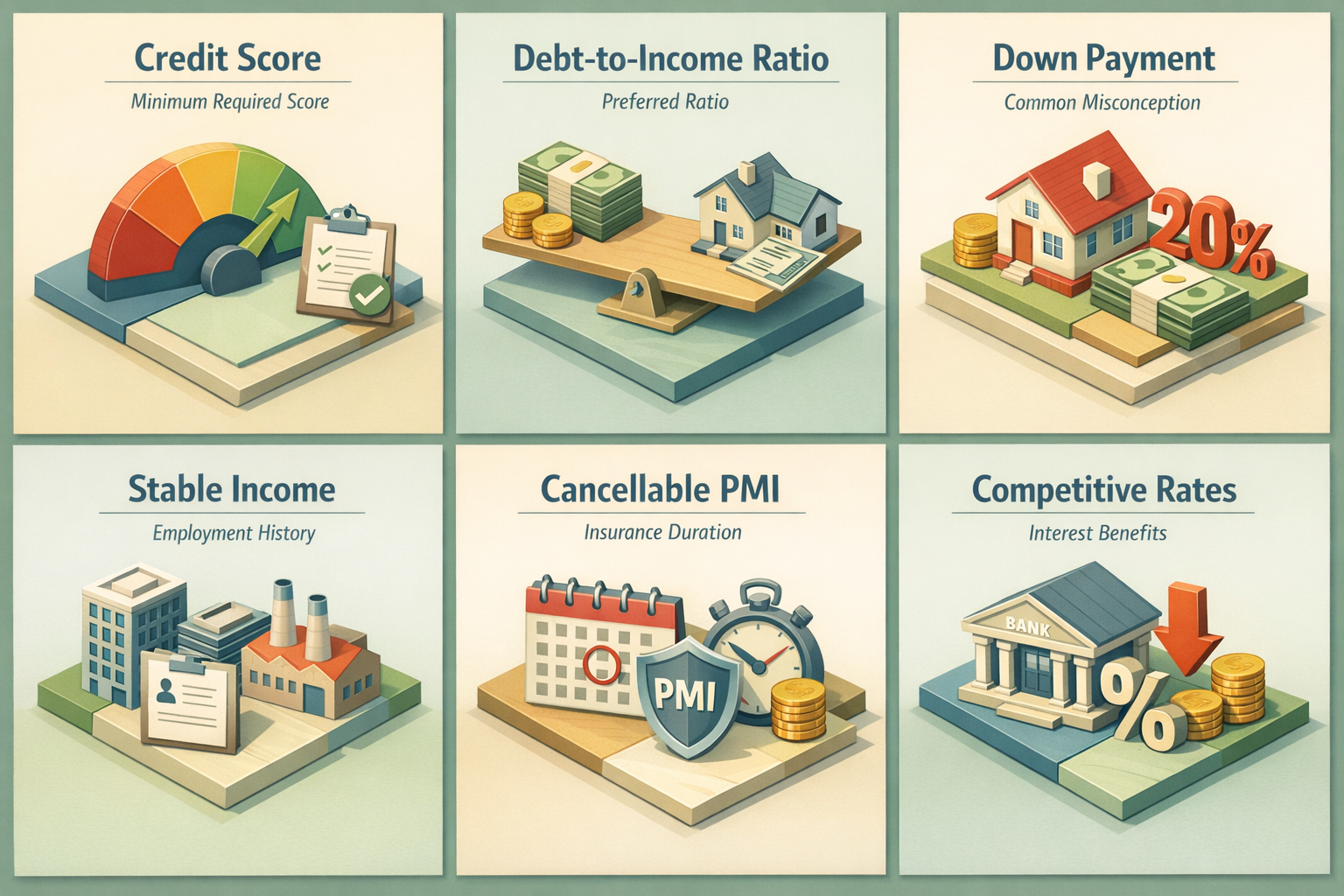
Qualifying for a conventional loan typically involves meeting several key benchmarks. While specific requirements can vary by lender, here are the most common criteria you'll encounter during the application process.
Credit Score
Most lenders generally require a minimum credit score of 620 to qualify for a conventional loan. However, borrowers with higher scores — particularly those above 740 — may access the most competitive interest rates. If your score is on the lower end, it may be worth spending a few months improving it before applying.
Debt-to-Income Ratio
Your debt-to-income (DTI) ratio compares your monthly debt obligations to your gross monthly income. Lenders typically prefer a DTI of 45% or below, though some may allow slightly higher ratios with compensating factors like strong reserves or a larger down payment.
Down Payment
One of the common misconceptions about conventional loans is that you need 20% down. In reality, some conventional loan programs allow down payments as low as 3%. That said, putting down less than 20% usually triggers a requirement for private mortgage insurance (PMI), which adds to your monthly costs until you build sufficient equity.
Stable Income and Employment History
Lenders want to see a reliable income stream. Most look for at least two years of consistent employment history and will verify your earnings through pay stubs, W-2s, or tax returns. Self-employed borrowers may need to provide additional documentation to demonstrate income stability.
How Private Mortgage Insurance Works — and When It Goes Away
If you put down less than 20% on a conventional loan, your lender will likely require private mortgage insurance (PMI). PMI protects the lender — not you — in the event you default on the loan. It's typically added to your monthly mortgage payment.
The good news is that PMI on a conventional loan is not permanent. Once you've built up 20% equity in your home — either through regular payments or appreciation — you can request PMI cancellation. By law, lenders must automatically terminate PMI when your loan balance reaches 78% of the original purchase price, assuming you're current on payments.
This is a meaningful advantage over FHA loans, where mortgage insurance premiums may remain for the life of the loan depending on your down payment amount. For many buyers, this makes a conventional loan a more cost-effective long-term option once they've established equity.
Conventional Loan Limits and What They Mean for Your Purchase
Each year, the FHFA sets conforming loan limits that determine how large a conventional loan can be and still be purchased by Fannie Mae or Freddie Mac. These limits vary by location and are adjusted to reflect changes in home prices.
In high-cost areas — such as parts of California, New York, and Hawaii — loan limits are set higher than the national baseline to account for elevated property values. If your loan amount exceeds the conforming limit for your area, you'll need a jumbo loan, which typically comes with more stringent qualification requirements and slightly different pricing.
It's worth checking the current conforming loan limits for your county before you begin house hunting. This can help you set a realistic budget and determine which type of conventional financing applies to your price range.
Key Benefits That Make Conventional Loans So Popular
For many homebuyers, homeowners refinancing their existing mortgage, and real estate investors, conventional loans offer a compelling combination of advantages. Here's why they remain one of the most sought-after mortgage products on the market:
- Competitive interest rates: Borrowers with strong credit profiles may access some of the lowest available rates, helping reduce total interest paid over the life of the loan.
- No upfront mortgage insurance premium: Unlike FHA loans, conventional loans don't require an upfront mortgage insurance payment, which can reduce your closing costs.
- Flexible property types: Conventional loans can be used for primary residences, second homes, and investment properties — making them a go-to for real estate investors.
- Variety of term options: Borrowers can typically choose from 10, 15, 20, or 30-year loan terms, allowing you to customize your repayment timeline.
- Cancellable PMI: As discussed, PMI doesn't last forever on a conventional loan, giving borrowers a path to reducing their monthly obligations over time.
- Refinancing flexibility: Conventional loans are also widely used in refinancing scenarios, including rate-and-term refinances and cash-out refinances for homeowners tapping into their equity.
Comparing Conventional Loans to Government-Backed Mortgage Options
When deciding between a conventional loan and a government-backed programs, it helps to understand the trade-offs. There's no universally better option — the right choice depends on your financial situation and goals.
Conventional vs. FHA Loans
FHA loans are designed for borrowers with lower credit scores or smaller down payments. They allow credit scores as low as 500 (with a 10% down payment) and as low as 580 (with 3.5% down). However, FHA loans require both an upfront mortgage insurance premium and annual mortgage insurance that may last the life of the loan. For borrowers who qualify conventionally, the long-term costs of FHA insurance can make a conventional loan the more economical choice.
Conventional vs. VA Loans
VA loans, available to eligible veterans and active-duty service members, offer exceptional benefits — including no down payment and no PMI. If you qualify for a VA loan, it's often difficult for a conventional loan to compete on upfront costs. However, VA loans are limited to eligible military borrowers and primary residences only.
Conventional vs. USDA Loans
USDA loans serve buyers in eligible rural and suburban areas and can offer zero down payment financing. Like VA loans, they come with geographic and eligibility restrictions that conventional loans don't have. If you're buying in an urban area or don't meet USDA income limits, a conventional loan is likely your most practical option.
Smart Strategies to Strengthen Your Conventional Loan Application
If you're preparing to apply for a conventional loan, a few proactive steps could meaningfully improve your chances of approval — and help you secure more favorable terms.
- Review your credit report early: Check for errors or outdated negative items and dispute anything inaccurate. Even a modest score improvement could move you into a better rate tier.
- Pay down revolving debt: Reducing credit card balances can quickly improve your credit utilization ratio, which is a significant factor in your credit score.
- Avoid major financial changes before applying: Opening new credit accounts, making large purchases, or switching jobs right before applying could raise red flags for underwriters.
- Save for reserves: Lenders may look more favorably on applications that show cash reserves after closing. Having two to six months of mortgage payments saved can strengthen your file.
- Get pre-approved before house hunting: A pre-approval letter gives sellers confidence that you're a serious buyer and helps you understand exactly how much you can borrow before you fall in love with a property.
- Work with an experienced mortgage advisor: A knowledgeable loan officer can help you identify the best program for your situation, walk you through documentation requirements, and guide you through the process efficiently.
Taking these steps won't just improve your likelihood of approval — they could also save you thousands of dollars over the life of your loan by helping you qualify for better terms.
●Conclusion
A conventional loan is a flexible, widely available mortgage option that works well for a broad range of borrowers — from first-time homebuyers to seasoned real estate investors. While the qualification standards are higher than some government-backed programs, the long-term benefits — including cancellable PMI, competitive rates, and broad property eligibility — make it one of the most powerful tools in residential financing. Whether you're buying your first home, upgrading to a larger property, or refinancing for a better rate, understanding how conventional loans work puts you in a stronger position to make confident, informed decisions. Ready to explore your options? Connect with a LoanWise mortgage advisor today and take the first step toward the home financing solution that fits your goals.