If you're shopping for a mortgage, you've likely come across the term conventional loan more than once. It's one of the most widely used home financing options in the United States, and for good reason. Conventional loans offer flexible terms, competitive interest rates, and broad eligibility for a wide range of borrowers. But what exactly is a conventional loan, and how do you know if it's the right fit for your situation? This guide walks you through everything you need to know — from the basics of how conventional loans work to qualification requirements, costs, and how they compare to government-backed alternatives.
Understanding What a Conventional Loan Actually Is
A conventional loan is a type of mortgage that is not insured or guaranteed by a federal government agency. Unlike FHA loans backed by the Federal Housing Administration, VA loans supported by the Department of Veterans Affairs, or USDA loans tied to the U.S. Department of Agriculture, conventional loans are offered by private lenders such as banks, credit unions, and mortgage companies.
Because there's no government backing, lenders typically apply stricter qualification standards to manage their risk. However, this also means that eligible borrowers may enjoy more flexibility in how they use the loan and what types of properties they can finance.
Conventional loans fall into two broad categories:
- Conforming loans: These loans meet the guidelines set by Fannie Mae and Freddie Mac, the two government-sponsored enterprises that purchase mortgages from lenders. Conforming loans must stay within established loan limits, which can vary by location.
- Non-conforming loans: These exceed conforming loan limits or don't meet standard guidelines. Jumbo loans are the most common example and are used to finance higher-priced properties.
Most homebuyers who meet standard credit and income requirements will likely qualify for a conforming conventional loan, which remains the most common mortgage type used across the country.
How Conventional Loans Work From Application to Closing
The process of obtaining a conventional loan follows a structured path that begins with a lender application and ends with the closing of your home purchase or refinance. Here's a simplified look at how it typically unfolds:
- Pre-qualification or pre-approval: Before you start house hunting, most lenders recommend getting pre-approved. This involves a review of your credit score, income, assets, and debts to determine how much you may be able to borrow.
- Loan application: Once you've found a property, you submit a formal application. Your lender will collect detailed financial documentation including pay stubs, tax returns, and bank statements.
- Underwriting: A mortgage underwriter reviews your file to assess risk and verify that you meet lending guidelines. This stage may involve requests for additional documents.
- Appraisal: The lender orders an independent appraisal of the property to confirm its market value supports the loan amount.
- Closing: Once approved, you'll sign final loan documents, pay closing costs, and receive the keys to your new home.
The timeline from application to closing can vary, but it often takes anywhere from 30 to 60 days depending on the lender, the complexity of your file, and current market conditions.
Conventional Loan Requirements: What Lenders Look For
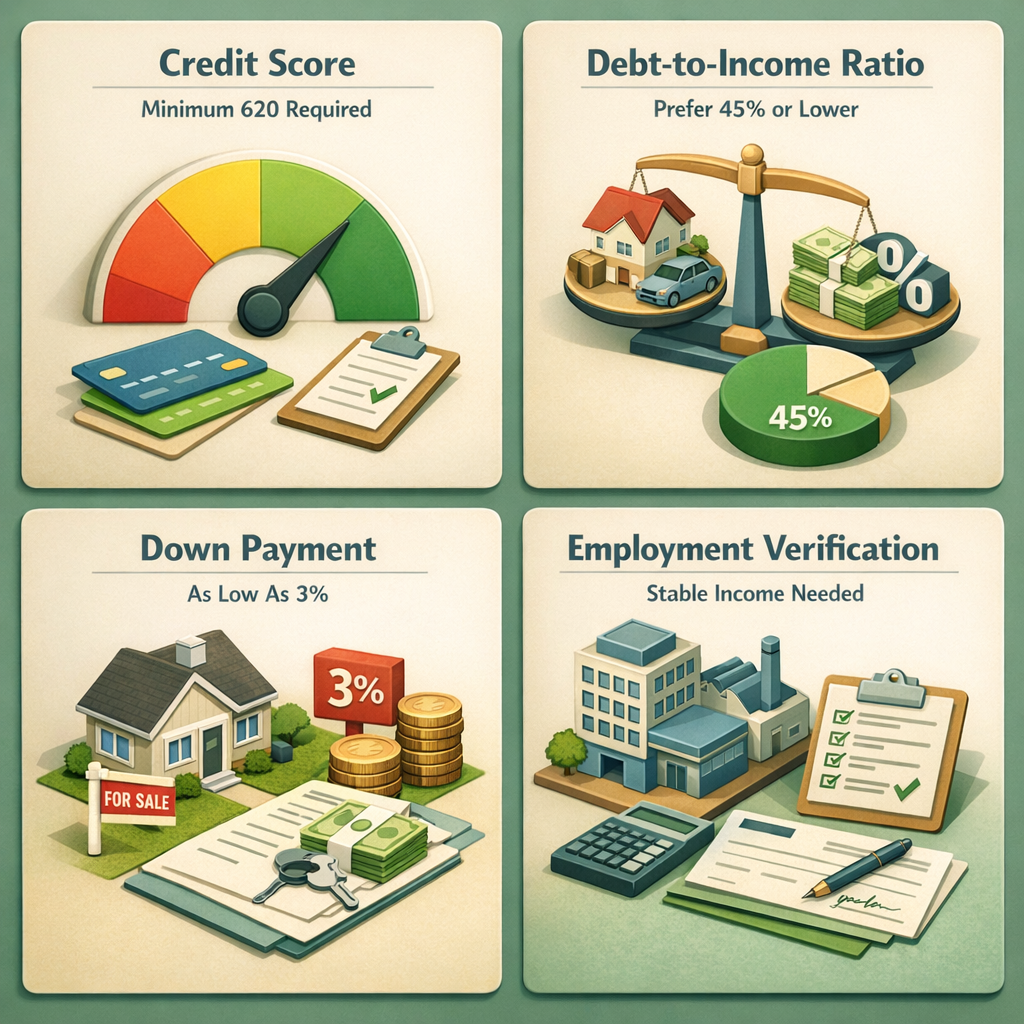
Qualifying for a conventional loan generally requires meeting several key benchmarks. While specific criteria can vary by lender, here are the most common requirements homebuyers and refinancers should be prepared for:
Credit Score
Most conventional loan programs typically require a minimum credit score of 620. However, borrowers with higher scores — particularly those above 740 — may qualify for better interest rates and lower mortgage insurance costs. Your credit history signals to lenders how reliably you've managed debt in the past.
Debt-to-Income Ratio
Your debt-to-income (DTI) ratio compares your monthly debt obligations to your gross monthly income. Most lenders prefer a DTI ratio of 45% or lower for conventional loans, though some programs may allow slightly higher ratios with compensating factors such as strong reserves or excellent credit.
Down Payment
One of the most appealing aspects of conventional loans is the range of down payment options. Borrowers may be able to put down as little as 3% with certain conforming loan programs, though a 20% down payment eliminates the need for private mortgage insurance (PMI). The more you put down, the lower your monthly payment and the less risk you represent to the lender.
Employment and Income Verification
Lenders want to see stable, verifiable income. W-2 employees typically need to provide recent pay stubs and two years of tax returns. Self-employed borrowers may face additional documentation requirements and should explore non-QM or bank statement loan options if standard verification proves challenging.
Private Mortgage Insurance and How It Affects Your Costs
If you put down less than 20% on a conventional loan, your lender will likely require private mortgage insurance (PMI). PMI protects the lender — not you — in the event you default on the loan. It's an added cost that gets rolled into your monthly mortgage payment.
PMI rates can vary based on your credit score, down payment amount, and loan size. Generally speaking, the cost tends to range from a fraction of a percent to over one percent of the loan amount annually. On a $350,000 loan, that could translate to several hundred dollars per month.
The good news is that PMI on conventional loans is not permanent. Once you've built enough equity — typically reaching 20% of the home's original value — you can request cancellation of PMI. Under the federal Homeowners Protection Act, lenders are required to automatically cancel PMI once your loan balance reaches 78% of the original purchase price, as long as your payments are current.
This is one of the key advantages conventional loans have over FHA loans, which require mortgage insurance for the life of the loan in many cases. For homeowners who plan to build equity quickly or make extra principal payments, a conventional loan may offer long-term savings despite a higher initial rate.
Conventional vs. Government-Backed Loans: Weighing Your Options
Choosing between a conventional loan and a government-backed mortgage depends largely on your financial profile, down payment capacity, and long-term homeownership goals. Here's a practical comparison to help you think it through:
Conventional vs. FHA Loans
FHA loans are often recommended for first-time homebuyers with lower credit scores or limited down payment savings. They allow scores as low as 580 with a 3.5% down payment. However, FHA loans require both an upfront mortgage insurance premium and annual mortgage insurance premiums, which can add significant cost over the life of the loan. Borrowers with strong credit and a 10% or more down payment may find conventional loans to be more cost-effective.
Conventional vs. VA Loans
VA loans are exclusively available to eligible veterans, active-duty service members, and surviving spouses. They offer significant benefits including no down payment and no PMI. If you qualify for a VA loan, it's often worth comparing it carefully against conventional options, as the VA program may offer lower overall costs despite a VA funding fee.
Conventional vs. USDA Loans
USDA loans are designed for buyers in eligible rural and suburban areas who meet income limits. They also offer no-down-payment financing. If you're purchasing in a qualifying area and meet income requirements, a USDA loan could be a competitive alternative to a conventional mortgage.
For most borrowers with solid credit and moderate to strong down payments, a conventional loan remains one of the most versatile and cost-competitive mortgage options available.
Using a Conventional Loan to Refinance Your Existing Mortgage
Conventional loans aren't just for purchases — they're also a popular tool for refinancing. Homeowners may consider refinancing into a conventional loan to lower their interest rate, shorten their loan term, remove mortgage insurance, or access home equity through a cash-out refinance.
Rate-and-Term Refinance
If interest rates have dropped since you took out your original mortgage, refinancing to a lower rate could reduce your monthly payment and total interest paid over time. Homeowners who originally took out FHA loans may also refinance into a conventional loan once they've built sufficient equity, effectively eliminating the ongoing FHA mortgage insurance premium.
Cash-Out Refinance
A cash-out refinance allows you to replace your existing mortgage with a larger loan and pocket the difference as cash. This equity-tapping strategy is often used to fund home improvements, consolidate higher-interest debt, or cover major expenses. Lenders typically allow you to borrow up to 80% of your home's appraised value with a conventional cash-out refinance.
Before refinancing, it's important to calculate your break-even point — how long it will take for your monthly savings to offset the closing costs of the new loan. If you plan to stay in the home long enough to recoup those costs, refinancing may make strong financial sense.
●Conclusion
A conventional loan is a powerful and flexible home financing tool that works well for a broad range of borrowers — from first-time homebuyers to experienced real estate investors and homeowners looking to refinance. While qualification requirements are generally more stringent than government-backed programs, the potential for lower long-term costs, cancellable mortgage insurance, and wide property eligibility makes conventional loans a go-to choice for many. If you're ready to explore your options, connecting with a knowledgeable mortgage professional can help you determine whether a conventional loan aligns with your goals and financial situation. LoanWise is here to help guide you through every step of the process.