Many homebuyers assume that USDA loans are only for people purchasing large rural farms or properties with significant acreage. That's actually a common misconception. The truth is that what are the requirements for a USDA loan without land is one of the most searched questions among first-time homebuyers exploring affordable mortgage options. USDA loans can be used to purchase modest single-family homes in eligible rural and suburban areas — no farmland or large lot required. If you've been wondering whether this government-backed program could work for your next home purchase, this guide breaks down everything you need to know in plain, straightforward language.
Understanding the USDA Loan Program and Its Purpose
The USDA Rural Development Guaranteed Housing Loan Program — commonly called the USDA loan — was created to help low- to moderate-income borrowers achieve homeownership in rural and certain suburban communities. It's backed by the U.S. Department of Agriculture and offered through approved private lenders.
One of its most attractive features is the zero down payment requirement, making it especially appealing for buyers who haven't had the chance to save a large lump sum. But despite its name, the program isn't exclusively for agricultural properties or land purchases. In fact, the USDA loan is primarily designed for residential purchases — meaning a typical house on a modest lot is perfectly eligible.
There are two main USDA loan programs to know about:
- USDA Guaranteed Loans: Offered through approved lenders and backed by the USDA. These are the most commonly used and widely available.
- USDA Direct Loans: Funded directly by the USDA for very low-income borrowers. These come with additional eligibility requirements and income caps.
Understanding which program fits your situation is a smart first step before diving into the full qualification checklist.
What Are the Requirements for a USDA Loan Without Land
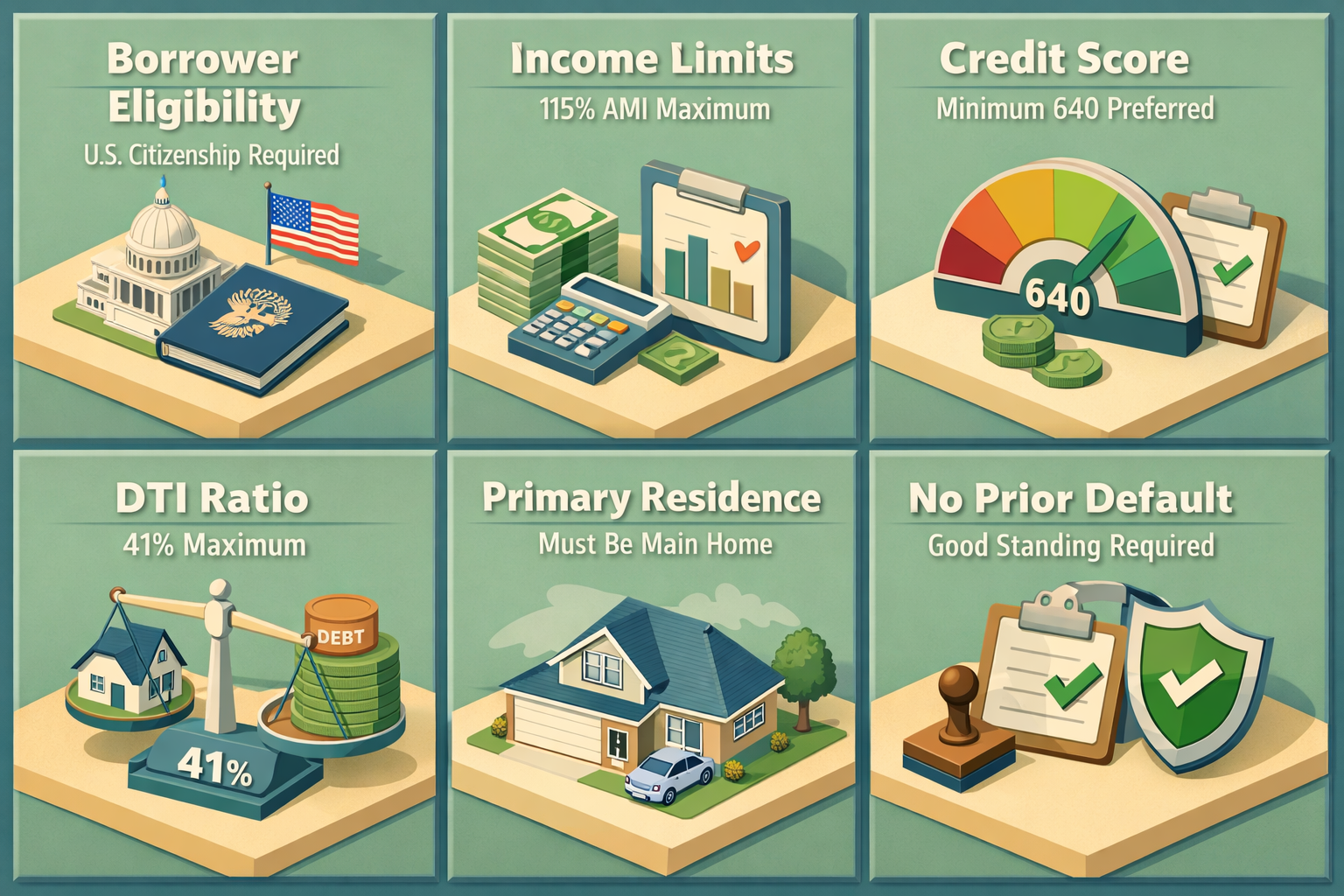
So, what are the requirements for a USDA loan without land? The short answer is that a large land component is not required — but the property and borrower must still meet several specific criteria. Here's a breakdown of the core eligibility requirements:
Borrower Eligibility
- U.S. citizenship or permanent residency: Applicants must be citizens or qualified non-citizens.
- Income limits: Household income must generally fall at or below 115% of the area median income (AMI) for the county or region where the home is located. Limits vary by location and household size.
- Credit score: Most lenders prefer a minimum credit score of 640 for streamlined processing, though some lenders may consider lower scores with additional documentation and manual underwriting.
- Debt-to-income (DTI) ratio: Typically, total monthly debt obligations should not exceed 41% of gross monthly income, though exceptions may be considered with compensating factors.
- Primary residence intent: The purchased home must be used as your primary residence — investment properties and vacation homes do not qualify.
Occupancy and Use Requirements
You must intend to occupy the home as your main living space. USDA loans are not available for rental properties or second homes. This is a firm program guideline that lenders will verify during underwriting.
No Prior USDA Loan Default
If you've had a previous USDA loan, you must be in good standing with that obligation. Applicants with prior federal loan delinquencies or debarment may face disqualification.
USDA Loan Property Eligibility: What the Home Itself Must Meet
When it comes to USDA loan property eligibility, the home must be located in a USDA-designated eligible area. These areas are typically classified as rural or semi-rural, but many communities that might surprise you — including some suburban neighborhoods outside major metropolitan areas — may qualify.
You can check whether a specific property address qualifies using the USDA's official eligibility map tool on their website. This is one of the first steps any homebuyer should take before falling in love with a listing.
Property Type Requirements
The following property types are generally eligible for USDA financing:
- Single-family detached homes
- Townhomes and row houses (in some cases)
- Condominiums (if USDA-approved)
- New construction homes
- Modular homes (meeting HUD standards)
Multi-family properties, commercial buildings, and properties used primarily for income generation do not qualify. The home should be modest in size, design, and cost relative to the area — USDA guidelines generally exclude properties with swimming pools or income-producing features like barns or large agricultural infrastructure.
Physical Condition Standards
The property must meet minimum safety, soundness, and sanitation standards. This typically means the home must have a functional roof, adequate heating, safe electrical systems, and access to clean water and sewage disposal. An appraisal conducted by a USDA-approved appraiser will confirm these conditions.
Rural Housing Loan Requirements Without Acreage: The Lot Size Question
One of the most relieving facts for many homebuyers is that rural housing loan requirements without acreage are surprisingly straightforward. You do not need to purchase a large parcel of land or farm property to qualify for a USDA loan. A standard residential lot — even a modest quarter-acre suburban yard — can absolutely work.
That said, the USDA does pay attention to the land component of the property value. The value of the site (land) relative to the overall property value is reviewed during appraisal. If the land itself accounts for a disproportionately large share of the total value, it may raise questions about whether the purchase is primarily a land acquisition rather than a home purchase — which is outside the program's intent.
In practical terms, most typical residential lots in eligible areas won't trigger this concern. It's primarily a factor when buyers are looking at rural properties with many acres attached. Lenders may also look at whether the land is considered typical for the neighborhood and use.
If you're purchasing a home that happens to sit on a larger lot, it's worth discussing the appraisal implications with your lender early in the process. Transparency upfront can save time later.
Can a USDA Loan Be Used for an Existing Home or a Fixer-Upper
A common question from buyers is: can a USDA loan be used for an existing home? The answer is yes — USDA loans are not limited to new construction. Existing homes that meet property condition requirements are fully eligible, and in fact, the majority of USDA purchases involve existing residential properties.
USDA Loan for Fixer-Upper Homes
What about properties that need some work? Using a USDA loan for fixer-upper homes is possible under certain conditions. The USDA offers a Section 504 Home Repair program for very low-income homeowners to repair existing USDA-financed homes, but for purchase financing, the property must meet the minimum condition standards at closing.
However, if you're using the USDA Guaranteed Loan program to purchase a home that needs repairs, the property must generally be in livable, safe condition at the time of closing. Homes with significant structural damage, missing systems, or health and safety hazards may not clear the USDA appraisal process as-is.
Some borrowers explore escrowing repair funds at closing, though this option varies by lender and loan structure. It's always best to ask your lender whether any repair-related flexibility exists for your specific property scenario. Homes that are move-in ready with only minor cosmetic issues tend to sail through the approval process most smoothly.
Income, Credit, and Financial Preparation Tips for USDA Approval
Getting financially prepared before applying for a USDA loan can make a meaningful difference in how smoothly the process goes. Here are some practical tips to help you position yourself for approval:
Check Your Credit Profile Early
Pull your credit reports from all three bureaus — Equifax, Experian, and TransUnion — and review them for errors or outdated information. Disputing inaccuracies ahead of your application could improve your score and strengthen your file. Most USDA lenders look for a 640+ credit score for automated underwriting, though manual review may be available for scores below that threshold.
Understand Household Income Calculations
USDA income limits consider all household members' income, not just those on the loan. This includes income from a working spouse, adult children living in the home, and other household earners. Make sure you understand how your full household income compares to the AMI limit for your target area before getting too deep into the search process.
Reduce Outstanding Debt Obligations
Since USDA guidelines typically look for a DTI ratio around 41% or lower, paying down credit card balances, auto loans, or student loan obligations before applying could improve your qualifying position. Even modest debt reduction can shift your ratios favorably.
Document All Income Sources
Be ready to provide two years of tax returns, recent pay stubs, and bank statements. Self-employed borrowers may need additional documentation such as profit-and-loss statements. The more organized your financial records, the faster your lender can process your application.
Working With a Lender Who Understands USDA Program Nuances
Choosing the right lender is just as important as meeting the program's eligibility requirements. Not every lender is equally experienced with USDA loans, and since the program has specific guidelines around property eligibility, income calculations, and appraisal standards, working with someone who knows the process well can save you from unexpected delays or surprises.
Look for a lender who is an approved USDA lender and has a documented track record with rural housing loan closings. Ask how many USDA loans they've closed in the past year, and don't hesitate to ask specific questions about property eligibility in your target area.
A knowledgeable loan officer will help you:
- Verify whether a specific property address falls within a USDA loan property eligibility zone
- Understand your income limits based on household size and county
- Prepare your documentation correctly to avoid back-and-forth delays
- Navigate the USDA Conditional Commitment process, which is an additional step compared to conventional loan approvals
It's also worth knowing that USDA loans have a guarantee fee structure in place of traditional mortgage insurance. There's an upfront guarantee fee (currently around 1% of the loan amount, though this may be subject to change) and an annual fee (typically around 0.35% of the remaining loan balance). These fees are generally lower than FHA mortgage insurance premiums, making USDA loans cost-competitive for eligible borrowers.
At LoanWise, our team is well-versed in USDA program guidelines and can help you navigate every step — from checking your property's eligibility to preparing a complete, lender-ready application.
●Conclusion
Understanding what are the requirements for a USDA loan without land opens a door that many homebuyers didn't know was available to them. You don't need a farm, a large lot, or acres of land to benefit from this program. What you do need is a qualifying property in an eligible area, a stable income within USDA limits, decent credit, and a plan to use the home as your primary residence.
USDA loans remain one of the most powerful zero-down mortgage options available to eligible buyers today. Whether you're a first-time homebuyer exploring affordable paths to ownership or a homeowner considering a move to a qualifying community, this program may offer the financing solution you've been looking for. Reach out to the LoanWise team today to find out if you and your target property qualify — and take the next step toward confident homeownership.