For many homebuyers, coming up with a large down payment is one of the biggest obstacles to homeownership. That's where the USDA loan program can make a real difference. Backed by the U.S. Department of Agriculture, USDA loans offer eligible buyers the rare opportunity to purchase a home with zero down payment — and often at competitive interest rates. But like any mortgage program, there are specific USDA loan requirements that buyers must meet before they can take advantage of this benefit. Understanding these requirements upfront can save you time, stress, and surprises during the loan process. In this guide, we'll walk you through everything you need to know about qualifying for a USDA loan, from income limits and credit standards to property location rules and the application process.
What Is a USDA Loan and Who Is It Designed For?
A USDA loan is a government-backed mortgage program offered through the U.S. Department of Agriculture. It was created to encourage homeownership in rural and suburban areas by making financing more accessible to low- and moderate-income households. Unlike conventional loans, USDA loans don't require a down payment, which makes them especially attractive for first-time homebuyers or those who haven't had the chance to build significant savings.
There are two primary types of USDA home loans available to individual borrowers:
- USDA Direct Loans: These are funded directly by the USDA and are reserved for applicants with very low to low incomes. They may come with payment assistance to further reduce monthly costs.
- USDA Guaranteed Loans: These are issued by approved private lenders but backed by the USDA. They're available to a slightly broader income range and tend to be the more commonly used option.
It's worth noting that while the program carries the USDA name, you don't need to be a farmer or have any agricultural ties to qualify. The program simply targets properties in areas that the USDA designates as rural or eligible suburban communities.
Core USDA Loan Requirements Every Buyer Should Know
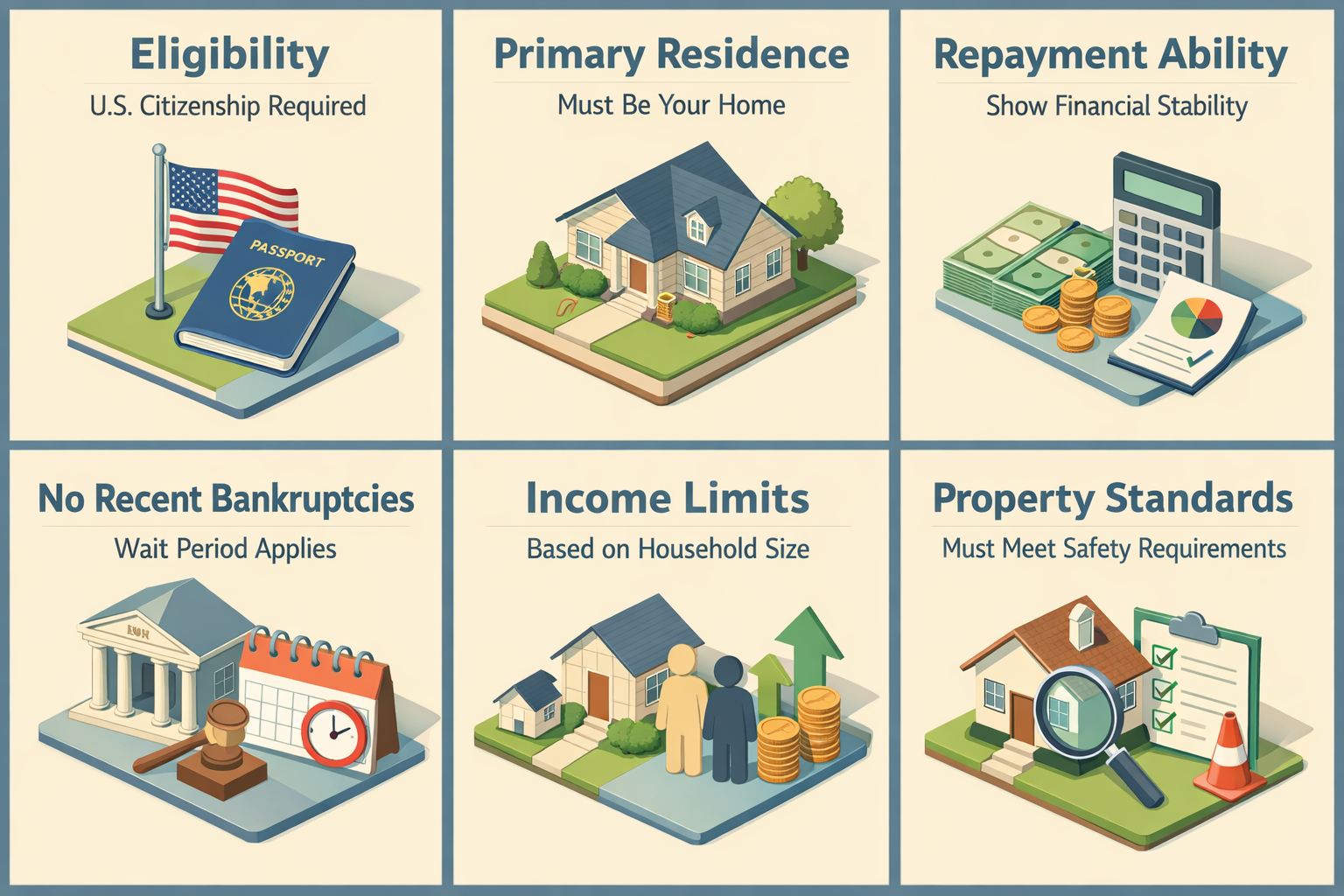
Meeting the USDA loan requirements involves satisfying several distinct criteria. These requirements are designed to ensure the program reaches households that genuinely benefit from rural development financing. Here's a breakdown of the primary areas lenders and the USDA will evaluate:
U.S. Citizenship or Eligible Non-Citizen Status
Borrowers must be U.S. citizens, U.S. non-citizen nationals, or qualified aliens to be eligible. Lenders will typically verify this status early in the application process.
Primary Residence Requirement
USDA loans are strictly for primary residences. You cannot use this program to finance a vacation home, investment property, or rental unit. The home must be where you plan to live full-time after purchase.
Ability to Repay
Applicants should demonstrate a reasonable ability to repay the mortgage. Lenders will review your employment history, income stability, and overall financial picture. While there's no universal minimum required, a consistent work history — typically two years in the same field — can strengthen your application considerably.
No Recent Bankruptcies or Foreclosures
Borrowers who have experienced a Chapter 7 bankruptcy may generally need to wait around three years before becoming eligible, while a Chapter 13 discharge may require a shorter waiting period with satisfactory payment history. Foreclosures typically carry a similar three-year waiting window, though individual lender overlays may vary.
Income Limits and Household Eligibility Explained
One of the most distinct aspects of USDA financing is the income limit requirement. Unlike many other loan programs, the USDA sets a cap on how much a household can earn and still qualify. These limits exist to ensure the program serves low- to moderate-income families who may struggle to access conventional financing.
Income limits are based on the total household income — not just the income of the borrowers on the loan. This means all adults living in the home may need to have their income counted, even if they're not on the mortgage application. For the USDA Guaranteed Loan program, household income generally must not exceed 115% of the median income for the area where the property is located.
These limits vary by county and household size, so what qualifies in a rural county in one state may differ significantly from the limits in another region. Before assuming you're eligible or ineligible based on income, it's a good idea to check the USDA's official income eligibility tool or speak with an approved lender who can run the numbers for your specific location and household.
For USDA Direct Loans, the income thresholds are stricter, generally targeting households at or below 80% of the area median income. These loans are intended for applicants with the most limited financial means, and payment subsidies may be available to make monthly obligations more manageable.
Property Location and Condition Standards
Property eligibility is another critical piece of the USDA puzzle. The home you're purchasing must be located in a USDA-designated eligible area. Contrary to popular belief, these areas aren't always remote farmland — many suburban communities on the outskirts of major cities also qualify. The USDA maintains an online property eligibility map that allows buyers to search any address to determine if it falls within an approved zone.
What Types of Properties Qualify?
- Single-family homes (site-built)
- Eligible condominiums and townhomes (must meet USDA approval criteria)
- Manufactured homes (subject to additional requirements depending on the loan type)
- New construction homes in eligible areas
Property Condition Requirements
The home must also meet certain safety and habitability standards. Since USDA loans are government-backed, the property will need to pass an appraisal that confirms it's structurally sound, has functioning utilities, and is free from major hazards. Homes in significant disrepair may not qualify unless repairs are made prior to or as part of the transaction.
It's also worth noting that the property size and land area may be considered. Homes with very large tracts of agricultural land could potentially raise questions about whether the property is primarily residential in nature, which is a core requirement of the program.
Credit Score Expectations and Financial Benchmarks
The USDA doesn't set a hard universal minimum credit score for its guaranteed loan program, but approved lenders typically look for a score of at least 640 to use the USDA's automated underwriting system. Borrowers with scores below this threshold may still be considered through manual underwriting, though this process tends to require more documentation and a stronger compensating factors profile.
Manual underwriting evaluates things like payment history, savings reserves, and the overall context of any credit blemishes. If you've had late payments or minor derogatory marks, having a clear explanation and demonstrated financial improvement can work in your favor.
Debt-to-Income Ratio Guidelines
Lenders will also assess your debt-to-income (DTI) ratio, which compares your monthly debt obligations to your gross monthly income. For USDA loans, a common guideline is a front-end DTI of around 29% for housing costs and a back-end DTI of around 41% for all debts combined. However, borrowers with strong credit profiles and financial reserves may be approved with slightly higher ratios through automated underwriting.
Keeping your debt levels manageable and reviewing your credit report for errors before applying can both improve your standing. Even small improvements to your credit score or DTI could move you from manual underwriting territory into the streamlined automated approval process.
Understanding USDA Loan Fees and Mortgage Insurance
While USDA loans don't require a down payment, they do carry their own set of fees that borrowers should factor into their budget. Understanding these costs upfront helps ensure there are no surprises at the closing table.
Upfront Guarantee Fee
For the USDA Guaranteed Loan program, borrowers are charged an upfront guarantee fee at closing. This fee is typically a percentage of the total loan amount and can often be rolled into the loan itself, meaning you may not need to pay it out of pocket. This is a meaningful advantage for buyers who are working with limited cash reserves.
Annual Fee
In addition to the upfront fee, borrowers also pay an annual fee, which is divided into monthly installments and added to the mortgage payment. This is sometimes compared to the private mortgage insurance (PMI) required on conventional loans with less than 20% down, though USDA annual fees have historically been lower than standard PMI rates. These fee structures can change, so confirming current rates with a USDA-approved lender is always a smart step.
One benefit over FHA loans is that USDA annual fees may be eliminated or reduced as your loan balance decreases over time, depending on program guidelines in effect when your loan was originated. This can contribute to long-term savings for homeowners who stay in their properties for several years.
Steps to Apply for a USDA Loan With Confidence
If you believe you may meet the USDA loan requirements, the next step is taking action. The application process shares many similarities with other mortgage programs, but there are a few USDA-specific steps to keep in mind.
- Check your eligibility: Use the USDA's online tools to verify both your income eligibility and the property's location status before falling in love with a specific home.
- Find a USDA-approved lender: Not every mortgage lender participates in the USDA Guaranteed Loan program. Seek out lenders who are specifically approved by the USDA and have experience processing these types of loans.
- Gather your documentation: Be prepared to provide two years of tax returns, recent pay stubs, bank statements, employment verification, and information about all household members' income.
- Get pre-qualified or pre-approved: A pre-approval letter from a USDA-approved lender gives you a clearer picture of what you can afford and signals to sellers that you're a serious buyer.
- Work with a knowledgeable real estate agent: An agent familiar with USDA transactions can help you find eligible properties and navigate any unique conditions that arise during the process.
- Be patient with the timeline: USDA loans may take slightly longer to process than conventional loans because the loan may need to be reviewed or issued by the USDA in addition to the lender's standard underwriting. Building extra time into your homebuying schedule can reduce stress.
Working with experienced professionals who understand the nuances of USDA financing can make the entire experience smoother and more predictable from start to finish.
●Conclusion
USDA loans remain one of the most powerful and underutilized tools available to eligible homebuyers. With no down payment required, competitive interest rates, and flexible credit standards, they can open doors that other mortgage programs might leave closed. However, navigating the income limits, property eligibility maps, and application nuances does require some preparation and guidance. If you think you might qualify — or you're simply curious whether a USDA loan could be the right fit for your situation — reaching out to a knowledgeable lending professional is a great place to start. At LoanWise, we're here to help you explore your options, compare programs, and take confident steps toward the home you've been working toward.