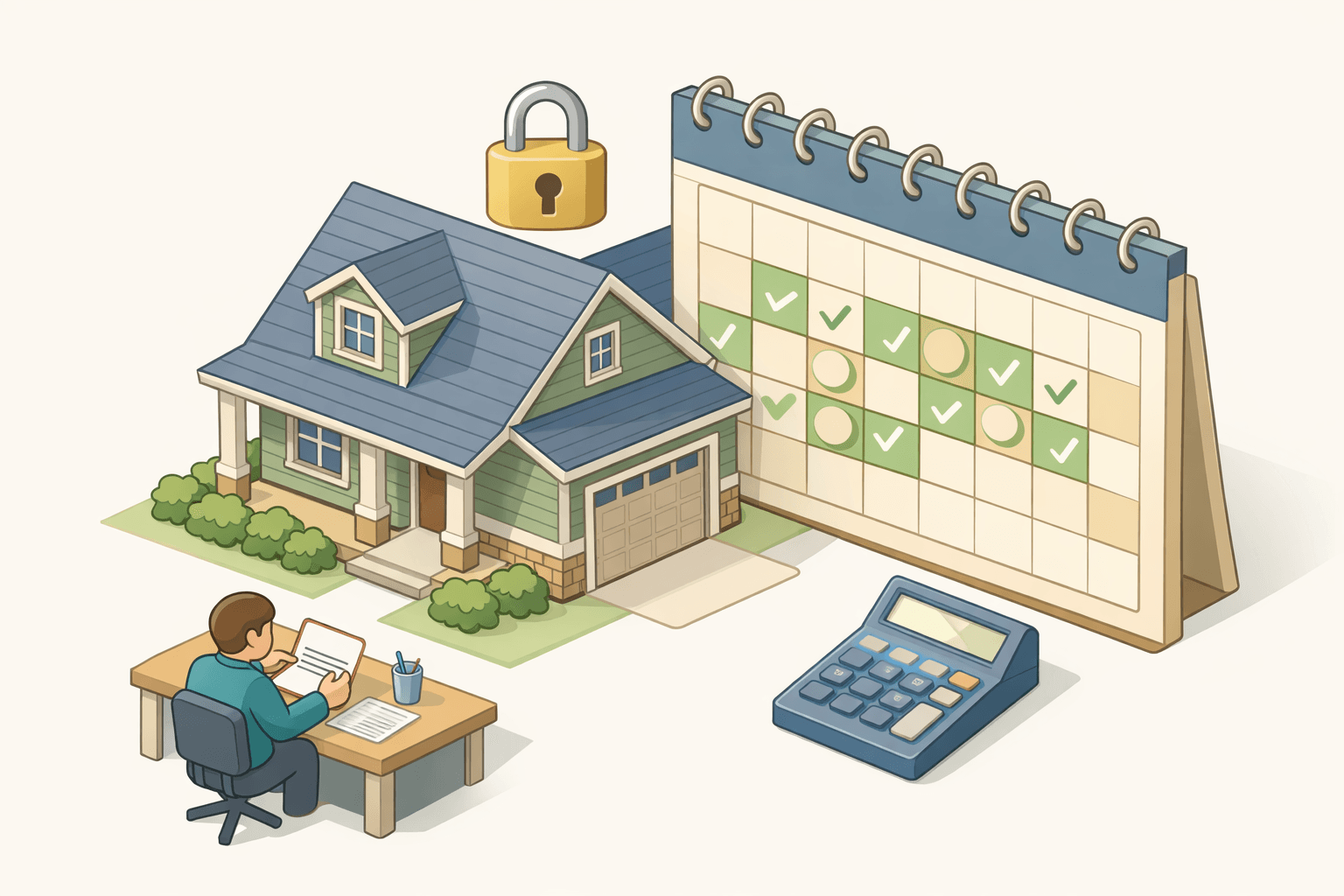
When you decide to refinance your mortgage, one of the most important decisions you'll face isn't just which lender to choose or what loan term to select — it's when and how to lock your interest rate. Markets shift daily, and a rate that looks great on Monday could climb noticeably by Friday. That's where understanding mortgage rate locks for refinancing becomes truly essential. A rate lock is a lender's commitment to hold a specific interest rate for you while your loan application moves through the approval process. Done right, it can protect your monthly savings and give you peace of mind. Done carelessly, it can cost you money or leave your refinance in limbo. This guide breaks down everything you need to know — from lock periods and extensions to calculators and timing strategies — so you can approach your refinance with confidence.
What a Mortgage Rate Lock Actually Does for Refinancers
A mortgage rate locks is a written agreement between you and your lender that freezes your interest rate at a specific level for a defined period of time. For refinancers, this matters enormously because the time between submitting your application and actually closing your new loan can span several weeks — sometimes longer. During that window, broader economic forces, Federal Reserve signals, inflation data, and bond market movements can all push interest rates up or down.
When you lock your rate, you're essentially purchasing protection against upward movement. If rates rise after you lock, your agreed-upon rate stays in place. However, it's worth noting that in most standard lock agreements, you typically don't automatically benefit if rates fall — you're committed to the locked rate unless you have a special float-down option (more on that shortly).
For homeowners refinancing to reduce their monthly payment, lower their interest cost, or access home equity, a rate lock provides the certainty needed to plan your financial future. Without one, the rate you're quoted during pre-approval could differ from the rate you receive at closing, which could undermine the very savings you were hoping to achieve.
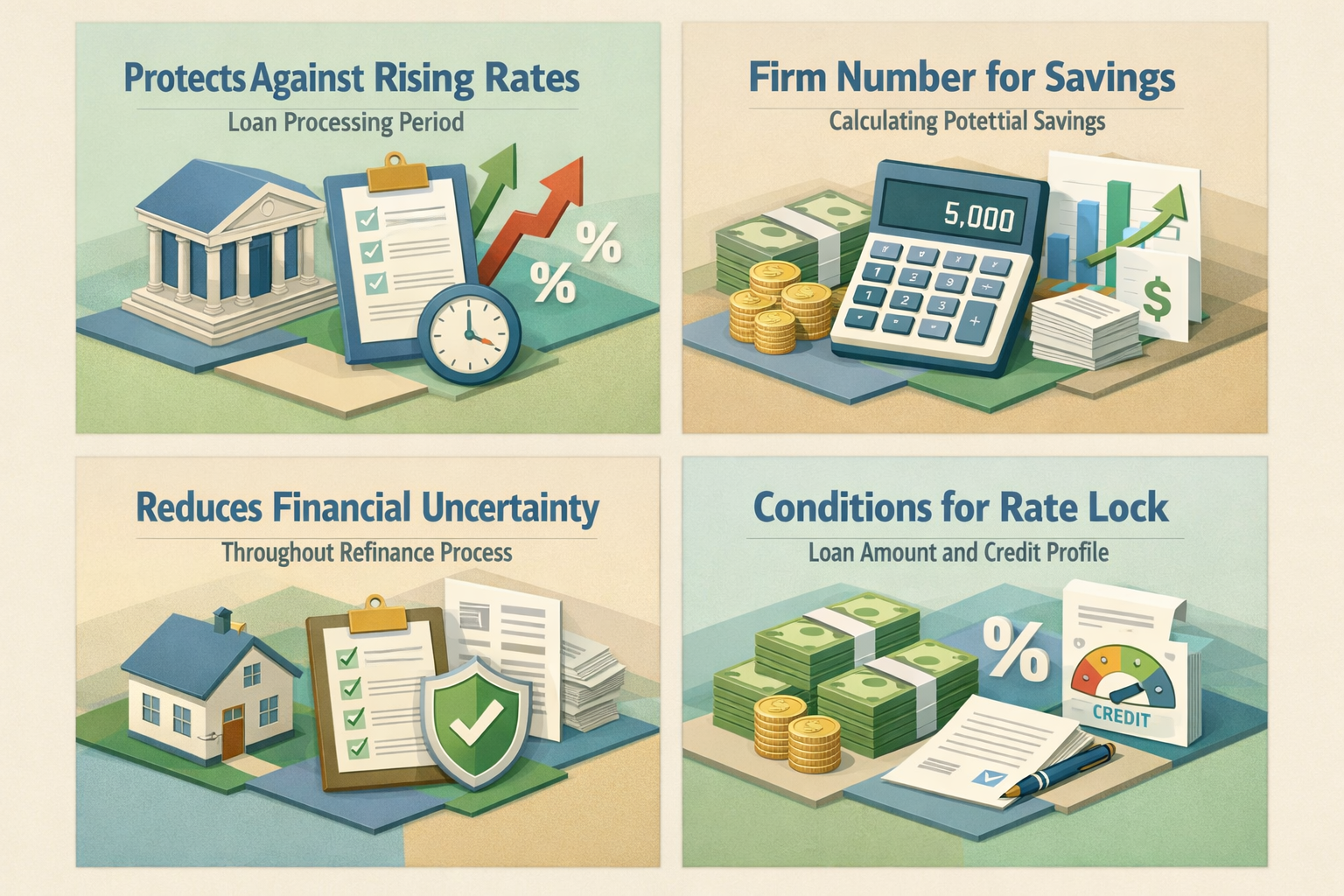
- Protects against rising rates during the loan processing period
- Gives you a firm number to use when calculating potential savings
- Reduces financial uncertainty throughout the refinance process
- May come with conditions tied to loan amount, property type, or credit profile
How Long Can I Lock My Mortgage Rate During a Refinance
One of the most common questions refinancers ask is: how long can I lock my mortgage rate? The answer depends on the lender, the loan type, and market conditions at the time you apply. Most lenders offer standard lock periods ranging from 15 to 60 days, with 30-day and 45-day locks being the most commonly selected options for refinance transactions.
Some lenders do offer longer lock periods — 60, 75, or even 90 days — particularly for more complex loan scenarios, government-backed loans like FHA or VA refinances, or jumbo refinances that require additional underwriting time. Extended lock periods may be available in certain markets, though they often come at a cost.
Matching the Lock Period to Your Refinance Timeline
Choosing the right lock duration requires realistic thinking about how long your refinance will take. A streamlined refinance on a conventional loan with a strong credit profile and complete documentation might close in three weeks. A cash-out refinance, a self-employed borrower scenario, or a property with title complications could easily stretch to 45 or 60 days.
If you lock too short and your loan doesn't close in time, you'll either need to pay for an extension or risk losing your rate entirely. If you lock too long unnecessarily, you may pay a slightly higher rate upfront, since longer locks typically carry a small premium. The goal is to estimate your timeline honestly and choose a lock period that covers it comfortably — with a small buffer built in.
The Real Cost of Extending a Mortgage Rate Lock
Sometimes, despite everyone's best efforts, a refinance doesn't close within the original lock window. Delays can come from appraisal scheduling, title searches, underwriting backlogs, or last-minute document requests. When that happens, you'll typically need to consider extending your mortgage rate lock — and that extension usually comes at a price.
Lenders commonly charge extension fees based on the number of additional days needed and the size of the loan. These fees are often expressed as a fraction of a discount point (one point equals one percent of the loan amount). For example, a short extension of 7 to 15 days might cost anywhere from 0.125% to 0.25% of the loan amount, though this can vary widely by lender and market conditions. Longer extensions naturally cost more.
Who Pays and When
In many cases, extension costs are negotiable depending on why the delay occurred. If the hold-up was caused by the lender's own processing time rather than missing documents from the borrower, some lenders will extend the lock at no charge or split the cost. It's worth asking directly before assuming you'll absorb the full fee.
To minimize extension risk, refinancers should respond quickly to every document request, schedule appraisals promptly, and stay in close contact with their loan officer about where things stand in the pipeline. Proactive communication often makes the difference between a smooth close and a costly extension.
Using a Mortgage Refinance Rate Lock Calculator to Plan Ahead
A mortgage refinance rate lock calculator is a practical tool that helps homeowners model the potential savings — and costs — tied to different lock scenarios. While these calculators vary in sophistication, most are designed to help you weigh the tradeoff between locking now versus waiting, or between a shorter lock period and a longer one.
At its core, a rate lock calculator typically asks for your current loan balance, your existing interest rate, the new rate you've been quoted, and the proposed lock period length. From there, it can estimate your monthly payment difference, break-even timeline, and total interest savings over the life of the new loan.
What to Look for in a Rate Lock Tool
The most useful calculators also factor in lock extension costs, potential rate changes during the lock window, and any points or fees associated with a longer lock period. This kind of scenario modeling is especially valuable when you're deciding between a 30-day lock at one rate versus a 45-day lock at a slightly higher rate.
Even if you use a basic calculator, the exercise encourages you to think concretely about your refinance goals. Are you primarily trying to lower your monthly payment? Reduce your total interest paid? Shorten your loan term? Knowing your primary objective helps you determine how sensitive your outcome is to small rate differences — and whether paying a modest premium for a longer lock is worth the added security.
Float-Down Options and What They Mean for Your Refinance Strategy
A standard rate lock protects you if rates rise, but what if rates fall after you lock? That's where a float-down option can be valuable. This is an add-on feature — offered by some lenders for an additional fee — that allows you to capture a lower rate if the market moves down by a specified amount before your loan closes.
Float-down options typically come with conditions. The rate drop usually needs to exceed a minimum threshold (often 0.25% or more) before the float-down activates. The fee for this feature is typically built into your rate or charged as a separate closing cost. Whether it makes sense depends on the current rate environment and your read on where rates are likely to head during your lock period.
In a volatile or declining rate environment, a float-down option can provide meaningful savings. In a relatively stable market, the added cost might not be justified. Talk to your loan officer about whether your lender offers this feature and what the specific terms are — since they vary considerably between institutions.
The Impact of a Rate Lock on Your Overall Refinance Outcome
The impact of a rate lock on your refinance goes beyond just protecting a number on paper. It influences your total closing costs, your monthly payment certainty, and your ability to make sound financial decisions during the loan process. When your rate is locked, you can calculate your new payment with confidence and start planning your budget accordingly — before you've even signed closing documents.
There are a few key areas where rate lock decisions have a direct, measurable impact:
- Break-even timeline: A locked rate determines how quickly you'll recoup closing costs through monthly savings. A slightly higher rate from a longer lock could push your break-even further out.
- Total interest paid: Even a 0.125% difference in rate, compounded over a 30-year term, can translate to thousands of dollars in additional interest.
- Appraisal and closing timing: Knowing your lock deadline creates urgency that can actually speed up your closing timeline and keep all parties accountable.
- Refinance feasibility: In a rising rate environment, locking quickly after receiving a competitive quote may be the difference between a refinance savings and one that doesn't.
It's also worth remembering that a rate lock is tied to specific loan terms. If you change your loan amount, switch from a fixed to an adjustable product, or alter your loan purpose mid-process, your existing lock may no longer apply and a new agreement may be required.
Timing Your Rate Lock Wisely in Today's Refinance Market
Knowing when to lock is just as important as knowing how a rate lock works. Rate timing is genuinely difficult — even professional economists and mortgage market analysts regularly get it wrong. Still, there are some practical principles that can guide refinancers toward smarter decisions.
First, consider locking when you've received a rate that makes your refinance financially meaningful — not necessarily the lowest possible rate in theory, but one that achieves your specific goals. If locking now saves you $200 per month and you plan to stay in the home long enough to recoup closing costs, waiting for a slightly better rate may introduce more risk than reward.
Second, pay attention to broader market signals. When economic data comes in stronger than expected or inflation rises, mortgage rates tend to move up. When uncertainty rises or growth slows, rates may ease. Following weekly rate trend commentary from reputable lending sources can help you recognize windows of relative stability or decline where locking might make sense.
Third, talk openly with your loan officer about market conditions. A knowledgeable mortgage professional who follows rate movements daily can offer perspective that general news sources can't. They may also have insight into upcoming economic reports or Fed meeting schedules that could influence rates in the near term.
Finally, don't let perfect be the enemy of good. Waiting too long to lock in hopes of squeezing out an extra 0.125% improvement has caused many refinancers to miss out on meaningful savings entirely when rates moved in the wrong direction. Understanding mortgage rate locks for refinancing ultimately means accepting that certainty has value — and acting decisively when the numbers work in your favor.
●Conclusion
A mortgage rate lock is one of the most powerful tools available to refinancers, yet it's often misunderstood or treated as an afterthought. By taking the time to truly understand how lock periods work, what extensions cost, how float-down options function, and how to use a mortgage refinance rate lock calculator to model your options, you position yourself to make confident, well-informed decisions. The goal of refinancing is to improve your financial situation — and a thoughtful rate lock strategy helps ensure you actually capture the savings you set out to achieve. If you're ready to explore your refinance options, connect with a LoanWise mortgage specialist today and take the first step toward locking in a rate that works for you.