
Co-owning a vacation property with family members, friends, or investment partners can be a smart way to share the joy — and the costs — of a beloved retreat. But when it comes time to leverage that property's equity through a Home Equity Line of Credit (HELOC), things can get a bit more complicated. Understanding HELOC requirements for co-owned vacation property is essential before you take any steps toward an application. Lenders look at shared ownership situations differently than they do for single-owner primary residences, and knowing what to expect can save you time, frustration, and money.
What Is a HELOC and How Does It Work for Vacation Properties?
A Home Equity Line of Credit, or HELOC, is a revolving credit line secured by the equity you've built in a property. Think of it like a credit card, but backed by real estate. During the draw period — which often lasts around 10 years — borrowers can access funds up to their approved credit limit, repay them, and draw again. After the draw period ends, the repayment phase begins, typically spanning 10 to 20 years.
For a vacation home, the mechanics of a HELOC are similar to those on a primary residence, but lenders may apply stricter qualifying criteria. Since vacation or second homes aren't owner-occupied full time, lenders often view them as carrying slightly more risk. This means you might encounter lower loan-to-value (LTV) limits, higher interest rates, or more conservative income requirements compared to a HELOC on your main home.
When the property is co-owned — meaning two or more people share title — the situation adds another layer of complexity. Lenders need to understand who has ownership rights, how those rights are structured, and whether all owners are willing to participate in the loan process.
How Co-Ownership Structures Affect HELOC Eligibility for Shared Property
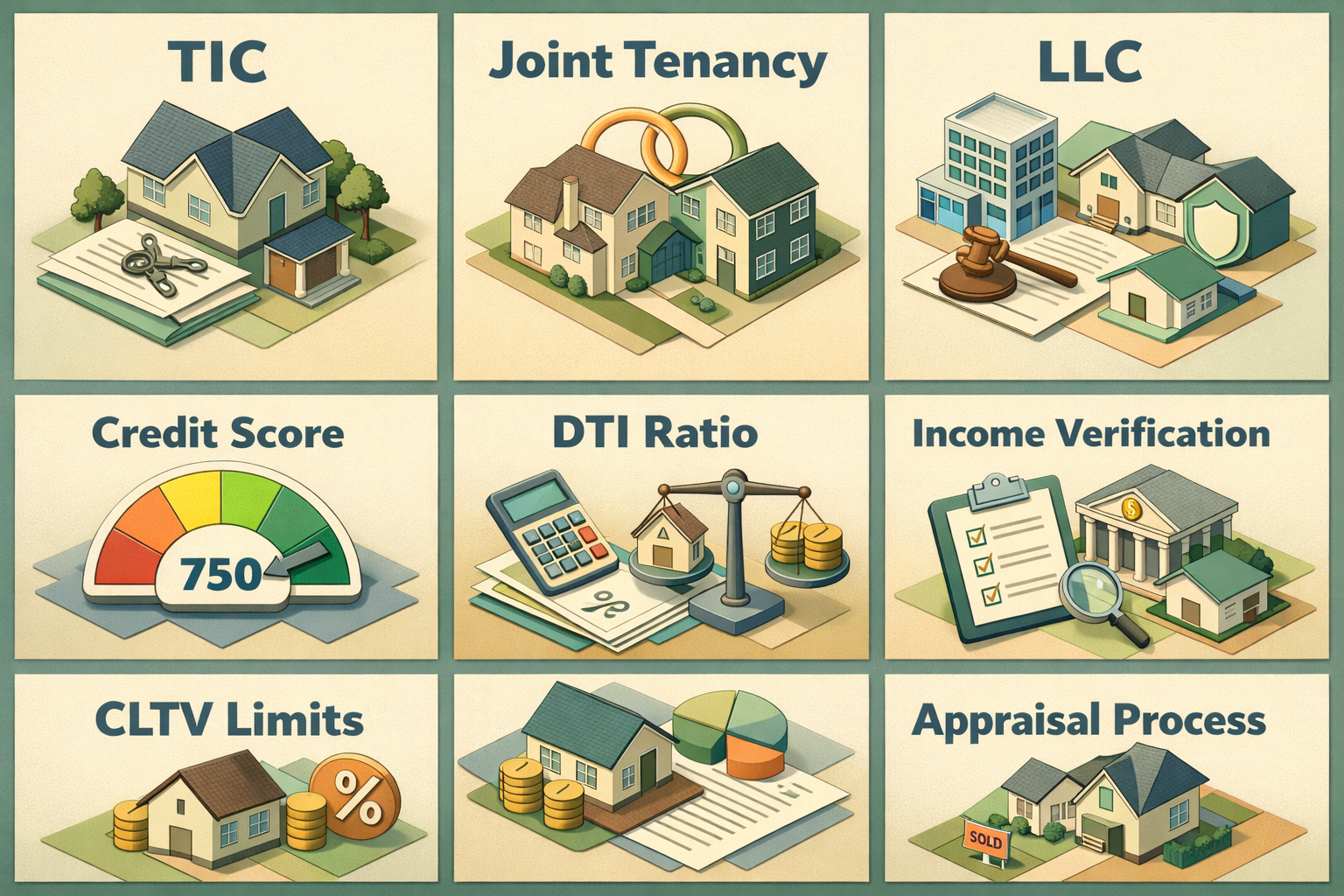
One of the first things a lender will examine is how the vacation property is titled. The way ownership is legally structured plays a significant role in determining who can apply for a HELOC and what the lender will require. There are a few common co-ownership arrangements:
- Tenancy in Common (TIC): Each owner holds a specific, often unequal share of the property. With TIC, one co-owner may be able to borrow against their individual share in some circumstances, though this is not universally available and many lenders are reluctant to offer a HELOC on a fractional interest.
- Joint Tenancy with Right of Survivorship: All owners hold equal shares, and the property passes to surviving owners upon one owner's death. Lenders typically require all joint tenants to be on the HELOC application, since all parties have a stake in the collateral.
- LLC or Trust Ownership: Some co-owners hold vacation property through a legal entity. HELOCs on properties titled to an LLC or trust can be harder to obtain, as many traditional lenders prefer to lend to individuals rather than entities. Specialty or portfolio lenders may be more accommodating in these scenarios.
In most cases, lenders offering a HELOC for shared ownership property will want every shared owner to sign on the loan, regardless of the ownership structure. This protects the lender's interest by ensuring that every party with a claim to the collateral acknowledges the lien. If even one co-owner is unwilling to participate, many lenders may decline the application altogether.
Credit and Income Qualifications When Multiple Owners Are Involved
When multiple borrowers are on a HELOC application, lenders evaluate each party's financial profile. Here's what typically comes into play:
Credit Score Considerations
Most lenders look at the credit scores of all borrowers and often use the lowest middle score among them to determine eligibility and pricing. So if one co-owner has excellent credit and another has a fair score, the loan terms may reflect the weaker profile. It's worth reviewing each co-owner's credit report well before applying so there's time to address any issues.
Debt-to-Income Ratio
Lenders will calculate each borrower's debt-to-income (DTI) ratio, which compares monthly debt obligations to gross monthly income. For second homes and vacation properties, lenders may apply tighter DTI thresholds than they would for a primary residence HELOC. Typically, lenders prefer DTI ratios below 43%, though some may allow higher ratios with compensating factors like strong reserves or excellent credit.
Income Verification
All co-borrowers will likely need to provide income documentation, which may include W-2s, tax returns, pay stubs, or — for self-employed owners — profit and loss statements. If any co-owner has irregular income, a side business, or recently changed jobs, this could affect the overall strength of the application.
It's also worth noting that rental income from the vacation property might be counted toward qualifying income in some cases, but lenders vary widely in how they treat this. Some may require a two-year history of rental income reported on tax returns before including it.
Equity Requirements and Loan-to-Value Limits for Second Home HELOCs
Even if your credit is strong and all co-owners are on board, you'll still need sufficient equity in the vacation property to qualify. Lenders use the combined loan-to-value (CLTV) ratio to measure how much total debt is secured against the home relative to its appraised value.
For primary residences, some lenders allow borrowers to access equity up to 85% or 90% CLTV. For vacation or second homes, however, lenders often apply more conservative limits — frequently capping CLTV at 75% to 80%. This means if the vacation property is appraised at $500,000 and there's an existing mortgage balance of $200,000, the available equity for a HELOC might be limited even if the property has appreciated significantly.
A professional appraisal will almost certainly be required as part of the process. The lender will order this to establish the current market value of the property, which directly determines how much credit may be extended. In some co-ownership scenarios where the property is held through an LLC or trust, the appraisal process may also be more involved.
Keeping the property well-maintained and making strategic improvements over time can help preserve or increase appraised value — which is good news for co-owners hoping to access more equity in the future.
Navigating Lender Policies and Finding the Right Fit for Shared Vacation Home Equity
Not every lender offers HELOCs on vacation properties, and even fewer routinely work with co-owned or shared ownership properties. It's important to shop around and ask the right questions upfront to avoid wasting time on applications with lenders who aren't equipped to handle your situation.
Here are a few strategies that may help:
- Work with a mortgage broker: Brokers have access to multiple lenders and can help match your specific ownership situation with a lender experienced in vacation property HELOCs. This can save significant time compared to approaching lenders one by one.
- Consider portfolio lenders or credit unions: Smaller institutions that keep loans in-house — rather than selling them on the secondary market — often have more flexibility in underwriting. They may be more willing to work through the nuances of a co-owned vacation home.
- Ask about their experience with co-ownership: When speaking with any lender, ask directly whether they've handled HELOCs on co-owned vacation properties before. A lender who's familiar with the process will be better positioned to guide you efficiently.
- Get a co-ownership agreement in place: Some lenders may feel more comfortable extending credit if co-owners have a formal written agreement outlining usage rights, expense sharing, and what happens if one owner wants to sell. This kind of documentation can demonstrate organization and reduce perceived risk.
Understanding HELOC requirements for co-owned vacation property isn't just about meeting financial thresholds — it's also about presenting your situation clearly and working with lenders who understand shared real estate arrangements.
Common Challenges and How Co-Owners Can Prepare Strategically
Even well-prepared borrowers can encounter hurdles when applying for a HELOC on a shared vacation home. Being aware of common challenges ahead of time can help you strategize effectively.
Disagreements Among Co-Owners
Perhaps the most significant non-financial obstacle is simply getting all co-owners to agree. If one owner is opposed to taking on debt secured by the property, the application may stall or fail entirely. Open communication among all parties — ideally before any lender conversations begin — is essential. Defining the purpose of the HELOC (renovation, emergency fund, investment) and how repayments will be shared can help align everyone's expectations.
Complex Tax Situations
The tax implications of a HELOC on a vacation property can be more nuanced than on a primary residence. Interest on a HELOC may or may not be tax-deductible depending on how the funds are used and current IRS rules. Co-owners should consult a qualified tax professional to understand how the HELOC could affect each person's individual tax situation, especially if the property is also used as a short-term rental.
Title and Legal Clarity
If the property's title has any clouds — such as unresolved liens, ambiguous inheritance situations, or errors in public records — these will need to be resolved before a lender will move forward. A title search will typically be part of the HELOC process, so it's worth reviewing the title proactively and addressing any issues with a real estate attorney if needed.
●Conclusion
Tapping into the equity of a co-owned vacation property through a HELOC is entirely possible, but it requires more preparation than a standard home equity line on a primary residence. From understanding how ownership structure affects lender requirements to ensuring all co-borrowers meet credit and income standards, there are many moving parts to manage. By approaching the process thoughtfully — reviewing credit, aligning with co-owners, building sufficient equity, and working with experienced lenders — you can improve your chances of a smooth approval. If you're exploring your options for a HELOC for shared ownership property, LoanWise is here to help you connect with lenders who understand the unique dynamics of co-owned real estate. Reach out today to start the conversation.