
If you own a home with a mother-in-law suite, you may be sitting on a valuable financial asset. A Home Equity Line of Credit (HELOC) lets you borrow against the equity you've built in your property, giving you flexible access to funds for renovations, debt consolidation, or other financial goals. But when your home includes an attached apartment or secondary living unit, the lending process can get a little more nuanced. Understanding HELOC requirements for a property with a mother-in-law suite is essential before you apply, so you can avoid surprises and position yourself as a strong borrower from the start.
What Is a HELOC and How Does It Work for Homeowners?
A HELOC is a revolving line of credit secured by the equity in your home. Think of it like a credit card, but backed by your property. During the draw period — which typically lasts five to ten years — you can borrow funds as needed, up to your approved credit limit. After that, you enter a repayment period where you pay down the principal plus interest.
Unlike a traditional home equity loan that gives you a lump sum, a HELOC offers flexibility. You only pay interest on what you actually borrow during the draw period, which makes it appealing for ongoing projects or unpredictable expenses. Interest rates on HELOCs are usually variable, meaning they can change over time based on market conditions.
For homeowners with a mother-in-law suite, the appeal of a HELOC is clear. Whether you want to upgrade the secondary unit, improve the main home, or free up cash for other needs, leveraging your equity could be a smart move — provided you meet the lender's requirements.
How Lenders Classify a Property With an Attached Apartment
One of the first things a lender will evaluate is how your property is classified. This classification can significantly affect which loan products you qualify for and under what terms. A mother-in-law suite — sometimes called an accessory dwelling unit (ADU) or in-law apartment — is typically a secondary living space within or attached to a single-family home.
Most lenders will categorize your property as a single-family residence if the suite shares utilities, a common entrance, or is otherwise integrated into the primary home. However, if the suite has a completely separate entrance, its own utilities, and operates more like a standalone rental unit, the lender may classify the property as a two-unit or multi-family property.
This distinction matters more than many borrowers realize. HELOC guidelines for single-family homes and multi-family properties often differ. Multi-family classifications may come with:
- Higher equity requirements
- Stricter income documentation standards
- More conservative loan-to-value (LTV) limits
- Additional underwriting scrutiny
It's worth having an honest conversation with your lender early in the process about how your property might be classified. In some cases, you may be able to provide documentation — such as permit records or utility statements — that supports a more favorable classification.
Key Equity and Loan-to-Value Requirements You Should Know
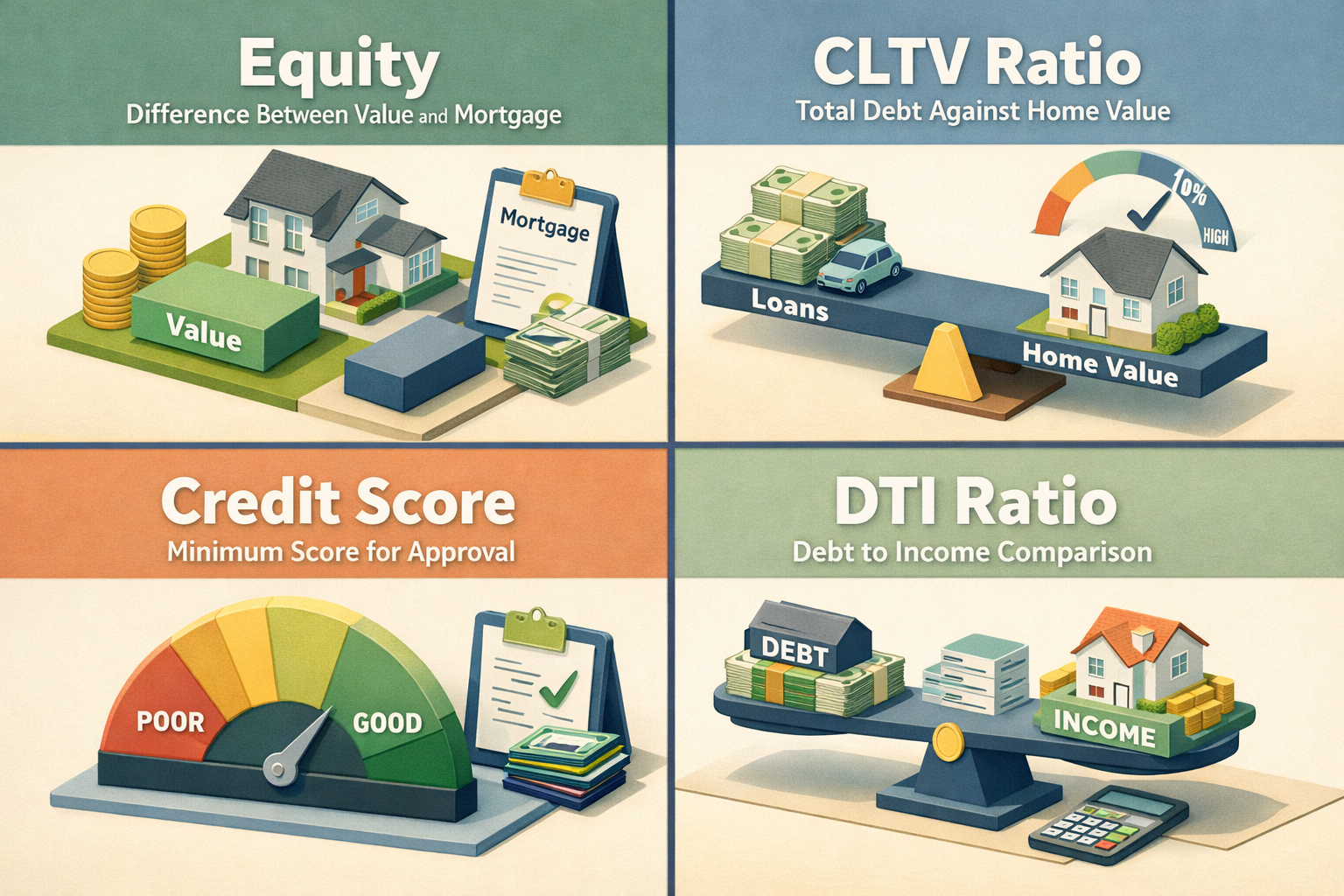
Equity is the foundation of any HELOC. It's calculated as the difference between your home's current market value and the outstanding balance on your mortgage. Lenders typically require you to maintain a certain amount of equity in the property even after the HELOC is factored in.
Most lenders set a combined loan-to-value (CLTV) ratio limit, which measures your total debt — your existing mortgage plus the new HELOC — against your home's appraised value. For a standard single-family home, lenders commonly allow a CLTV of up to 80% to 90%, though this can vary by lender and borrower profile.
For a HELOC on a property with an attached apartment, the CLTV requirements may be more conservative. If the lender classifies your home as a two-unit property, you might encounter a lower CLTV ceiling — sometimes around 75% to 80% — meaning you'd need more equity built up before qualifying.
Here's a simplified example: If your home is appraised at $500,000 and you owe $300,000 on your mortgage, you have $200,000 in equity. With a 85% CLTV limit, you could potentially access up to $125,000 through a HELOC ($500,000 x 85% = $425,000 minus the $300,000 mortgage balance). Keep in mind this is illustrative — your actual numbers will depend on your lender's specific guidelines and your home's appraisal.
Income, Credit, and Financial Eligibility Factors That Matter
Beyond equity, lenders look carefully at your financial profile. The core factors that influence HELOC approval include your credit score, debt-to-income (DTI) ratio, and income stability. Understanding these elements can help you prepare before you apply for a HELOC.
Credit Score Requirements
Most lenders prefer a credit score of at least 620 for a HELOC, though many prefer scores of 680 or higher for more competitive terms. A stronger credit score may help you access a higher credit limit and a lower interest rate. If your score needs improvement, taking time to pay down existing balances and resolve any derogatory marks could be worthwhile before applying.
Debt-to-Income Ratio
Your DTI ratio compares your monthly debt obligations to your gross monthly income. Lenders typically look for a DTI of 43% or lower, though some may allow slightly higher ratios depending on compensating factors like significant equity or strong cash reserves. If your mother-in-law suite generates rental income, some lenders may allow you to include a portion of that rental income in your qualifying income — but documentation is usually required, such as a signed lease and possibly a history of rental deposits.
Employment and Income Documentation
Expect to provide recent pay stubs, W-2 forms, or tax returns. Self-employed borrowers may need to supply two years of business and personal tax returns. If you rely on rental income from the suite, lenders may apply a vacancy factor — typically discounting the rental income by a certain percentage — to account for periods when the unit might be unoccupied.
The Appraisal Process and Its Role in Your HELOC Approval
A professional property appraisal is a standard part of the HELOC process. The appraiser determines the current market value of your home, which directly affects how much equity you can access. For properties with a mother-in-law suite, the appraisal can be more involved than a typical single-family home evaluation.
Appraisers will consider the size, condition, and functionality of the suite. If the unit adds measurable value — for instance, because it generates rental income or provides additional livable square footage — it could positively influence the appraised value. On the other hand, if the suite was built without proper permits or doesn't meet local building codes, it may not be counted toward the property's value at all, and could even raise concerns during underwriting.
This is why proper permitting matters. Homeowners who've added or renovated a mother-in-law suite should verify that all work was completed with appropriate local permits before applying for a HELOC. Unpermitted additions can complicate the appraisal and may create liability issues if the lender or future buyer discovers them later.
In some cases, lenders may order a desk appraisal or automated valuation model (AVM) for straightforward properties, but a full appraisal is more common for properties with unique features like secondary units. Be prepared for the possibility that the appraiser may value the suite more conservatively than you expect.
Navigating Lender Guidelines and Finding the Right Fit
Not every lender has the same appetite for properties with mother-in-law suites or accessory dwelling units. Some lenders are well-versed in these property types and have clear guidelines, while others may be less familiar and could apply a more cautious approach. Shopping around is genuinely important in this situation.
Here are some strategies to help you navigate the lending landscape:
- Work with a knowledgeable mortgage broker: A broker who has experience with non-standard property types can connect you with lenders who are comfortable with ADUs and secondary units.
- Ask questions upfront: Before submitting a full application, ask lenders how they classify your property and what their CLTV and income documentation requirements are for that classification.
- Gather your documentation early: Having permits, lease agreements, rental history, and tax records ready can speed up underwriting and reduce back-and-forth delays.
- Consider credit unions and community banks: These institutions sometimes offer more flexible guidelines and portfolio lending options that aren't bound by standard secondary market requirements.
- Review your state's regulations: Some states have specific rules around HELOCs and ADUs that could affect your options.
Understanding HELOC requirements for a property with a mother-in-law suite is much easier when you're working with a lender who truly understands the product. Don't hesitate to consult with multiple lenders to compare terms and find the best fit for your unique situation.
●Conclusion
Owning a home with a mother-in-law suite can be a real advantage — both as a lifestyle asset and as a financial tool. A HELOC can unlock meaningful equity to help you reach your goals, whether that's funding a major renovation, building a financial cushion, or investing in your property further. That said, understanding HELOC requirements for a property with a mother-in-law suite means recognizing that your situation may come with additional steps, from property classification to income documentation and appraisal nuances.
The good news is that with the right preparation and the right lending partner, these hurdles are manageable. Start by assessing your equity position, reviewing your credit profile, and gathering key documents. Then connect with a mortgage professional who has experience with properties that include secondary units. Taking these steps early can make the difference between a smooth approval and an unnecessary delay. At LoanWise, we're here to help you navigate every step of the process with confidence.