
Buying a home while carrying student loan debt is a challenge millions of Americans face every year. For many first-time homebuyers, the FHA loan program offers an accessible path to homeownership — but understanding the requirements for FHA loan with student loan deferment can feel confusing. The good news is that having deferred student loans doesn't automatically disqualify you. What matters most is how lenders count that debt when reviewing your financial profile. This guide breaks down exactly what you need to know so you can approach the process with confidence.
Why FHA Loans Are Popular Among Borrowers with Student Debt
The Federal Housing Administration (FHA) loan program has long been one of the most accessible mortgage options available to American homebuyers. It's especially attractive to those who are still building their credit or managing significant financial obligations like student loans. FHA loans typically allow for lower down payments — often as low as 3.5% for borrowers with qualifying credit scores — and they tend to have more flexible credit requirements compared to conventional mortgage products.
For borrowers juggling student debt, this flexibility can be a meaningful advantage. Many recent graduates and young professionals may not have had enough time to pay down their loans significantly, yet they're eager to stop renting and start building equity. The FHA program was designed with these kinds of borrowers in mind, making it a strong candidate for anyone researching home financing options while managing existing education debt.
That said, the FHA program still has clear rules around how student loan obligations — including deferred ones — are treated during the underwriting process. Understanding those rules upfront could save you from surprises later in your application.
What Student Loan Deferment Actually Means for Your Application
Student loan deferment means your lender has temporarily paused your required monthly payments, usually because you're still in school, experiencing financial hardship, or serving in the military. While deferment offers short-term payment relief, it doesn't make those loan balances disappear in the eyes of a mortgage lender.
This is a critical distinction. Just because you're not currently making payments on your student loans doesn't mean FHA underwriters will ignore them. On the contrary, FHA guidelines require lenders to account for deferred student loan debt when calculating your debt-to-income (DTI) ratio — one of the most important factors in determining whether you qualify for a mortgage.
Your DTI ratio compares your total monthly debt obligations to your gross monthly income. A lower DTI generally signals to lenders that you have enough income to handle a new mortgage payment comfortably. When deferred student loans are factored in, your DTI may rise, which could affect your approval or the loan amount you qualify for. Understanding this relationship is foundational to meeting the requirements for FHA loan with student loan deferment.
How FHA Guidelines Calculate Deferred Student Loan Payments
One of the most important aspects of FHA loan student debt rules is how the agency instructs lenders to calculate a monthly payment for deferred loans. Because there's no active payment being made, lenders can't simply pull a statement and use the current amount due. Instead, FHA guidelines provide a specific formula.
According to FHA policy, if a student loan is in deferment and the monthly payment is listed as zero on the borrower's credit report, lenders are generally required to use a calculated payment. The standard approach is to use 1% of the outstanding loan balance as the estimated monthly payment for DTI calculation purposes. For example, if you have $40,000 in deferred student loans, the lender would typically count $400 per month as a debt obligation — even if you're not currently paying a dime.
There is, however, an alternative approach. If the borrower can provide documentation from the student loan servicer showing what the actual monthly payment will be once the deferment period ends, lenders may be permitted to use that documented figure instead of the 1% calculation. This can be a significant advantage if your projected repayment amount is lower than 1% of your balance, particularly if you're enrolled in an income-driven repayment plan.
- Default method: 1% of the total outstanding deferred loan balance used as the monthly payment
- Alternative method: Fully amortized monthly payment documented by the loan servicer, if available and acceptable to the lender
It's worth noting that FHA guidelines can be updated, and individual lenders may have their own overlays — additional requirements beyond the FHA minimum standards. Always confirm the current rules with your lender or a HUD-approved housing counselor.
Core Eligibility Standards Beyond Student Debt Considerations
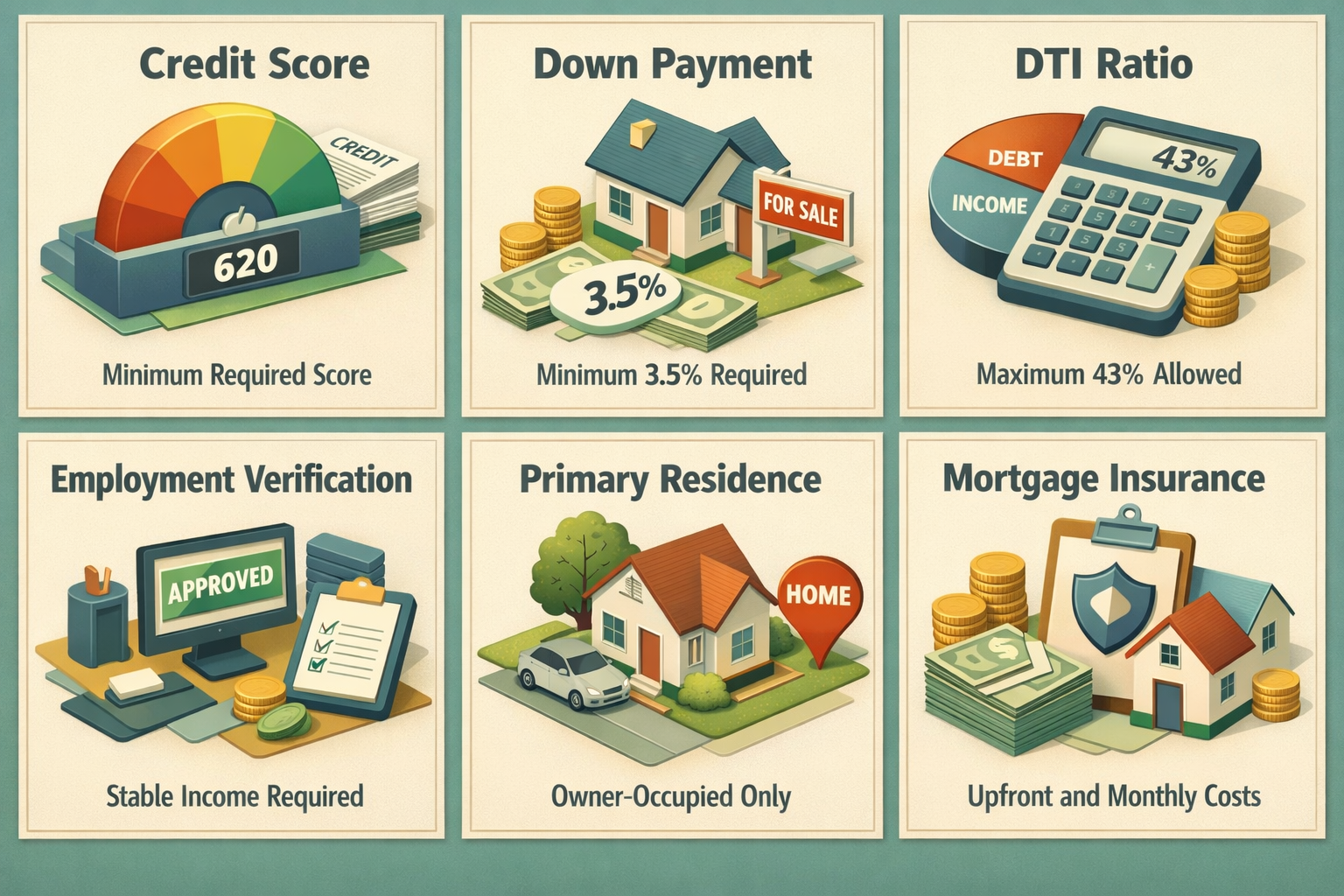
Meeting the requirements for FHA loan with student loan deferment involves more than just managing how your student debt is counted. You'll also need to satisfy the broader FHA eligibility criteria that apply to all applicants. Here's a breakdown of what lenders will typically evaluate:
- Credit Score: Most FHA lenders require a minimum credit score of 580 to qualify for the 3.5% down payment option. Borrowers with scores between 500 and 579 may still qualify but could be required to put down 10%. Individual lenders may set higher minimums through their own overlays.
- Down Payment: As noted, the minimum down payment is typically 3.5% of the purchase price for qualifying borrowers. This can sometimes be gifted by a family member, which provides additional flexibility.
- Debt-to-Income Ratio: FHA guidelines generally allow a back-end DTI of up to 43%, though some lenders may approve higher ratios with compensating factors such as strong reserves or a higher credit score. Your deferred student loans will factor into this number.
- Employment and Income Verification: Lenders will verify that you have stable, reliable income. Self-employed borrowers or those with non-traditional income may need to provide additional documentation.
- Primary Residence Requirement: FHA loans are intended for owner-occupied properties. You must plan to live in the home as your primary residence.
- Mortgage Insurance: FHA loans require both an upfront mortgage insurance premium (UFMIP) and an annual mortgage insurance premium (MIP), which is paid monthly. This is an ongoing cost to factor into your budget.
While student loan deferment is certainly an important piece of the puzzle, lenders are evaluating your overall financial picture. Strengthening other areas — like your credit score or cash reserves — can help offset the impact of a higher DTI caused by deferred loans.
Practical Strategies to Improve Your Approval Chances
If your deferred student loans are pushing your DTI ratio higher than you'd like, there are several practical steps you might take to strengthen your application before applying for an FHA loan.
Request Documentation of Your Future Repayment Amount
If you're enrolled in an income-driven repayment (IDR) plan or expect a lower payment once deferment ends, contact your student loan servicer and request a formal letter stating your projected monthly payment. Providing this documentation to your lender may allow them to use the actual projected payment rather than the 1% calculation, which could meaningfully reduce your calculated DTI.
Pay Down Other Debts First
Since your deferred student loans may be difficult to change in the short term, consider reducing other monthly debt obligations — such as credit card balances or car loan balances — to lower your overall DTI. Even a modest reduction in other debts can shift your DTI back into a more favorable range.
Increase Your Income Documentation
A higher documented income directly reduces your DTI ratio. If you've recently received a raise, taken on a second job, or have additional income sources, make sure these are well-documented and verifiable before you apply.
Build Up Reserves
While reserves don't directly reduce DTI, having several months of mortgage payments saved in a bank account can serve as a compensating factor that lenders may consider favorably — especially if your DTI is on the higher end of the acceptable range.
Work with an FHA-Approved Lender Early
Not all lenders interpret FHA guidelines the same way, and some have more experience working with borrowers who have complex financial situations. Speaking with an FHA-approved lender early in the process can help you understand your options and identify the best path forward for your specific situation.
Common Misconceptions About FHA Loans and Student Debt
There are a few widespread myths about FHA loans and student debt that are worth addressing directly, because they can discourage otherwise qualified borrowers from even applying.
Myth: Deferred Student Loans Won't Be Counted at All
Some borrowers assume that because they're not currently making payments, lenders won't factor their student loans into the application. This is generally not accurate for FHA loans. As discussed, FHA guidelines typically require lenders to calculate an estimated payment and include it in your DTI — regardless of whether you're currently in a deferment period.
Myth: You Must Pay Off All Student Debt Before Buying a Home
This is also a misconception. You don't need a zero student loan balance to qualify for a mortgage. Millions of homeowners carry student debt alongside their mortgages. What matters is whether your overall debt load — including student loans — fits within the DTI guidelines your lender uses.
Myth: FHA Loans Are Only for Low-Income Borrowers
FHA loans are open to a broad range of income levels. There's no maximum income limit to qualify. The program is income-flexible, which makes it relevant for first-time buyers, repeat buyers, and even those refinancing an existing FHA loan.
Clearing up these misconceptions is important because they can lead well-qualified borrowers to unnecessarily delay or abandon their homeownership journey.
●Conclusion
Navigating the requirements for FHA loan with student loan deferment is absolutely manageable with the right information and preparation. The key takeaway is that deferred student loans are not ignored during the mortgage process — they're factored into your DTI using a specific calculation method. However, this doesn't mean homeownership is out of reach. By understanding how lenders count your deferred debt, gathering the right documentation, and strategically strengthening your financial profile, you can position yourself for a successful FHA loan application. If you're ready to explore your options, consider speaking with an FHA-approved lender or a HUD-certified housing counselor who can provide personalized guidance based on your unique situation. Your path to homeownership may be closer than you think.