
For millions of Americans, student loan debt is a financial reality that follows them well into adulthood. If you're hoping to buy a home while still paying off your education, you may be wondering how your loans affect your mortgage options. The good news is that an FHA loan could still be within reach. Understanding the requirements for FHA loan with student loan debt is the first step toward turning your homeownership goals into reality. This guide breaks down everything you need to know — from how lenders count your student debt to practical strategies that could strengthen your application.
What Is an FHA Loan and Why Does It Appeal to Borrowers with Student Debt
An FHA loan is a government-backed mortgage insured by the Federal Housing Administration. Because the federal government reduces the lender's risk, FHA loans typically come with more flexible qualifying standards than conventional mortgages. That flexibility makes them especially attractive to first-time homebuyers, younger borrowers, and anyone managing existing debt obligations — including student loans.
FHA loans are known for allowing lower credit scores and smaller down payments. Borrowers may qualify with a credit score as low as 580 with a 3.5% down payment, or potentially as low as 500 with a 10% down payment, depending on the lender. These thresholds can be helpful for recent graduates who haven't yet had years to build a deep credit history.
That said, having student loan debt doesn't automatically disqualify you from FHA financing. What matters most is how that debt fits into the bigger picture of your financial profile — particularly your debt-to-income ratio.
How Student Loans Factor Into Your FHA Loan DTI
One of the most critical factors in FHA loan DTI student loans calculations is how lenders count your monthly student loan obligation. The debt-to-income ratio, or DTI, compares your total monthly debt payments to your gross monthly income. FHA guidelines generally allow a back-end DTI of up to 43%, though some lenders may approve borrowers with higher ratios under certain compensating factors.
The challenge with student loans is that not every borrower is actively repaying them at the standard rate. Some are on income-driven repayment plans with very low monthly payments, while others may have loans in deferment or forbearance. How the lender handles these scenarios can significantly affect your qualifying DTI.
Deferred Student Loans
If your student loans are currently deferred, FHA guidelines have historically required lenders to include a projected payment in your DTI calculation — even if you're not making payments right now. Lenders may use 1% of the outstanding loan balance as the assumed monthly payment if no documented payment amount is available. For example, if you owe $40,000 in student loans and the loans are deferred, the lender might count $400 per month toward your DTI.
Income-Driven Repayment Plans
If you're enrolled in an income-driven repayment (IDR) plan, your actual documented monthly payment may be used in the DTI calculation — even if that payment is very low or even $0. However, lender policies can vary, and some lenders may still apply a minimum percentage of the balance. It's worth verifying this directly with your loan officer before you apply.
Core Requirements for FHA Loan with Student Loan Debt
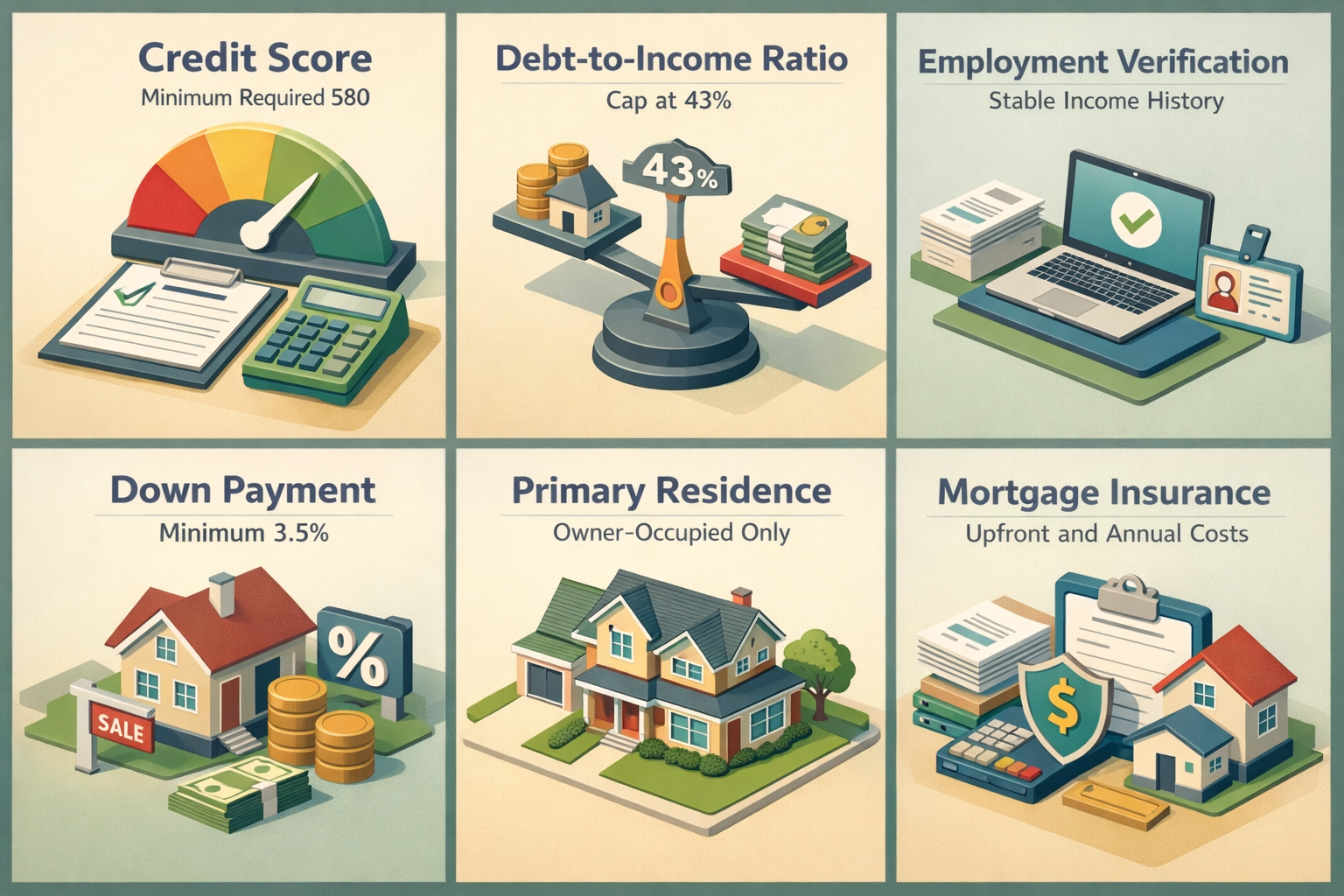
Beyond the DTI calculation, there are several foundational requirements for FHA loan with student loan debt that every applicant should understand. Meeting these benchmarks won't guarantee approval, but falling short of any one of them could create obstacles worth addressing ahead of time.
- Credit Score: A minimum credit score of 580 is typically required for the standard 3.5% down payment option. Borrowers with scores between 500 and 579 may still qualify but would need a larger down payment of at least 10%.
- Debt-to-Income Ratio: As mentioned, FHA guidelines generally cap the back-end DTI at 43%, though lenders may consider higher ratios when strong compensating factors are present, such as significant cash reserves or a low loan-to-value ratio.
- Employment and Income Verification: Lenders will want to verify stable employment, typically spanning at least two years. Consistent income history helps demonstrate the ability to repay the mortgage alongside existing student debt.
- Down Payment: A minimum down payment of 3.5% of the purchase price is required for borrowers with credit scores at or above 580. This can come from personal savings, gifts from family members, or certain down payment assistance programs.
- Primary Residence Requirement: FHA loans are intended for owner-occupied properties. You must intend to live in the home as your primary residence.
- FHA Mortgage Insurance Premiums: All FHA borrowers pay an upfront mortgage insurance premium (MIP) as well as an annual MIP, which is typically paid monthly. This cost should be factored into your overall affordability picture.
Qualifying for FHA with Student Debt When Your DTI Is a Challenge
When your student loan payments push your DTI toward or above the guideline threshold, qualifying for FHA with student debt becomes more nuanced. But there are several approaches that could help you navigate this situation more effectively.
Pay Down Other Debts First
If you carry credit card balances, auto loans, or personal loans in addition to your student debt, reducing or eliminating those obligations before applying could meaningfully lower your DTI. Even paying off one smaller account may create enough breathing room to fall within acceptable limits.
Increase Your Income
Taking on a part-time job, freelance work, or a side income that can be documented consistently may help raise your gross monthly income and lower your DTI percentage. Keep in mind that lenders typically want to see income sources that are stable and likely to continue.
Choose a Less Expensive Property
A lower purchase price means a smaller monthly mortgage payment, which keeps your total monthly obligations more manageable. Shopping strategically in your price range could make the difference between qualifying and being declined.
Lean on Compensating Factors
FHA guidelines allow lenders to consider compensating factors when a borrower's DTI exceeds the standard threshold. These might include substantial cash reserves after closing, a strong history of making on-time payments, or a large down payment. Presenting a complete and well-documented financial picture to your lender can work in your favor.
How Student Loan Repayment Plans Shape Your FHA Eligibility
The type of student loan repayment plan you're on can have a significant effect on your FHA application. Understanding this connection is an important part of managing the student loan impact on FHA approval.
Borrowers on standard 10-year repayment plans will have a clearly defined monthly payment that lenders can easily incorporate into the DTI calculation. This predictability can actually make the underwriting process smoother, even if the payment itself is higher.
For borrowers on income-driven repayment plans — such as SAVE, PAYE, or IBR — the monthly payment may be significantly lower than it would be on a standard plan. FHA guidelines have evolved over time regarding how these payments are treated, and the current guidance generally allows lenders to use the documented IDR payment amount in the DTI calculation. However, each lender may apply its own overlay policies, so it's smart to ask your loan officer specifically how they handle IDR payments.
If your loans are in deferment or forbearance, consider reaching out to your loan servicer to understand what your payment would look like under an IDR plan. In some cases, switching to an IDR plan with a documented low payment before applying could result in a more favorable FHA loan DTI student loans calculation than the assumed percentage-of-balance method used for deferred loans.
Practical Strategies for Managing Student Loans Before Applying for an FHA Mortgage
Preparation is one of the most powerful tools available to any homebuyer carrying student debt. The following strategies focus on managing student loans for FHA mortgage qualification and could meaningfully improve your chances of approval.
- Review your credit report: Obtain a free copy of your credit report from each of the three major bureaus. Look for any errors, especially related to student loan accounts that may be showing incorrect balances or payment statuses. Dispute inaccuracies before you apply.
- Get on an income-driven repayment plan: If your loans are deferred or on a standard plan with high monthly payments, exploring an IDR option may reduce your documented monthly obligation and improve your DTI.
- Avoid opening new credit accounts: New credit inquiries and new debt obligations can temporarily lower your credit score and raise your DTI. In the months leading up to your mortgage application, it's generally wise to hold off on new credit cards or auto loans.
- Build up your savings: Having cash reserves after your down payment and closing costs demonstrates financial resilience. Lenders view this favorably as a compensating factor.
- Work with an FHA-approved lender early: Getting pre-qualified before you begin shopping for homes gives you a clearer picture of what you can realistically afford. It also gives you time to address any qualifying issues before they become deal-breakers.
Finding the Right Lender When You Have Student Loan Debt
Not all FHA lenders interpret guidelines the same way. Many lenders apply additional internal requirements — often called lender overlays — that go beyond the minimum FHA standards. This means that one lender might decline your application while another approves it based on the same financial profile.
When shopping for a lender, it pays to ask direct questions about how they handle student loan debt in their DTI calculations. Some lenders are more experienced working with borrowers who have significant student debt and may be better equipped to find solutions. Others may apply stricter overlays that make qualification harder.
Working with a mortgage broker or loan officer who specializes in FHA financing could give you access to a wider range of lenders and more nuanced guidance. Be transparent about your full financial picture — including your student loan balances, repayment plan, and monthly payment — so your loan officer can accurately assess your options from the start.
It's also worth exploring whether you qualify for any first-time homebuyer assistance programs in your state. Many states offer down payment assistance or even programs designed to help borrowers with student debt bridge the gap to homeownership. These resources, when combined with an FHA loan, could make buying a home a realistic near-term goal rather than a distant aspiration.
●Conclusion
Carrying student debt doesn't have to put homeownership out of reach. By understanding the requirements for FHA loan with student loan debt, knowing how your repayment plan affects your DTI, and taking strategic steps to strengthen your application, you may be in a much stronger position than you realize. FHA loans were designed with accessible guidelines for a reason — to help more Americans achieve the dream of owning a home. If you're ready to take the next step, connecting with an experienced FHA-approved lender at LoanWise could help you map a clear path from where you are today to the front door of your new home.