
Buying a home when you're carrying student loan debt and a less-than-perfect credit score isn't impossible — especially with an FHA loan. These government-backed mortgages are designed to help borrowers who might not qualify for conventional financing. But when you add a co-borrower to the mix, the requirements can get a bit more layered. Understanding the requirements for FHA loan with co-borrower student loan debt and low credit is an essential first step before you start house hunting. This guide walks you through what lenders typically look for, how student loan debt is calculated, and what role a co-borrower plays in your approval odds.
What Is an FHA Loan and Who Typically Qualifies
An FHA loan is a mortgage insured by the Federal Housing Administration. Because the government backs these loans, lenders are generally more willing to work with borrowers who have lower credit scores or limited down payment savings. This makes FHA loans particularly popular among first-time homebuyers, recent graduates managing student debt, and anyone rebuilding their financial standing.
FHA loans typically allow a minimum credit score of 580 with a 3.5% down payment. If your score falls between 500 and 579, you may still qualify, but a 10% down payment is usually required. Borrowers with scores below 500 are generally not eligible under standard FHA guidelines. These thresholds make FHA one of the more accessible mortgage programs available for people with low credit.
It's worth noting that while the FHA sets baseline guidelines, individual lenders may apply what's known as "lender overlays" — stricter internal requirements on top of FHA's minimums. This means one lender might require a 620 credit score even though FHA only requires 580. Shopping around can make a meaningful difference in your approval outcome.
Understanding FHA Co-Borrower Requirements and How They Help
Adding a co-borrower to an FHA loan application can strengthen your file — but it's important to understand exactly how the arrangement works. A co-borrower (sometimes called a co-applicant) is someone who shares equal responsibility for repaying the loan. Their income, credit history, and debts are all factored into the application alongside yours.
FHA loans allow non-occupant co-borrowers, meaning the co-borrower doesn't have to live in the home. This is often how parents help adult children purchase their first property. The co-borrower must be a U.S. citizen or have eligible immigration status, and they must have a valid Social Security number.
When a co-borrower is added, lenders typically look at the lower middle credit score between all borrowers when determining eligibility and pricing. So if your co-borrower has excellent credit but your score is 580, the lender may base the loan decision largely on your score. This is an important nuance — a co-borrower doesn't automatically erase your low credit standing in FHA underwriting.
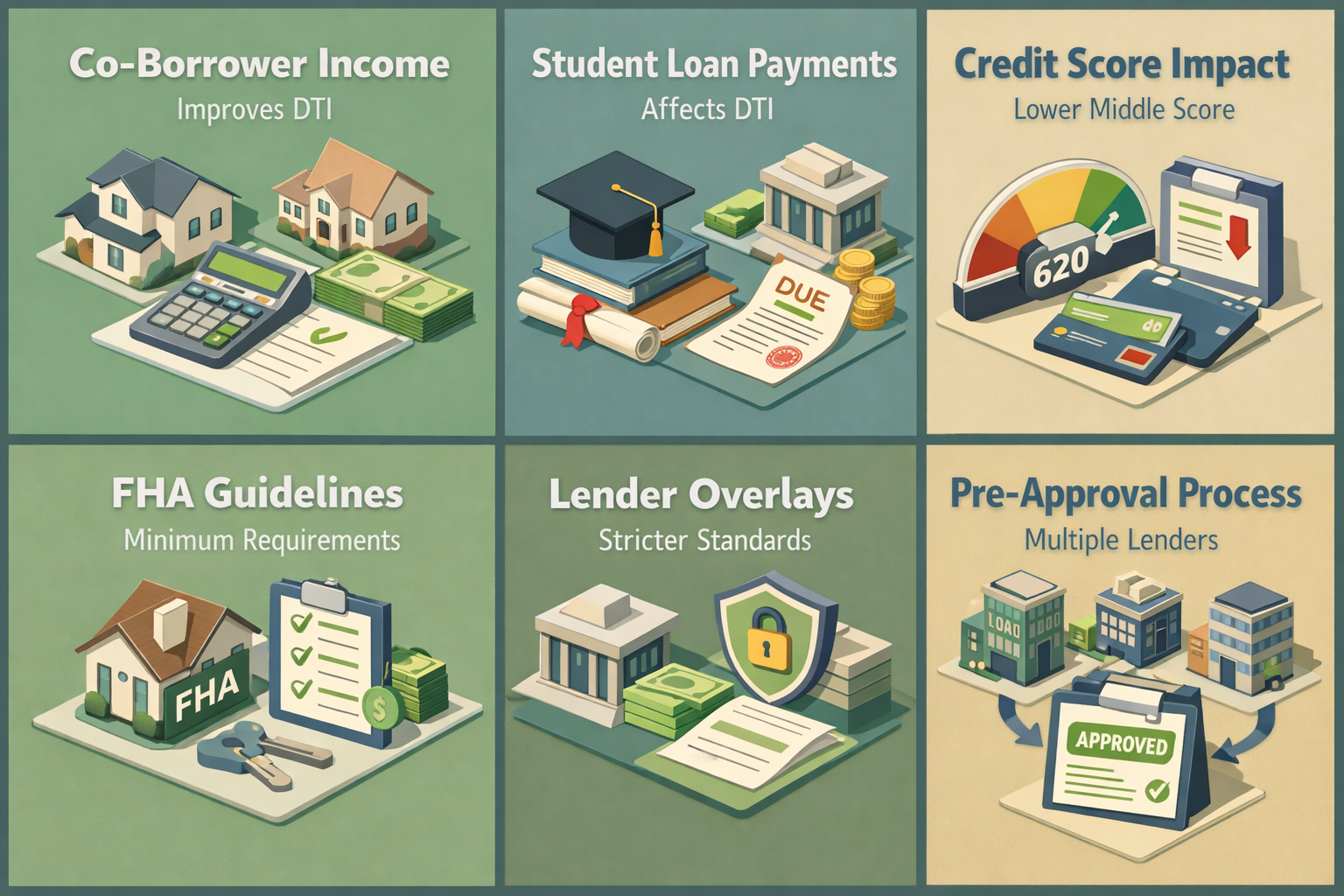
However, a co-borrower's income can significantly improve your debt-to-income ratio (DTI), which is one of the most critical factors in FHA approval. If you have substantial student loan payments weighing down your DTI, a co-borrower with stable income could make the difference between a denial and an approval.
Co-Borrower vs. Co-Signer: Know the Difference
Many homebuyers confuse co-borrowers with co-signers. While both arrangements involve a second person supporting your application, they're not the same. FHA loan co-signer requirements differ from co-borrower arrangements — a co-signer typically doesn't share ownership rights to the property, while a co-borrower is on the title and shares both ownership and repayment responsibility. FHA guidelines more commonly reference non-occupant co-borrowers rather than traditional co-signers, so it's important to clarify the structure with your lender upfront.
How Student Loan Debt Affects Your FHA Loan Application
Student loan debt is one of the most common challenges that younger homebuyers face when applying for a mortgage. The way lenders calculate your student loan payments for DTI purposes has evolved over the years, and understanding these rules is critical when reviewing the requirements for FHA loan with co-borrower student loan debt and low credit.
Under current FHA guidelines, if your student loans are in repayment, lenders must use the actual monthly payment shown on your credit report. If your loans are deferred or in forbearance, FHA guidelines generally require lenders to use either the documented payment amount or 0.5% of the outstanding loan balance — whichever is greater — as a hypothetical monthly payment. This rule exists to ensure lenders account for future repayment obligations even when payments aren't currently active.
For example, if you have $60,000 in federal student loans in deferment, the lender may factor in a monthly payment of approximately $300 (0.5% of $60,000) for DTI calculations. That $300 could meaningfully affect your debt-to-income ratio, potentially pushing you above FHA's preferred DTI threshold.
DTI Limits and Why They Matter for Student Loan Borrowers
FHA guidelines typically allow a maximum DTI of 43%, though some lenders may approve borrowers with DTIs up to 50% or slightly higher when compensating factors are present — such as significant cash reserves or a co-borrower with strong income. If student loan debt on an FHA loan is inflating your DTI beyond acceptable limits, a co-borrower's income could serve as the compensating factor that keeps your application viable.
It's also worth asking your lender whether income-driven repayment (IDR) plan documentation might be accepted in place of the 0.5% calculation. Policies on this can vary by lender, so it's worth the conversation.
Navigating Low Credit Scores on an FHA Application
A low credit FHA loan is achievable, but it requires careful preparation. Credit scores in the 580–619 range may still qualify, but lenders often scrutinize the entire credit profile more closely. Late payments, collections, and high credit utilization can all raise red flags even if the score itself meets the minimum threshold.
Here are some steps that may help improve your credit standing before applying:
- Pay down revolving balances: Reducing credit card utilization below 30% can have a relatively quick positive impact on your score.
- Dispute inaccuracies: Review all three credit bureau reports and formally dispute any errors that may be dragging your score down.
- Avoid new credit inquiries: Applying for new credit cards or loans shortly before your mortgage application can temporarily lower your score.
- Keep accounts open: Closing old accounts can reduce your available credit and shorten your credit history, both of which can hurt your score.
- Make on-time payments consistently: Payment history is typically the largest factor in credit scoring models, so every on-time payment helps rebuild your profile.
If your score is below 580 today, a short period of intentional credit improvement — even six to twelve months — could move you into qualifying territory. Speaking with a HUD-approved housing counselor may also provide personalized guidance at no cost.
Key Financial Documents You and Your Co-Borrower Will Need
Getting organized before you apply can save significant time and reduce stress during underwriting. Both the primary borrower and the co-borrower will typically need to provide a comprehensive set of financial documents. Here's what to expect:
- Two years of federal tax returns and W-2s or 1099s for all borrowers
- Recent pay stubs (typically the last 30 days) for each employed borrower
- Bank statements from the past two to three months to verify assets and down payment funds
- Student loan statements showing current balance and payment status, including any deferment or income-driven repayment documentation
- Photo ID and Social Security numbers for all borrowers
- Rental history or mortgage statements if applicable, to demonstrate housing payment reliability
- Gift letter if any portion of the down payment is being gifted, which FHA allows
Lenders will verify all of this information independently through third-party checks. Having clean, well-organized documentation can help your file move through underwriting more efficiently and reduce the chance of last-minute surprises.
FHA Mortgage Insurance and What It Means for Your Monthly Budget
One important trade-off with FHA loans is mortgage insurance. Because FHA loans are available to higher-risk borrowers, the program requires two forms of mortgage insurance: an upfront mortgage insurance premium (UFMIP) and an annual mortgage insurance premium (MIP) paid monthly.
The UFMIP is typically 1.75% of the loan amount and is usually rolled into the loan balance. The annual MIP varies based on loan term, loan-to-value ratio, and loan amount, but it commonly ranges from 0.55% to 1.05% per year. For a borrower with a $250,000 loan, this could mean an additional $115 to $219 per month added to the base mortgage payment.
Unlike private mortgage insurance on conventional loans, FHA MIP doesn't automatically cancel when you reach 20% equity — for most borrowers, it remains for the life of the loan. This is an important consideration when evaluating total cost of homeownership over time. Once you've built equity and improved your credit, refinancing into a conventional loan could eventually eliminate the MIP obligation.
Tips for Strengthening Your FHA Application as a Team
When you're applying with a co-borrower, think of the process as a team effort. The goal is to present the strongest possible combined financial picture to the lender. Here are some practical strategies:
- Let the co-borrower's income lead: If your co-borrower has higher, more stable income, make sure their employment history and income documentation are thorough and well-organized.
- Address student loan status early: If your loans are in deferment, gather documentation from your servicer showing the IDR payment amount, which may be lower than the 0.5% calculation and could reduce your effective DTI.
- Work on your credit score proactively: Even a 20–30 point improvement can shift you into a better pricing tier and reduce lender overlays that might otherwise block approval.
- Save more than the minimum down payment: Having additional reserves after closing is a compensating factor that lenders appreciate, especially when credit or debt levels are a concern.
- Get pre-approved with multiple lenders: Since lender overlays vary widely, one lender's denial doesn't mean all lenders will say no. Comparing options is especially important when you're dealing with the full combination of challenges covered in the requirements for FHA loan with co-borrower student loan debt and low credit.
Working with a mortgage professional who has specific experience with FHA lending and student loan cases can also be genuinely valuable. They can help you structure the application in a way that highlights your strengths and addresses potential concerns before underwriting begins.
●Conclusion
Qualifying for an FHA loan when you're managing student loan debt and a lower credit score is genuinely within reach — especially when you bring a co-borrower into the process thoughtfully. The key is understanding how lenders evaluate each piece of your financial profile and taking deliberate steps to present the strongest possible application. Whether it's reducing your DTI with a co-borrower's income, documenting your income-driven repayment plan, or spending a few months improving your credit score, every action adds up. At LoanWise, we're here to help you navigate these decisions with clarity and confidence. Ready to explore your FHA loan options? Connect with one of our lending specialists today and take the first step toward homeownership.