
Buying a home while carrying student loan debt is a reality for millions of Americans today. When a co-borrower enters the picture, the process can feel even more complex. Understanding the requirements for FHA loan with co-borrower student loan debt is essential for anyone hoping to use this government-backed program to achieve homeownership. FHA loans are known for their flexible credit standards and lower down payment options, making them a popular choice for first-time homebuyers and those with less-than-perfect financial profiles. But when student loans are part of the equation — especially on a co-borrower's credit report — lenders have specific guidelines that must be followed. This article walks you through everything you need to know, from debt-to-income calculations to credit score thresholds, so you can approach the process with confidence.
What Is an FHA Loan and Why Do Co-Borrowers Matter
An FHA loan is a mortgage insured by the Federal Housing Administration, a division of the U.S. Department of Housing and Urban Development (HUD). Because the federal government backs these loans, lenders are often willing to offer them to borrowers with lower credit scores or smaller down payments than conventional mortgages typically require.
A co-borrower — sometimes called a co-applicant — is someone who applies for the mortgage alongside the primary borrower. Unlike a co-signer who only guarantees the loan, a co-borrower shares both the responsibility of repayment and an ownership interest in the property. This distinction matters significantly when it comes to how their financial obligations, including student loans, are evaluated during underwriting.
Co-borrowers are often added to strengthen an application. A primary borrower may have a strong income but a thin credit history, while the co-borrower brings a longer credit track record. However, adding a co-borrower also means their debts — including any outstanding student loans — become part of the overall financial picture the lender must assess.
How FHA Guidelines Handle Student Loan Debt in DTI Calculations
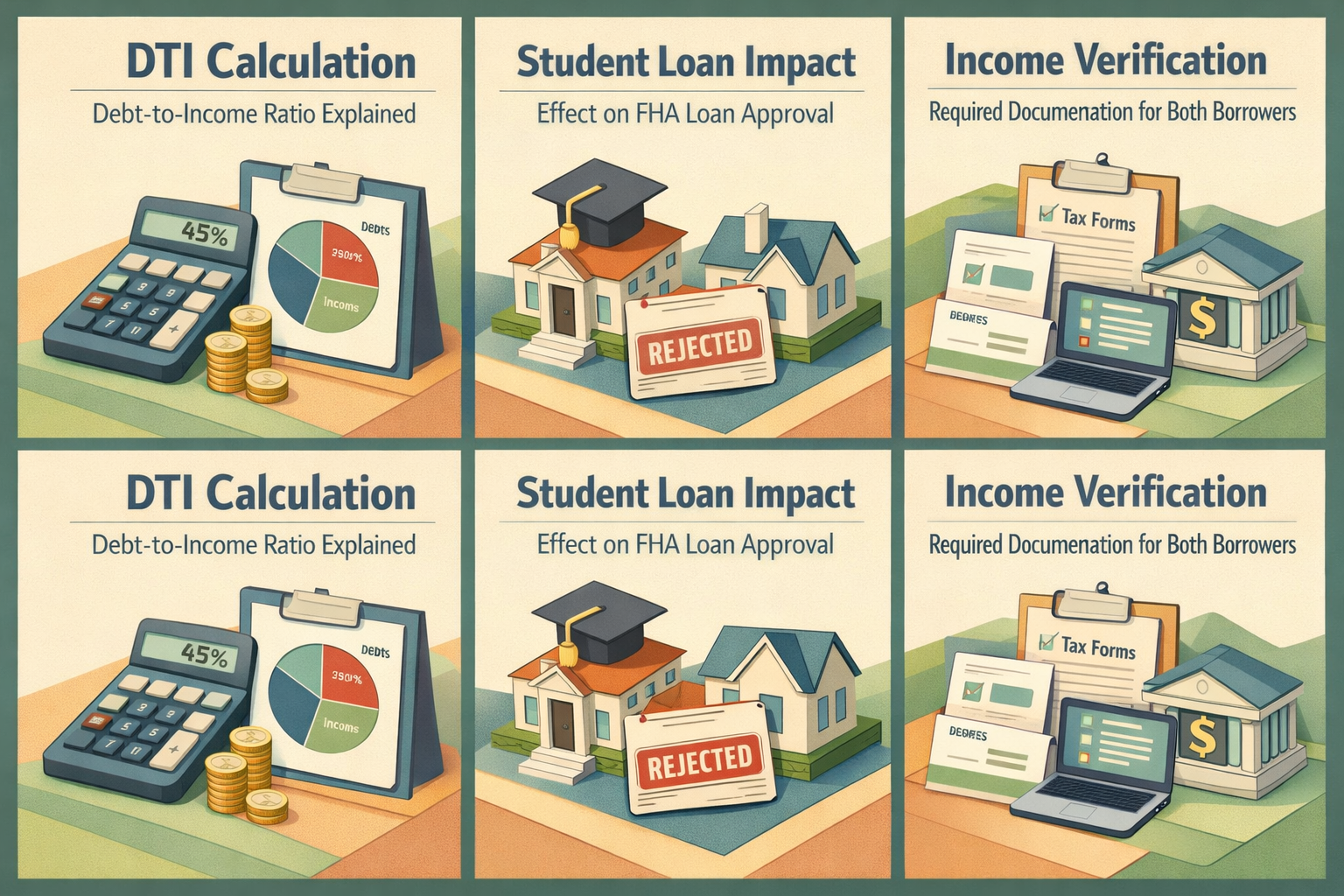
One of the most critical factors in any mortgage application is the debt-to-income ratio (DTI). This figure compares a borrower's total monthly debt obligations to their gross monthly income. FHA guidelines generally allow a maximum DTI of around 43%, though some lenders may approve borrowers with higher ratios under certain compensating factors.
When student loans are involved, FHA has specific rules about how those monthly payments must be counted. According to HUD guidelines, if a borrower's student loans are in deferment or forbearance, lenders are typically still required to count a payment toward the debt-to-income ratio calculation. In many cases, lenders use 1% of the outstanding loan balance as the assumed monthly payment if no payment is currently being made or if the actual payment cannot be documented.
This rule applies to both the primary borrower and the co-borrower. So if your co-borrower has $60,000 in student loan debt that is currently deferred, the lender may factor in $600 per month as part of the combined DTI — even if no payments are actively being made. This can significantly affect how much home the pair can qualify for.
If the co-borrower is on an income-driven repayment (IDR) plan and can provide documentation of their actual monthly payment, some lenders may be permitted to use that documented amount instead, which could be considerably lower. It's worth discussing this option with your loan officer early in the process.
Credit Score Requirements When a Co-Borrower Has Student Loans
FHA loans are relatively accessible from a credit standpoint. Borrowers may qualify with a credit score as low as 580 for the standard 3.5% down payment option. Those with scores between 500 and 579 may still be eligible but would typically need to bring a 10% down payment to the table.
When a co-borrower is added to the application, lenders typically look at the lowest middle credit score among all borrowers on the loan. This means that even if the primary borrower has an excellent score, a co-borrower with a lower score due to their student loan history — perhaps from a period of missed payments — could bring down the qualifying score used for the loan.
Student loans that have gone into default or have a history of late payments can significantly damage a co-borrower's credit profile. Before applying, it may be worth reviewing the co-borrower's credit report carefully to identify any derogatory marks related to student debt. Addressing these issues proactively — through rehabilitation programs or payment plans — could improve the co-borrower's score over time.
It's also worth noting that FHA guidelines require borrowers to be clear of any federal debt delinquencies. If a co-borrower has a defaulted federal student loan, this could disqualify the entire application until the default is resolved.
Income Verification and Employment Standards for Both Applicants
To meet the requirements for FHA loan with co-borrower student loan debt, both applicants must demonstrate stable, verifiable income. Lenders will typically request recent pay stubs, W-2 forms from the past two years, and federal tax returns. Self-employed co-borrowers may need to provide additional documentation such as profit and loss statements.
The purpose of income verification is twofold: it confirms the ability to repay the loan, and it provides the baseline for DTI calculations. A co-borrower with significant student loan obligations but a strong, steady income can often offset the DTI impact of those debts, making the combined application more competitive.
Employment history also plays a role. FHA guidelines generally look for at least two years of consistent employment or a stable trajectory in a given field. A co-borrower who recently graduated and started a new job in their field of study might still meet this standard, even with limited work history, if their income and employment situation appear sustainable.
The Role of an FHA Loan Co-Signer vs. Co-Borrower With Student Loans
It's common for borrowers to confuse the terms co-signer and co-borrower, but the distinction has real implications under FHA guidelines. An FHA loan co-signer with student loans guarantees repayment but does not hold an ownership interest in the property. A co-borrower, on the other hand, is both a financial co-applicant and a co-owner of the home.
Under FHA rules, a non-occupying co-borrower is allowed — meaning someone can co-sign the loan without living in the home. This arrangement is commonly used by parents helping adult children purchase their first home. However, even a non-occupying co-borrower's debts, including student loans, are factored into the DTI and credit analysis.
If the non-occupying co-borrower carries heavy student loan obligations, this could limit how much the primary borrower can qualify for. In some situations, it may be worth evaluating whether the co-borrower's income benefit outweighs the DTI burden their student debt introduces. Speaking with an experienced mortgage professional can help you model different scenarios before committing to a specific application structure.
Strategies to Strengthen Your FHA Application When Student Debt Is Involved
There are several practical steps that homebuyers and co-borrowers can take to improve their chances of FHA loan approval, even when student debt is a factor.
- Document your repayment plan: If the co-borrower is enrolled in an income-driven repayment program, gather official documentation of the monthly payment amount. Using the actual IDR payment rather than 1% of the balance could meaningfully reduce the calculated DTI.
- Pay down other debts: Reducing balances on credit cards, auto loans, or personal loans can lower the overall DTI even if the student loan balance remains unchanged.
- Boost income sources: Part-time work, freelance income, or rental income — if properly documented — may be counted toward qualifying income, helping offset the student loan burden in DTI calculations.
- Resolve any federal loan defaults: Defaulted federal student loans must be addressed before an FHA loan can close. Enrolling in a loan rehabilitation program or consolidating through an eligible plan may restore borrower eligibility.
- Improve credit scores proactively: Both borrowers should monitor their credit, dispute any inaccuracies, and avoid opening new lines of credit before and during the application process.
- Work with an FHA-approved lender: Not all lenders interpret FHA guidelines the same way. Some may have more flexible overlays or additional products that accommodate borrowers with student loan debt more effectively.
Taking these steps won't guarantee approval, but they can meaningfully improve the strength of your combined application and demonstrate financial responsibility to underwriters.
What to Expect During the Underwriting Process
Once you submit an FHA loan application with a co-borrower, an underwriter will review the complete financial profile of both parties. This includes credit reports, income documentation, asset statements, and a detailed breakdown of all monthly debts — with student loans receiving particular attention.
The underwriter will verify that the DTI falls within acceptable limits, that credit scores meet the minimum threshold, and that no outstanding federal delinquencies exist. If the co-borrower's student loan information raises questions, the underwriter may issue a condition — a request for additional documentation before the loan can move forward.
Common conditions related to student loans might include a letter from the loan servicer confirming repayment status, a copy of the income-driven repayment agreement, or evidence that a previous default has been resolved. Responding to these conditions promptly and thoroughly can help keep the process on track.
It's also worth noting that FHA loans require both an appraisal and a home inspection to ensure the property meets HUD's minimum property standards. These steps happen in parallel with underwriting, so staying organized and responsive throughout the process is key to a smooth closing experience.
●Conclusion
Meeting the requirements for FHA loan with co-borrower student loan debt requires careful preparation from both applicants. Student loans don't have to be a deal-breaker — but they do need to be managed thoughtfully within the context of FHA's underwriting guidelines. From understanding how deferred loans affect your DTI to ensuring your co-borrower's credit is in good standing, each detail plays a role in the outcome of your application. If you're exploring this path to homeownership, partnering with a knowledgeable FHA-approved lender can make a meaningful difference. At LoanWise, our lending specialists are here to help you navigate every step of the process with clarity and confidence. Reach out today to explore your options and take the next step toward owning your home.