
Losing a home to foreclosure is one of the most financially difficult experiences a person can go through. Add ongoing student loan debt to the picture, and the path back to homeownership can feel overwhelming. But here's the encouraging news: the FHA loan program was specifically designed to give borrowers a second chance. Understanding the requirements for FHA loan with a recent foreclosure and ongoing student debt can help you plan your financial recovery with confidence and clarity. Whether you're a first-time buyer who hit a rough patch or a returning homeowner working to rebuild, this guide walks you through what matters most.
How the FHA Loan Program Supports Borrowers After Financial Hardship
The Federal Housing Administration insures FHA loans, which means approved lenders take on less risk when lending to borrowers with imperfect credit histories. This government backing is precisely why FHA loans tend to be more accessible than conventional mortgages for people who've experienced foreclosure, bankruptcy, or other financial setbacks.
FHA loans are known for their relatively low down payment requirements and more flexible credit standards. Borrowers with credit scores as low as 580 may qualify for a 3.5% down payment, while those with scores between 500 and 579 may still be eligible with a 10% down payment. These thresholds are notably more forgiving than what many conventional loan programs require.
That said, lenders who offer FHA-insured mortgages still apply their own overlays — meaning individual banks or mortgage companies may set stricter standards on top of the FHA's minimum guidelines. This is an important nuance to keep in mind as you shop for the right lender after a foreclosure.
The FHA Waiting Period After Foreclosure Explained
One of the first things borrowers ask about when pursuing an FHA loan after foreclosure is how long they must wait. According to FHA guidelines, the standard waiting period is three years from the date the foreclosure was completed — not the date you stopped making payments or the date the lender initiated proceedings.
This three-year clock begins when the title of the home is officially transferred out of your name, which typically aligns with the date the foreclosure sale is recorded. It's worth confirming this date with your previous lender or county records to ensure your timeline is accurate.
There is, however, an important exception to the standard waiting period. If the foreclosure resulted from documented extenuating circumstances — such as a serious illness, the death of a primary wage earner, or a significant reduction in income beyond the borrower's control — the FHA may allow a reduced waiting period of as little as one year. To qualify for this exception, borrowers must demonstrate that the hardship was truly beyond their control and that they've since reestablished responsible credit behavior.
It's also worth noting that if the foreclosed property was included in a bankruptcy filing, additional rules may apply. Lenders will typically calculate waiting periods from whichever event — the bankruptcy discharge or the foreclosure completion — occurred later.
Credit Rebuilding Steps That Matter Most Before Reapplying
Waiting out the mandatory period is only part of the equation. Lenders evaluating a post-foreclosure FHA application will scrutinize your credit behavior during the time since the foreclosure. Building a strong credit history in the years leading up to your new application can make a significant difference in both your approval odds and the interest rate you're offered.
Here are some of the most effective ways to rebuild credit during the waiting period:
- Open a secured credit card: A secured card requires a cash deposit as collateral and is one of the most accessible tools for rebuilding credit. Using it responsibly — keeping balances low and paying on time every month — can gradually lift your score.
- Avoid new negative marks: Late payments, collections, and charge-offs after a foreclosure can signal continued financial instability to lenders and may extend how long it takes to qualify.
- Diversify your credit mix: Having a mix of installment accounts (like a car loan) and revolving credit (like a credit card) may help demonstrate responsible credit management across different types of debt.
- Monitor your credit reports: Errors on credit reports are not uncommon. Checking your reports from all three major bureaus and disputing inaccuracies can help ensure your score reflects your true credit behavior.
- Keep credit utilization low: Lenders often look favorably on borrowers who use less than 30% of their available revolving credit at any given time.
Most FHA-approved lenders will want to see at least 12 months of clean payment history before approving a post-foreclosure application, and some may prefer 24 months of positive credit activity.
Qualifying for FHA With Student Loans: How Your Debt Is Calculated
For borrowers managing student debt alongside a foreclosure history, qualifying for FHA with student loans requires a careful look at how the FHA counts that debt in your overall financial picture. Student loans can have a meaningful impact on your debt-to-income (DTI) ratio, which is one of the most critical factors lenders evaluate.
The FHA's current guidelines address student loan debt in a specific way. Even if your student loans are in deferment or on an income-driven repayment plan with a very low monthly payment, lenders are typically required to count either the actual monthly payment shown on your credit report or a calculated percentage of the outstanding loan balance — whichever is greater. Historically, FHA required lenders to use 1% of the total outstanding student loan balance as the assumed monthly payment if no payment was listed. However, FHA policy in recent years has been updated to allow lenders to use the actual documented payment if it's greater than zero and reflected in the credit report.
This distinction matters greatly. If you owe $40,000 in student loans but your income-driven repayment plan has you paying $150 per month, your lender may be able to use that $150 figure rather than a larger calculated amount — potentially improving your DTI ratio and strengthening your application.
To make the most of this, keep these points in mind:
- Document your repayment plan: Provide official statements or servicer correspondence showing your current required monthly payment.
- Understand your DTI ceiling: FHA guidelines generally allow a back-end DTI ratio of up to 43%, though some lenders may approve higher ratios with compensating factors such as strong reserves or a higher credit score.
- Consider loan consolidation or refinancing: In some cases, consolidating federal student loans or refinancing to a lower monthly payment may improve your DTI, though refinancing federal loans into private loans may affect repayment protections.
Meeting the Full Requirements for FHA Loan With a Recent Foreclosure and Ongoing Student Debt
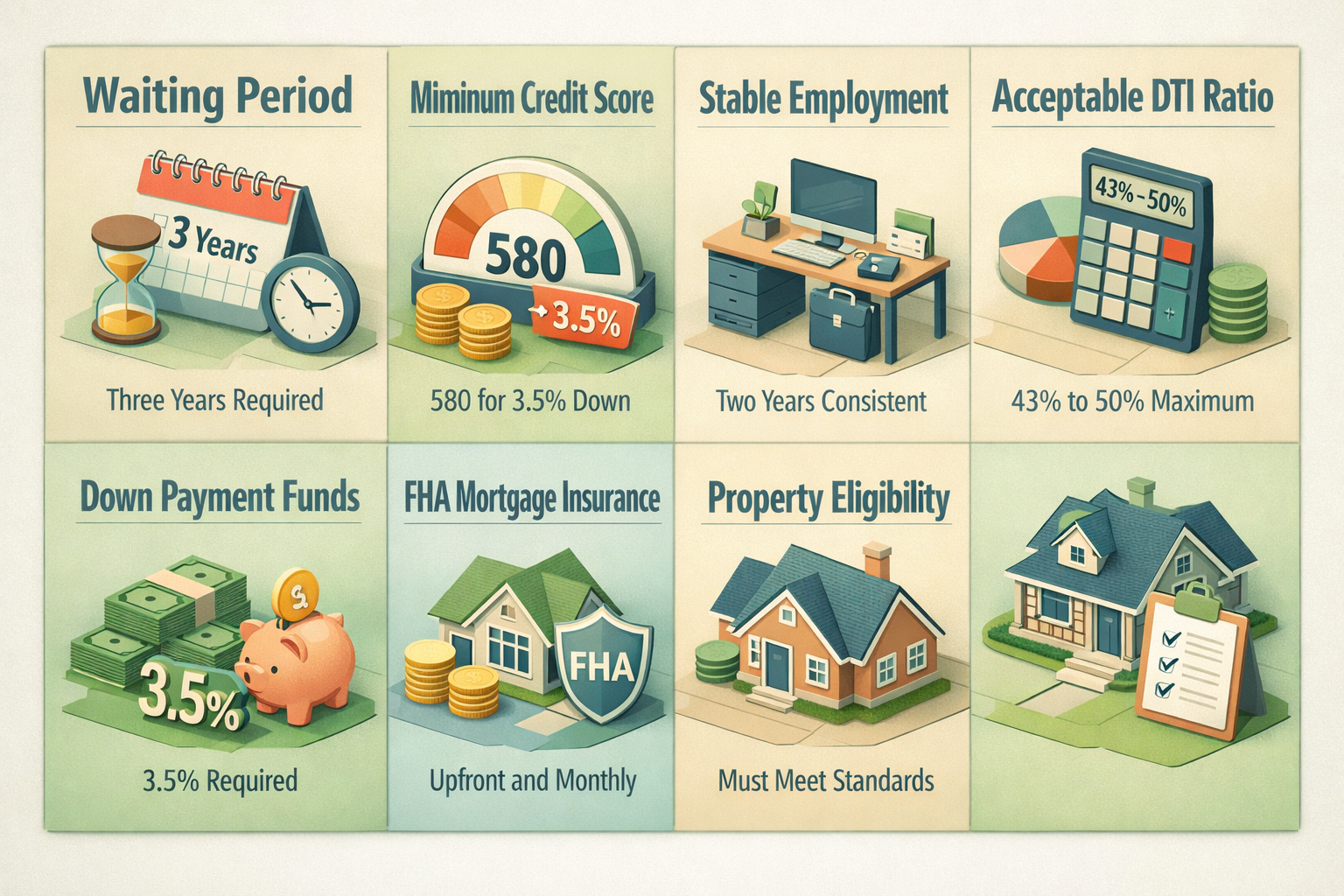
When you bring both a foreclosure history and student loan debt into a single FHA application, lenders will evaluate the full picture holistically. Understanding the complete requirements for FHA loan with a recent foreclosure and ongoing student debt means preparing across several dimensions at once.
Here's a practical checklist of what lenders will typically evaluate:
- Waiting period compliance: You must have cleared the three-year waiting period (or obtained approval under the extenuating circumstances exception) since the foreclosure was completed.
- Minimum credit score: A score of at least 580 is generally needed for a 3.5% down payment. Scores below that may still qualify with a larger down payment, depending on the lender.
- Stable employment and income: Lenders will want to see a consistent income history, typically two years of steady employment in the same field. Gaps in employment may require additional explanation.
- Acceptable DTI ratio: Your total monthly debt obligations — including your proposed mortgage payment, student loans, and any other recurring debts — should typically not exceed 43% to 50% of your gross monthly income, depending on lender guidelines and compensating factors.
- Down payment funds: You'll need at least 3.5% of the purchase price as a down payment, and these funds must be sourced and documented. Gift funds from family members are generally allowed under FHA guidelines.
- FHA mortgage insurance premiums: All FHA loans require an upfront mortgage insurance premium (MIP) and an annual MIP paid monthly. These costs are built into the loan structure and should be factored into your overall affordability calculations.
- Property eligibility: The home you're purchasing must meet FHA minimum property standards, which are intended to ensure the property is safe, sound, and structurally secure.
Strategies to Strengthen Your FHA Application as a Post-Foreclosure Borrower
Beyond meeting the baseline requirements, there are proactive strategies that may help you present a stronger application to lenders. Post-foreclosure borrowers often benefit from going above and beyond the minimum thresholds wherever possible.
Consider the following approaches:
- Save a larger down payment: While 3.5% is the minimum, putting down more can reduce your loan amount, lower your monthly payment, and signal financial stability to your lender.
- Build cash reserves: Having two to three months of mortgage payments saved in reserve after closing is a compensating factor that can tip the scales in your favor, especially if your credit score or DTI is borderline.
- Write a letter of explanation: Lenders often appreciate a clear, honest explanation of what caused the foreclosure and what steps you've taken since then to improve your financial situation. This context can humanize your application and address questions before they arise.
- Work with an FHA-experienced lender: Not all mortgage professionals are equally familiar with the nuances of post-foreclosure FHA loan after foreclosure lending. Seeking out a lender with direct FHA experience can help you navigate overlays and guidelines more effectively.
- Get a pre-approval before house hunting: A pre-approval gives you a realistic picture of what you can afford and shows sellers that you're a serious, vetted buyer — an important advantage in competitive markets.
●Conclusion
Recovering from a foreclosure while carrying student debt is undeniably challenging, but it doesn't have to mean homeownership is permanently out of reach. The FHA loan program offers a structured, accessible path back to owning a home — provided you understand the timelines, documentation requirements, and financial benchmarks involved. By respecting the mandatory waiting period, rebuilding your credit with intention, managing your student loan repayment strategically, and working with knowledgeable lenders, you can position yourself for a successful mortgage application. At LoanWise, we're here to help you navigate every step of that journey with clarity and confidence. If you're ready to explore your options, connect with one of our lending specialists today.