Buying a home when your credit score is low and your income includes child support payments can feel like an uphill battle. But here's the encouraging news: the Federal Housing Administration (FHA) loan program was specifically designed to help borrowers who don't fit the conventional lending mold. If you've been wondering about the requirements for FHA loan with 500 credit score and child support income, you're in the right place. This guide walks you through everything you need to know — from credit thresholds and down payment rules to how lenders treat child support as qualifying income. With the right preparation, homeownership may be closer than you think.
What Makes the FHA Loan Program Different from Conventional Financing
The FHA loan program is backed by the U.S. Department of Housing and Urban Development (HUD), which means lenders take on less risk when issuing these mortgages. That reduced risk allows lenders to extend credit to borrowers who might not qualify for conventional loans — including those with lower credit scores or non-traditional income sources.
Unlike conventional loans, which typically require a minimum credit score of 620 or higher, FHA guidelines allow scores as low as 500 under certain conditions. This makes the program one of the most accessible mortgage options available for first-time homebuyers and those rebuilding their financial footing.
The program also tends to be more flexible when it comes to qualifying income. Lenders that follow FHA guidelines may count income from a variety of sources — including regular child support payments — as part of your gross monthly income, provided specific documentation requirements are met. This flexibility is a key reason why FHA loans remain one of the most popular government-backed mortgage products in the country.
Understanding the FHA Loan Minimum Credit Score with Child Support
When it comes to the FHA loan minimum credit score with child support considerations, it's important to understand that there are two distinct credit score tiers within the FHA program, and each comes with different requirements.
Credit Score Between 580 and 619
Borrowers with a credit score of 580 or higher are generally eligible for the standard FHA down payment of 3.5% of the purchase price. This tier is more accessible and gives buyers a lower upfront cost to entry. However, individual lenders may apply their own "overlays" — meaning they could set a higher internal minimum, sometimes 600 or 620, even though HUD allows 580.
Credit Score Between 500 and 579
Borrowers in this range may still qualify for an FHA loan, but they'll typically be required to put down at least 10% of the purchase price. So if you're buying a home priced at $200,000, your down payment would need to be at least $20,000. This higher down payment reduces the lender's exposure and compensates for the increased credit risk.
It's worth noting that not all lenders offer FHA loans to borrowers with scores below 580. You may need to shop around specifically for lenders who are willing to work within the 500–579 credit score range. This is an important step in your home buying journey.
Requirements for FHA Loan with 500 Credit Score and Child Support Income Explained
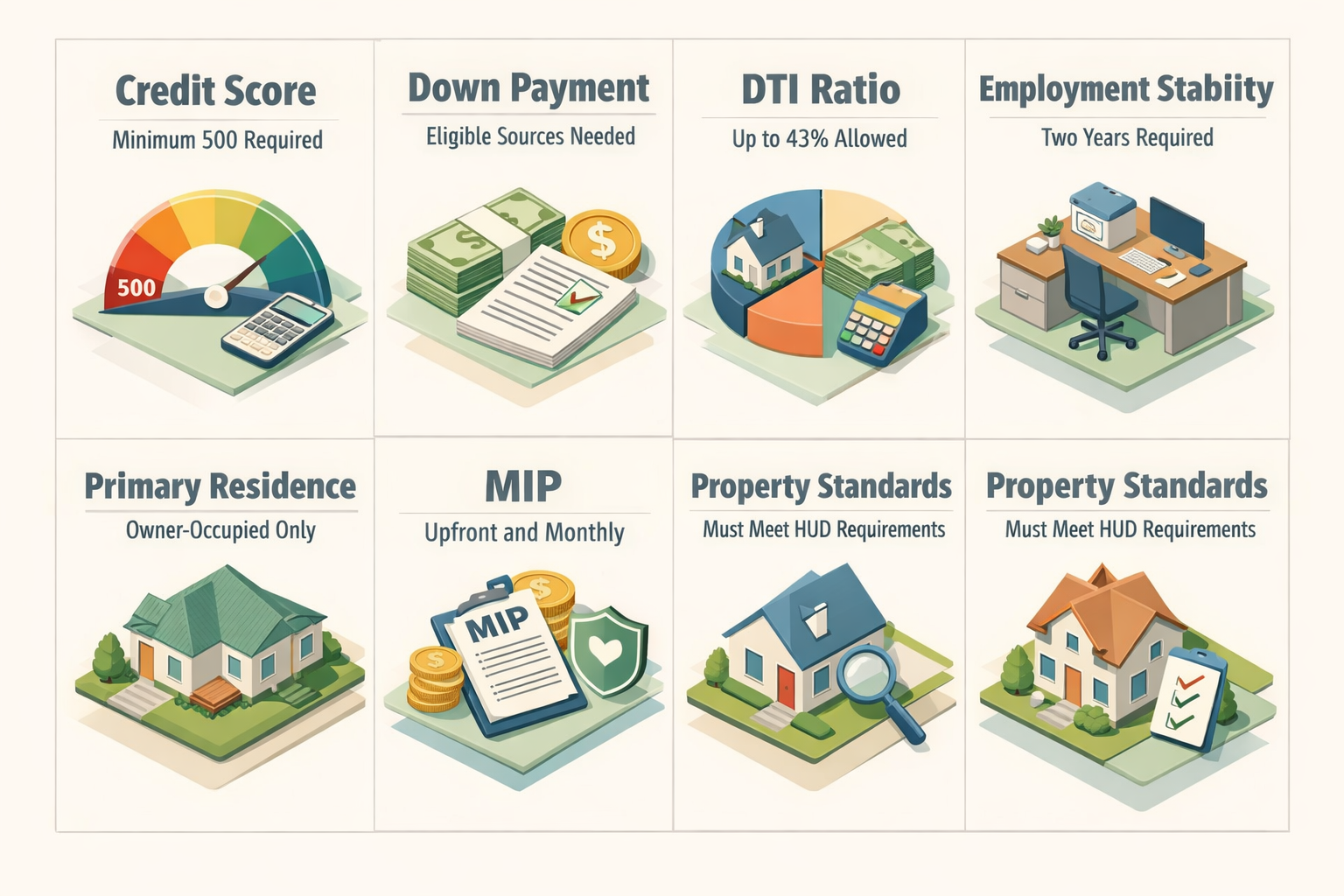
Meeting the requirements for FHA loan with 500 credit score and child support income involves satisfying several criteria simultaneously. Here's a breakdown of the key qualification factors lenders will review:
- Credit Score: A minimum score of 500 is required under FHA guidelines, though some lenders may set their own higher threshold. Scores between 500 and 579 require a 10% down payment; scores of 580 and above may qualify for 3.5% down.
- Down Payment: Must come from eligible sources such as personal savings, gift funds from a family member, or an approved down payment assistance program.
- Debt-to-Income Ratio (DTI): FHA guidelines typically allow a DTI of up to 43%, though some lenders may approve higher ratios when compensating factors are present, such as significant savings or a strong employment history.
- Employment and Income Stability: Lenders generally want to see at least two years of consistent employment or a reliable income history. This applies whether your income comes from wages, self-employment, or other qualifying sources like child support.
- Primary Residence Requirement: FHA loans are intended for owner-occupied properties. The home must be your primary residence, not a rental or investment property.
- FHA Mortgage Insurance Premiums (MIP): FHA loans require both an upfront MIP (typically 1.75% of the loan amount) and an annual MIP paid monthly. This is an ongoing cost to factor into your budget.
- Property Standards: The home must meet HUD's minimum property requirements and pass an FHA appraisal.
Taken together, these criteria paint a comprehensive picture of what lenders are looking for. Meeting several strong factors — even when your credit score is at the lower end — could improve your overall application.
How Child Support Income Is Counted Toward FHA Mortgage Qualification
Child support is recognized as a legitimate form of qualifying income under FHA guidelines, but it must meet specific requirements to be counted. Lenders can't simply take your word for it — they need documented proof that the income is real, consistent, and likely to continue.
Continuity of Income Requirement
One of the most critical rules is that child support income must be expected to continue for at least three years from the date of the mortgage application. If your child is close to the age of emancipation (typically 18), the remaining support period may not meet this threshold, and lenders might not be able to count it as qualifying income.
Documentation You'll Need to Provide
To use child support as qualifying income for an FHA loan, you'll typically need to provide:
- A copy of the court order or legal separation agreement outlining the child support obligation
- Proof of consistent receipt — usually 12 months of bank statements or payment records showing regular deposits
- Evidence that payments are current and not in arrears
How Lenders Calculate the Income Amount
Lenders will typically average the child support payments received over the past 12 months to arrive at a monthly qualifying income figure. If payments have been inconsistent or sporadic, lenders may discount the amount or decline to count it at all. Consistent payment history is essential.
It's also worth knowing that child support payments you make to another party are treated as a monthly debt obligation, which increases your DTI ratio. If you're both receiving and paying child support, both sides of that equation will be factored into your application.
Compensating Factors That Can Strengthen a Low-Score FHA Application
Having a 500 credit score doesn't automatically disqualify you from getting an FHA loan, but it does mean your application will face closer scrutiny. Fortunately, lenders and FHA guidelines recognize that credit scores don't tell the whole story. Compensating factors can work in your favor and may help offset the concerns that come with a lower score.
- Larger Down Payment: Putting down more than the required minimum signals financial discipline and reduces the loan-to-value ratio, which lowers the lender's risk.
- Significant Cash Reserves: If you have several months of mortgage payments saved in a bank account after closing, lenders may view you as a lower risk borrower.
- Low Debt-to-Income Ratio: Even if your credit score is low, a DTI well below 43% demonstrates that you're not over-extended financially.
- Stable Long-Term Employment: A steady job history — particularly with the same employer for several years — can reassure lenders about your ability to make consistent mortgage payments.
- Minimal Derogatory History: If your low credit score resulted from a single past hardship (such as a medical emergency) rather than a pattern of missed payments, lenders may be more willing to work with you.
- History of On-Time Rent Payments: Some lenders consider a strong rental payment history as evidence of financial responsibility, even when the credit score doesn't fully reflect it.
When you're applying with a 500 credit score and child support income, presenting as many of these compensating factors as possible could make a meaningful difference in whether your loan gets approved — and at what terms.
Steps to Prepare Before Applying for an FHA Loan in This Situation
Preparation is everything when you're navigating a mortgage application with credit challenges and non-traditional income. Here's a practical roadmap to help you get ready:
Check and Understand Your Credit Report
Pull your credit reports from all three major bureaus — Equifax, Experian, and TransUnion — and review them carefully. Look for errors, outdated negative items, or accounts that don't belong to you. Disputing inaccuracies could result in a score improvement without any other changes to your financial behavior.
Organize Your Child Support Documentation Early
Gather your court order, bank statements showing consistent deposits, and any payment history records. Having this paperwork ready before you apply will streamline the underwriting process and demonstrate organization and reliability to your lender.
Work on Improving Your Credit Score If Possible
Even a modest improvement in your credit score — say, from 500 to 580 — could cut your required down payment from 10% to 3.5%. Strategies that might help include paying down revolving balances, avoiding new hard inquiries, and making sure all current accounts remain in good standing.
Save for Your Down Payment and Closing Costs
With a 500 credit score, you'll likely need 10% down plus closing costs, which typically range from 2% to 5% of the loan amount. Building your savings well in advance gives you more flexibility and may also demonstrate financial responsibility to your lender.
Find an FHA-Approved Lender Who Works with Lower Credit Scores
Not every lender offers FHA loan requirements to borrowers in the 500–579 range. Research lenders who specialize in this area and consider getting pre-qualified with a few of them to compare terms. A mortgage broker may also be able to connect you with lenders who have experience working with borrowers in your specific situation.
●Conclusion
Understanding the requirements for FHA loan with 500 credit score and child support income is the first step toward making homeownership a realistic goal — not just a distant dream. The FHA program offers one of the most accessible pathways to a mortgage for borrowers with credit challenges and non-traditional income sources. While the road may require extra preparation, careful documentation, and some lender shopping, it's a path that many buyers in your situation have successfully traveled.
At LoanWise, we believe that every borrower deserves clear, honest information to make confident financial decisions. If you're ready to explore your FHA loan options or want to understand exactly where you stand before applying, connecting with an experienced mortgage professional is a smart next step. Your homeownership journey can start today — even if your credit score isn't perfect yet.