For many first-time homebuyers, saving enough money for a down payment is one of the biggest hurdles on the road to homeownership. That's exactly why FHA loans have remained one of the most popular mortgage options in the United States. Backed by the Federal Housing Administration, these loans are designed to make buying a home more accessible — especially for borrowers who may not have a large cash reserve or a perfect credit history. Understanding the requirements for FHA loan down payment is a smart first step before you begin the homebuying journey. In this article, we'll break down what you need to know, from minimum down payment thresholds to gift money rules and assistance programs that could help bridge the gap.
What Makes FHA Loans Different From Conventional Mortgages
FHA loans are government-backed mortgages insured by the Federal Housing Administration, a division of the U.S. Department of Housing and Urban Development (HUD). Because the government insures these loans, lenders take on less risk — which typically translates into more flexible qualification standards for borrowers.
Compared to conventional mortgages, FHA loans often allow lower credit scores, higher debt-to-income ratios, and — most notably — smaller down payments. This makes them particularly attractive to first-time homebuyers, buyers with limited savings, and those who are rebuilding their credit after financial setbacks.
However, it's worth noting that FHA loans do come with mortgage insurance premiums (MIP), both upfront and annual. This added cost is the trade-off for the more lenient entry requirements. Understanding both the benefits and the costs helps you make a well-informed decision before committing to a loan type.
FHA Loan Minimum Down Payment: The Core Numbers You Need to Know
The FHA loan minimum down payment is one of the program's most well-known advantages. Borrowers who meet certain credit score requirements may qualify to put down as little as 3.5% of the home's purchase price. On a $300,000 home, that would translate to just $10,500 — a significantly lower barrier compared to the traditional 20% down payment associated with conventional loans.
However, this 3.5% minimum isn't available to everyone. The FHA loan eligibility credit score plays a critical role in determining which down payment tier applies to you:
- Credit score of 580 or higher: Borrowers in this range may qualify for the 3.5% minimum down payment.
- Credit score between 500 and 579: Borrowers in this range are typically required to put down at least 10% of the purchase price.
- Credit score below 500: Most FHA-approved lenders will not approve borrowers in this range, as it falls outside standard program guidelines.
Keep in mind that while these are FHA program minimums, individual lenders may set stricter requirements — sometimes called "lender overlays." It's always a good idea to compare multiple lenders to find the best fit for your financial profile.
Understanding the Full Requirements for FHA Loan Down Payment
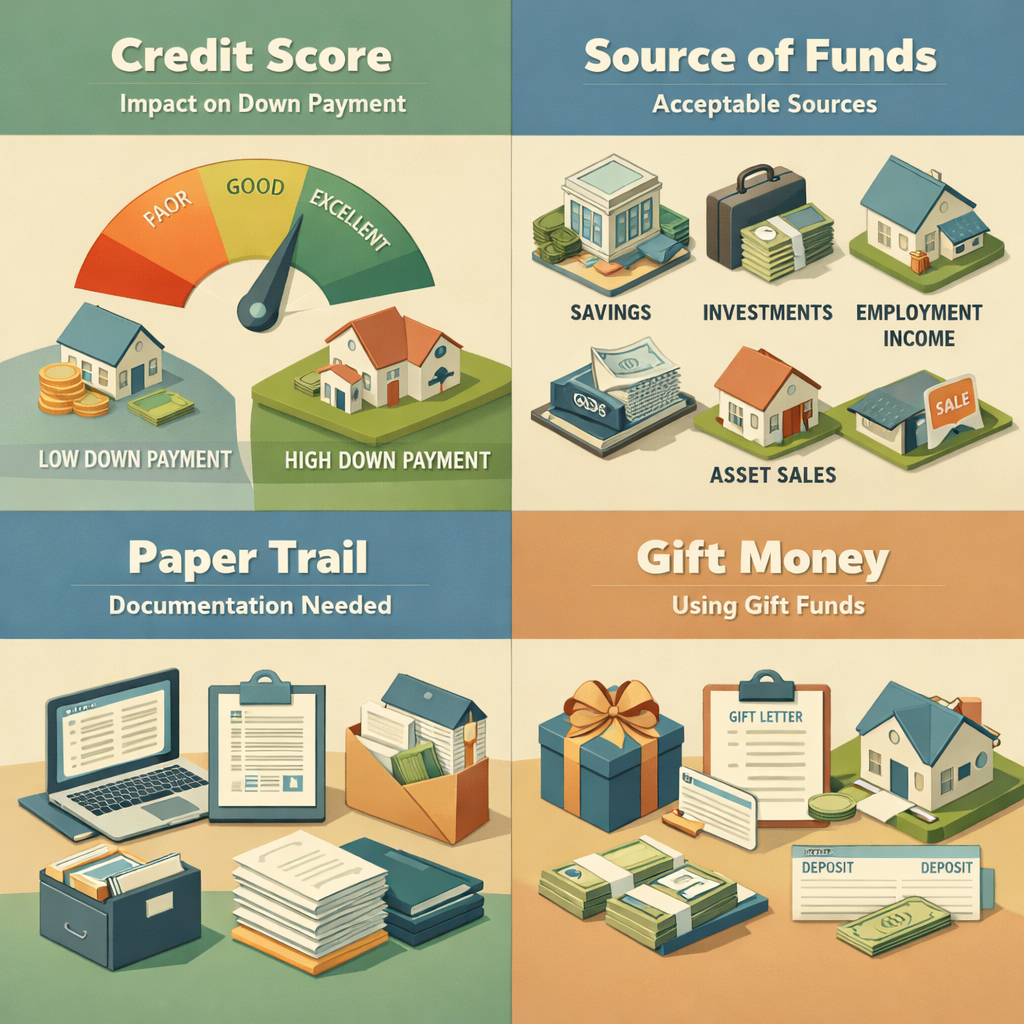
Beyond the dollar amount itself, the requirements for FHA loan down payment also include rules about where the funds can come from and how they must be documented. The FHA wants to ensure that down payment funds are legitimate and that borrowers aren't taking on additional hidden debt to cover the upfront cost.
Here's what lenders typically look for when reviewing your down payment:
- Source of funds: Your down payment must come from an acceptable source. Acceptable sources may include personal savings, checking accounts, retirement accounts (with documentation), and certain gift funds.
- Paper trail: Lenders will likely ask for bank statements going back 60 to 90 days to verify the origin of your funds. Large or unexplained deposits may raise questions and require additional documentation.
- No borrowed funds: You generally cannot borrow your down payment from a personal loan or credit card, as this could increase your debt load and affect your ability to repay the mortgage.
- Seasoned funds: Funds that have been sitting in your account for a longer period — often referred to as "seasoned" funds — are typically easier to document and less likely to trigger additional scrutiny.
Taking time to organize and document your finances well before applying for a mortgage can make the approval process smoother and faster.
Can I Use Gift Money for FHA Down Payment? Here's What the Rules Say
One of the most helpful features of the FHA loan program is its relatively flexible policy on gift funds. If you're wondering, can I use gift money for FHA down payment? — the answer is generally yes, with some important conditions attached.
The FHA allows borrowers to use gift funds from eligible donors to cover all or part of the required down payment. Eligible donors typically include:
- Family members such as parents, siblings, grandparents, or other relatives
- A fiancé or domestic partner
- Close friends with a clearly documented relationship to the borrower
- Certain employer assistance programs
- Charitable organizations approved by the FHA
However, the gift cannot come with any expectation of repayment. If the donor expects to be paid back, the funds would be classified as a loan rather than a gift — which would change how lenders evaluate your debt obligations.
To document a gift properly, your lender will typically require a gift letter signed by the donor. This letter should state the donor's name and relationship to you, the gift amount, the source of the funds, and a clear declaration that no repayment is expected. The donor may also need to provide bank statements showing the funds were transferred.
It's smart to coordinate with your loan officer early in the process if you plan to use gift funds, as documentation requirements can vary slightly between lenders.
FHA Down Payment Assistance Programs That Could Help Bridge the Gap
Even a 3.5% down payment can feel out of reach for some borrowers. Fortunately, there are FHA down payment assistance programs designed to help eligible homebuyers cover this upfront cost. These programs are typically offered through state housing finance agencies, local governments, and nonprofit organizations.
Down payment assistance (DPA) may come in several forms:
- Grants: Free money that doesn't need to be repaid. These are highly sought after and often come with income or first-time buyer restrictions.
- Forgivable loans: Second loans that are forgiven after you live in the home for a set number of years — often five to ten years. If you sell or refinance before that period ends, you may need to repay a portion.
- Deferred payment loans: Second mortgages where repayment is postponed until you sell, refinance, or pay off the primary mortgage.
- Matched savings programs: Some nonprofits and local agencies will match a portion of your savings dollar-for-dollar up to a specified limit.
Eligibility requirements for these programs vary widely. Many are designed for first-time homebuyers, though some define "first-time buyer" as anyone who hasn't owned a home in the past three years. Income limits, purchase price caps, and geographic restrictions may also apply.
To find programs available in your area, consider visiting your state's housing finance agency website or speaking with a HUD-approved housing counselor. A knowledgeable mortgage advisor can also help identify which assistance programs you might qualify for based on your income, location, and financial profile.
Other Key FHA Eligibility Factors Beyond the Down Payment
While the down payment often gets the most attention, it's just one piece of the FHA loan puzzle. To qualify for an FHA loan, borrowers generally need to meet several other requirements as well:
- Debt-to-income (DTI) ratio: FHA guidelines typically allow a DTI of up to 43%, though some lenders may accept higher ratios with compensating factors like significant cash reserves or a high credit score.
- Employment and income history: Lenders generally look for at least two years of steady employment or a stable income history. Self-employed borrowers may need to provide additional documentation.
- Primary residence requirement: FHA loans are intended for owner-occupied properties. Borrowers must plan to use the home as their primary residence, not as a rental or investment property.
- Property standards: The home must meet FHA minimum property requirements (MPR), which means it needs to be safe, sound, and secure. An FHA appraisal will evaluate whether the property meets these standards.
- Loan limits: FHA loan limits vary by county and are updated annually. In high-cost areas, the limits are higher, but in most parts of the country, there's a baseline conforming limit that applies.
Meeting these requirements doesn't guarantee approval, but being well-prepared on all fronts significantly improves your chances of a smooth and successful application process.
Practical Tips for Preparing Your FHA Down Payment
Whether you're months away from buying a home or just beginning to think about homeownership, preparing your down payment well in advance gives you more options and less stress. Here are some practical steps to consider:
- Check your credit score early: Since your FHA loan eligibility credit score directly impacts your down payment requirement, pulling your credit report early gives you time to address any errors or negative items before applying.
- Open a dedicated savings account: Keeping your down payment funds in a separate account makes it easier to track your progress and document the source of funds for your lender.
- Avoid large, unexplained deposits: If you receive a cash gift or large sum of money, document it immediately. Unexplained deposits can slow down the underwriting process.
- Research assistance programs in your area: Don't assume you won't qualify. Many assistance programs have more flexible income limits than people expect, and the application process is often more straightforward than it seems.
- Work with a HUD-approved housing counselor: These counselors are trained to help you navigate the homebuying process, including down payment planning and budgeting. Their services are often free or low-cost.
- Get pre-approved before house hunting: A pre-approval letter gives you a clear picture of your buying power and signals to sellers that you're a serious, prepared buyer.
Taking these steps doesn't just help you meet the requirements for an FHA loan — it also sets you up for long-term financial stability as a homeowner.
●Conclusion
Understanding the requirements for FHA loan down payment can make a real difference in how confidently you approach the homebuying process. From the 3.5% minimum for qualifying credit scores to the flexible rules around gift funds and down payment assistance, the FHA program is built to open doors for buyers who might otherwise struggle to enter the market. Of course, every borrower's situation is unique, and the details of your income, credit history, and local market will all shape the path ahead. The best move you can make right now is to connect with an experienced mortgage professional who can walk you through your specific options. At LoanWise, we're here to help you navigate every step — from understanding your down payment requirements to finding the right loan for your goals. Reach out today and let's start building your path to homeownership together.