
Relocating for a new job is exciting — but it also comes with a long list of financial questions, especially if you're trying to buy a home at the same time. One of the most common concerns among job-relocating homebuyers is whether their employer-provided relocation bonus can help them qualify for a mortgage. The short answer is: it depends. Lenders evaluate relocation income carefully, and the requirements for conventional loan with recent relocation bonus income can be more nuanced than many borrowers expect. Understanding how this type of income is treated during underwriting can help you prepare a stronger loan application and avoid surprises along the way.
What Is a Relocation Bonus and Why It Matters to Lenders
A relocation bonus — sometimes called a relo package or moving allowance — is compensation provided by an employer to help an employee cover the costs of moving to a new area for work. These payments can take many forms, including a lump-sum cash payment, reimbursements for moving expenses, temporary housing stipends, or even a combination of all three.
From a mortgage lender's perspective, the way this income is classified matters enormously. Lenders need to determine whether the income is stable, predictable, and likely to continue — all key factors in conventional mortgage underwriting. A relocation bonus is typically considered a one-time or short-term payment, which means it may not carry the same weight as a borrower's base salary when calculating qualifying income.
That said, a relocation bonus can still play a meaningful role in your mortgage application. It may strengthen your overall financial profile, assist with down payment funds, or in some cases, contribute to reserves — even if lenders don't count it as ongoing income. How your lender treats this payment will depend on several factors, including how the bonus is structured, whether it's already been received, and how it appears on your documentation.
How Conventional Mortgage Guidelines Treat Non-Recurring Income
Conventional loans are typically backed by Fannie Mae or Freddie Mac, and both agencies publish detailed guidelines about what types of income are eligible for qualification purposes. Under these guidelines, income generally must meet a two-year history requirement and have a reasonable expectation of continuance for at least three years into the future.
Relocation bonuses, because they are often one-time payments, may not satisfy the continuance requirement on their own. Lenders following conventional mortgage relocation bonus requirements will typically look at whether the bonus is:
- Documented with a formal offer letter or employer agreement — This confirms the payment is legitimate and tied to employment.
- Already deposited and verifiable — A bonus that has already hit your bank account is easier to document than one that's promised but not yet received.
- Taxable income versus a non-taxable reimbursement — Taxable bonuses may be treated differently than expense reimbursements, which are generally not considered income at all.
- Part of a broader compensation package — If your offer letter includes guaranteed bonus language tied to employment, lenders may be more willing to consider it.
It's worth noting that lenders have some flexibility in how they interpret bonus income, and different underwriters may apply guidelines somewhat differently. Consulting with an experienced loan officer early in the process can help clarify how your specific situation will be evaluated.
Requirements for Conventional Loan with Recent Relocation Bonus: A Closer Look
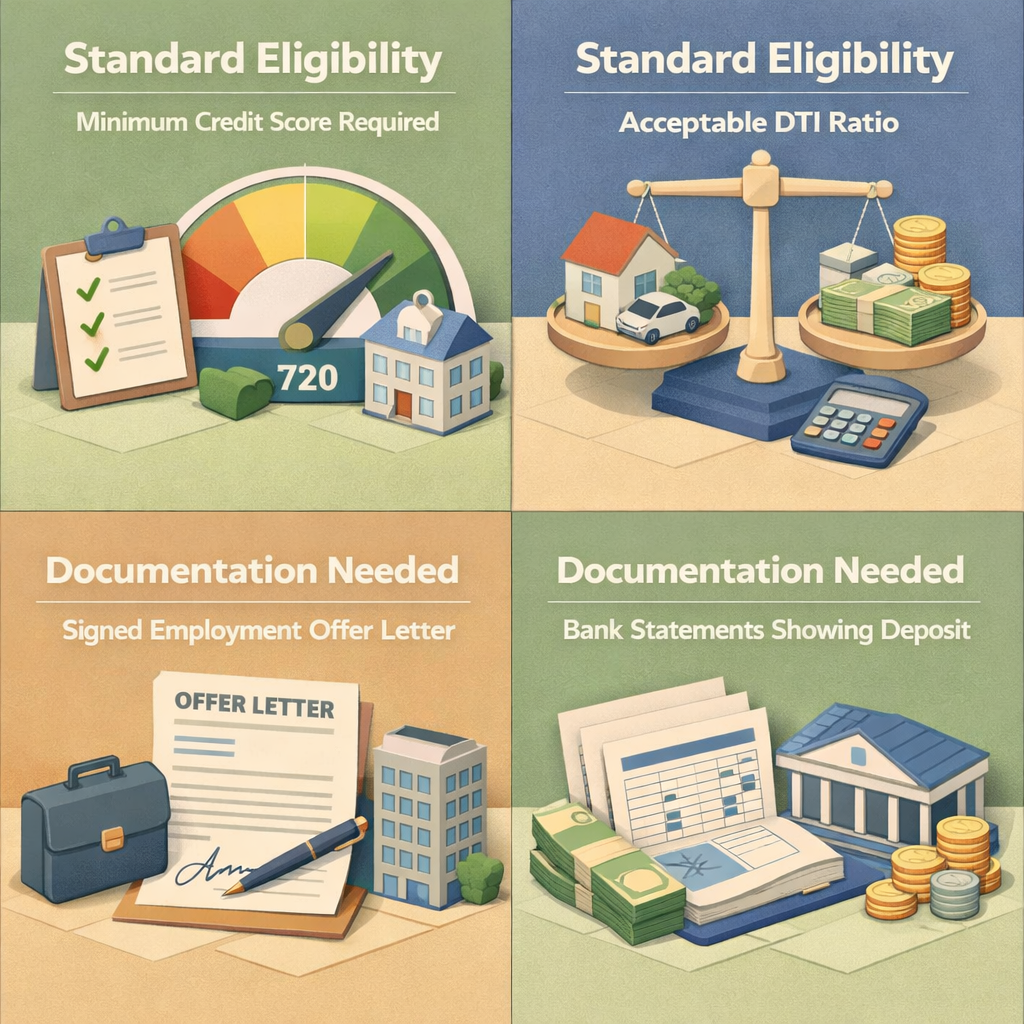
When applying for a conventional loan with a recently received relocation bonus, you'll generally need to meet the standard qualifying requirements in addition to providing documentation specific to your relocation income. Here's what lenders typically look for:
Standard Conventional Loan Eligibility
Before relocation income is even considered, you'll need to meet baseline conventional loan criteria, which commonly include:
- A minimum credit score — often at least 620, though higher scores may unlock better rates
- A debt-to-income (DTI) ratio that falls within acceptable limits — typically below 45% to 50%, depending on the lender and loan profile
- A down payment of at least 3% to 5% for primary residences, though 20% or more avoids private mortgage insurance (PMI)
- Stable, verifiable employment and income history
- Sufficient assets and reserves, as required by the loan program
Documentation for the Relocation Bonus
To support your relocation bonus as part of your application, lenders will generally ask for:
- A copy of your signed employment offer letter that clearly outlines the relocation bonus terms
- Bank statements showing the deposit of the bonus funds
- Pay stubs or W-2s if the bonus appears as part of payroll
- A written explanation of the bonus and how it relates to your new employment
Employment Start Date and New Job Considerations
If you're purchasing a home before or shortly after starting your new job, lenders may scrutinize your income profile more carefully. Fannie Mae and Freddie Mac guidelines may allow lenders to use a new employment offer letter to qualify a borrower — but specific conditions apply. For instance, the borrower may need to have already started the new job by closing, or the lender may require a 30-day pay stub from the new employer before funding the loan.
Using a Relocation Bonus for Your Down Payment or Closing Costs
Even if your relocation bonus doesn't count toward your qualifying income, it could still benefit your mortgage application in a significant way: as documented funds for your down payment, closing costs, or cash reserves.
Conventional loan guidelines generally allow borrowers to use their own funds — including bonuses — for down payment purposes, as long as those funds can be properly sourced and documented. This means your lender will want to see that the money is already in your account and that it came from a legitimate source, such as your employer.
Here are a few important points to keep in mind:
- Seasoned funds are preferred: Funds that have been in your account for at least two months (two bank statement cycles) are considered "seasoned" and typically require less documentation. A recently deposited bonus may require a paper trail and explanation letter.
- Large deposits trigger scrutiny: If a significant deposit appears on your bank statements without explanation, your lender will ask about it. Having your offer letter and employment documentation ready can resolve this quickly.
- Reserves can strengthen your application: After your down payment and closing costs are covered, any remaining bonus funds left in your account may count toward reserves — which can help offset risk factors like a new job or higher DTI.
Using your relocation bonus strategically as an asset, rather than income, can be a practical path forward when the bonus itself may not qualify as recurring income.
How Lenders Verify Employment After a Job-Related Move
Employment verification is one of the most important steps in the mortgage underwriting process — and it becomes especially relevant when you've recently changed jobs due to a relocation. Lenders want assurance that you have a reliable source of income to make your mortgage payments over the long term.
For borrowers who have recently relocated for work, lenders will typically verify employment in the following ways:
- Verbal verification of employment (VVOE): Lenders often contact your employer directly to confirm your position, start date, and employment status — usually within 10 business days of closing.
- Written verification: Some lenders may require a formal written verification of employment (WVOE) completed by your HR department or payroll provider.
- Offer letter review: If you haven't started your new job yet, lenders may rely heavily on your offer letter to determine income eligibility. The letter should clearly state your start date, salary, and any bonus or compensation details.
- Pay stubs from new employer: Once you've started working, recent pay stubs from your new employer will be required as part of the income documentation package.
It's also worth noting that if you've moved from one field to a similar role in the same industry, lenders may be more comfortable than if you've switched careers entirely. Continuity of employment in the same line of work can help demonstrate income stability, even if the employer has changed.
Common Challenges and How to Overcome Them
Applying for a conventional mortgage while navigating a job relocation can present a few hurdles. Here are some of the most common challenges borrowers face — and practical strategies to address them:
Challenge: Relocation Bonus Not Counted as Income
If your lender determines that your relocation bonus doesn't meet continuance requirements, it may not be included in your qualifying income. This could affect your DTI ratio or the loan amount you're eligible for. Solution: Focus on your base salary as the primary qualifying income. If your base income alone is sufficient to meet DTI requirements, the bonus exclusion may not be a barrier at all.
Challenge: Employment Gap or Recent Job Start
Moving to a new city and starting a new job simultaneously can create a brief employment gap that raises underwriting questions. Solution: Provide a clear, written explanation of your employment transition, supported by your offer letter and any documentation from your previous employer. Many lenders are familiar with relocation scenarios and will work with you if the story is well-documented.
Challenge: Documenting a Large Deposit
A sizable relocation bonus appearing in your bank account may trigger additional documentation requests. Solution: Keep your offer letter, employer communications, and any bonus agreement paperwork readily available. Provide a letter of explanation that clearly connects the deposit to your employment relocation package.
Challenge: Timing of the Home Purchase
Trying to close on a home before you've received your first paycheck from a new employer can complicate the underwriting process. Solution: If possible, time your home purchase to align with at least one or two pay stubs from your new employer. This gives lenders concrete income documentation and can smooth the approval process considerably.
Working With the Right Lender Makes a Difference
Not all lenders approach relocation income the same way. While Fannie Mae and Freddie Mac set the foundational guidelines for conventional loans, individual lenders — known as overlays — may apply additional or more conservative requirements on top of those guidelines. Conversely, some lenders may have greater experience with relocation scenarios and be better equipped to help you navigate the process.
When you're evaluating lenders, consider asking the following questions upfront:
- How does your underwriting team treat relocation bonuses and moving allowances?
- Will my new employer offer letter be sufficient to qualify if I haven't started yet?
- What documentation will you need to source my bonus funds for the down payment?
- Are there loan programs that may be better suited to my relocation situation?
Working with a loan officer who has specific experience handling requirements for conventional loan with recent relocation bonus scenarios can save you time and reduce stress. A knowledgeable mortgage professional can help you structure your application in the most favorable way possible and identify potential issues before they become roadblocks.
At LoanWise, our team understands the unique challenges that come with relocating and buying a home at the same time. Whether you're navigating a new job start date, documenting a lump-sum bonus, or simply trying to understand how your income will be evaluated, we're here to guide you every step of the way.
●Conclusion
Buying a home while relocating for work is entirely achievable — even with a recent relocation bonus in the picture. The key is understanding how lenders evaluate this type of income and preparing your documentation thoroughly. While your bonus may not always count as qualifying income under conventional mortgage guidelines, it can still serve as a valuable asset for your down payment, closing costs, or financial reserves. Meeting the conventional mortgage relocation bonus requirements starts with gathering the right paperwork, working with an experienced loan officer, and being transparent about your employment situation. With the right preparation and the right lending partner, your new home and your new job can come together seamlessly. Ready to explore your options? Connect with a LoanWise mortgage specialist today to get started.