
Buying a home is one of the biggest financial steps a person can take, and qualifying for a conventional mortgage isn't always straightforward. For some homebuyers, adding a co-signer can make the difference between an approval and a denial. But what happens when that co-signer runs their own business or works independently? Understanding the requirements for conventional loan with a co-signer who is self-employed is essential before you move forward. Self-employed borrowers are evaluated differently than traditional W-2 employees, and lenders apply that same scrutiny to co-signers. This guide walks you through what to expect, what documentation is needed, and how to position your application for the best possible outcome.
What a Co-Signer Actually Does on a Conventional Loan
Before diving into self-employment specifics, it helps to understand the role of a co-signer on a conventional loan. A co-signer — sometimes referred to as a non-occupant co-borrower — agrees to share legal responsibility for the loan. They're essentially telling the lender: if the primary borrower can't pay, I will.
Unlike a co-buyer who lives in the home, a co-signer typically doesn't occupy the property. However, their financial profile is still fully reviewed. Lenders look at their credit history, income, existing debts, and overall financial stability. If the co-signer has strong finances, they can help a primary borrower qualify for a loan they might not have secured on their own.
It's worth noting that conventional loans backed by Fannie Mae and Freddie Mac do allow non-occupant co-borrowers, though specific guidelines and lender overlays may vary. The co-signer's full financial picture — including liabilities and monthly obligations — will be factored into the overall loan qualification process.
- Co-signers share legal responsibility for the mortgage debt.
- Their credit and income are evaluated just like the primary borrower's.
- They do not need to live in the home in most conventional loan scenarios.
- Their debts and obligations are included in the debt-to-income (DTI) calculation.
Why Self-Employment Creates Additional Scrutiny for Co-Signers
When a co-signer is self-employed, lenders tend to take a closer look at their finances. That's because self-employment income can fluctuate from year to year, making it harder to establish a consistent earning pattern. Unlike a salaried employee who can provide a pay stub and a W-2, a self-employed individual must demonstrate income stability through other means.
Lenders typically want to see that self-employment income is stable, ongoing, and likely to continue. A single profitable year may not be enough. Most lenders prefer to see at least two years of self-employment history, supported by tax returns and other documentation. If the business is newer or shows inconsistent income, that could raise concerns even if the most recent year looks strong.
Additionally, self-employed individuals often take advantage of legal tax deductions that reduce their reported taxable income. While this is a smart tax strategy, it can work against a borrower — or co-signer — in a mortgage application, since lenders generally assess income based on what's reported to the IRS after deductions, not gross revenue.
This is why the requirements for conventional loan with a co-signer who is self-employed tend to be more document-intensive than for a traditionally employed co-signer. Lenders aren't trying to make things difficult — they're trying to verify that the income is real, reliable, and sufficient to support the loan obligation.
Conventional Mortgage Co-Signer Income Proof: What Documents Are Needed
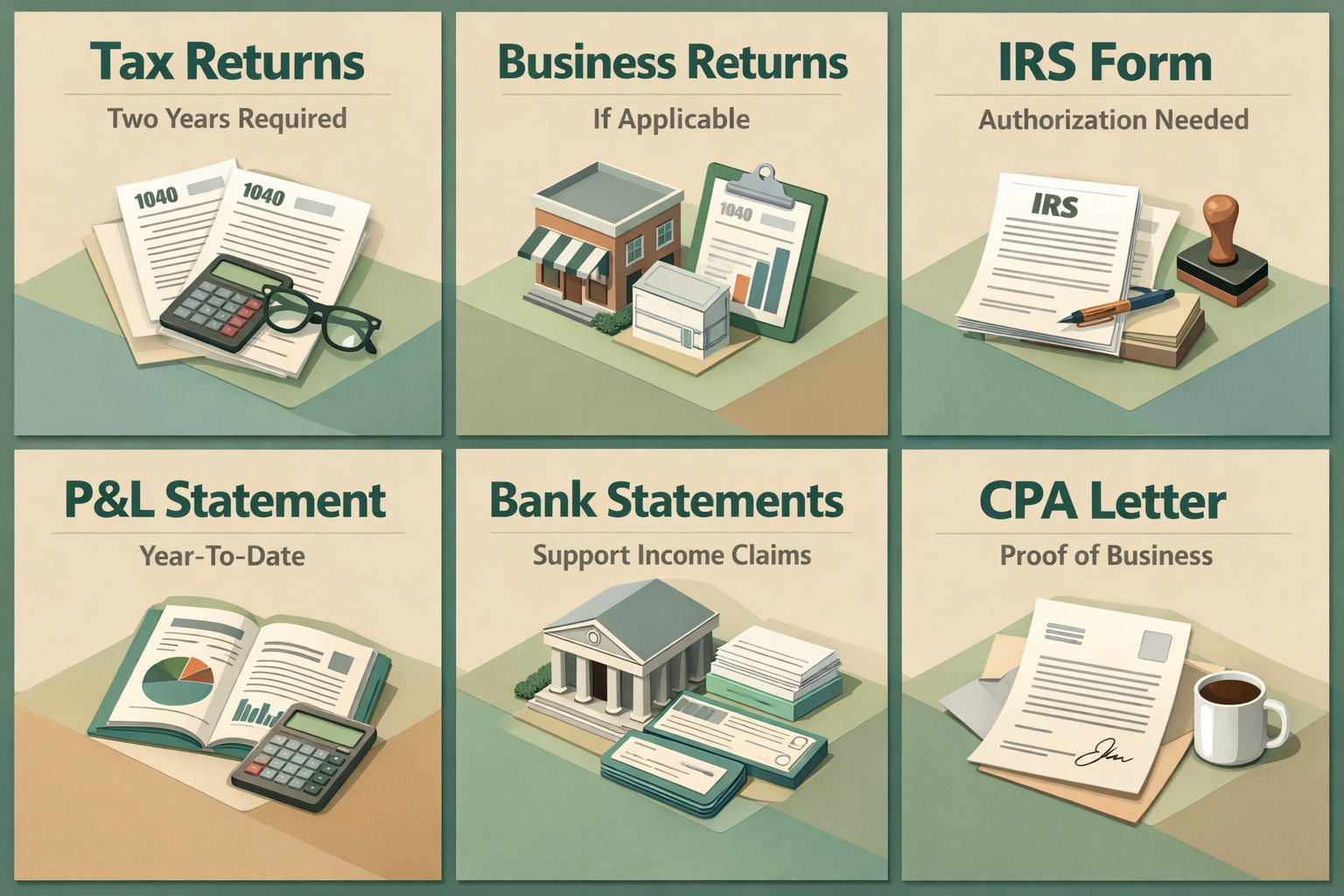
Documentation is at the heart of qualifying a conventional mortgage co-signer. Lenders need a clear picture of how the co-signer earns income, how stable that income is, and whether it will likely continue. Here's a breakdown of the documents that are commonly required:
- Two years of personal federal tax returns — These are used to calculate the co-signer's average annual income. Lenders typically average the income across both years unless it has declined, in which case the lower year may be used.
- Two years of business tax returns — If the co-signer owns a business entity such as an S-corporation, partnership, or LLC, the lender will likely review the business returns as well to assess business health and any potential liabilities.
- IRS Form 4506-C — This form authorizes the lender to obtain tax transcripts directly from the IRS, allowing them to verify that the submitted returns are accurate.
- Profit and loss (P&L) statement — Some lenders request a year-to-date P&L, particularly if the application is submitted mid-year and the most recent tax return is over a year old.
- Business bank statements — These may be used to support income claims and demonstrate that the business is actively generating revenue.
- CPA letter or business license — Proof that the business exists and has been operating for the required period of time.
It's important to note that lender requirements can vary, and some may request additional documentation depending on the complexity of the co-signer's business structure or income sources. Working with a knowledgeable mortgage professional can help ensure all necessary documents are gathered upfront.
Credit Score and Debt-to-Income Standards for Self-Employed Co-Signers
Income documentation is only part of the equation. Lenders also evaluate the co-signer's creditworthiness and their overall debt load relative to their income.
Credit Score Requirements
For conventional loans, most lenders require a minimum credit score — often cited around 620 — though many prefer scores of 680 or higher for better terms and lower risk. A co-signer with strong credit could help offset a primary borrower's weaker credit profile. However, if the co-signer's credit score is also marginal, the benefit may be limited. A self-employed co-signer should ideally bring a solid credit history with no recent derogatory marks, low credit utilization, and a demonstrated pattern of responsible debt management.
Debt-to-Income Ratio (DTI)
DTI is one of the most important qualifying metrics in any mortgage application. It measures how much of a borrower's gross monthly income goes toward debt payments. For conventional loans, lenders typically look for a combined DTI — including the new mortgage payment — of 45% or lower, though some automated underwriting systems may allow higher ratios under the right conditions.
When a self-employed co-signer is added to the loan, their income and their existing debts are both factored in. If the co-signer has significant business-related expenses, loan obligations, or personal debts, those will increase the overall DTI. On the other hand, if the co-signer has strong documented income and relatively low debts, they can meaningfully improve the overall qualification picture.
How Lenders Calculate Self-Employment Income for Co-Signers
The way lenders calculate income for self-employed individuals differs significantly from how they handle W-2 income. Understanding this process can help co-signers and primary borrowers set realistic expectations.
For most self-employed co-signers, lenders use a method called tax return income averaging. They look at the adjusted gross income (or net income for sole proprietors and LLCs) reported on federal tax returns over the past two years, add back certain allowable deductions — such as depreciation, depletion, and business use of home — and then divide by 24 months to arrive at a monthly income figure.
For example, if a self-employed co-signer reports net income of $80,000 in year one and $100,000 in year two after allowable add-backs, the lender might use an average of $90,000 per year, or $7,500 per month. This is a simplified illustration; actual calculations can be more complex depending on business structure.
If income has declined from year one to year two, lenders may use the lower year's income rather than averaging — or may require additional explanation. Declining income trends can raise red flags and may require the co-signer to provide a written explanation or additional documentation to justify the drop.
Business owners who operate as S-corporations or partnerships may have income calculated differently, as lenders also review the business's financial health and potential losses that could affect future earnings. Self-employed co-signers who understand this process ahead of time are better positioned to work with their tax professionals to ensure returns reflect as much qualifying income as possible.
Practical Tips for Strengthening Your Application with a Self-Employed Co-Signer
Adding a self-employed co-signer can be a smart move — but it works best when both parties are prepared. Here are some strategies that may help improve your chances of approval:
- File taxes well before applying — If the co-signer's most recent tax return hasn't been filed, lenders may not be able to use the prior year's income. Up-to-date returns are often a prerequisite.
- Minimize large write-offs before applying — While reducing taxable income is great for tax purposes, excessive deductions can lower the qualifying income lenders use. Self-employed co-signers might consider consulting with a tax advisor about the timing of deductions relative to a mortgage application.
- Maintain strong business bank statements — Consistent deposits and healthy cash flow in business accounts can support income claims and demonstrate that the business is financially sound.
- Avoid taking on new debt — Any new loans, credit cards, or leases opened by the co-signer before closing could increase the DTI and jeopardize the loan.
- Work with an experienced mortgage professional — Navigating the requirements for conventional loan with a co-signer who is self-employed is much easier with a lender who has experience structuring these types of applications.
- Get pre-approved early — Starting the pre-approval process gives both the borrower and co-signer time to gather documentation and address any issues before a formal application is submitted.
It may also be helpful for the co-signer to provide a letter of explanation for any unusual income patterns, business transitions, or gaps in employment history. Transparency with the lender goes a long way toward building confidence in the application. Those looking to strengthen your application should consider starting with a payment calculator to understand what loan amounts are realistic.
●Conclusion
Adding a self-employed co-signer to a conventional mortgage can be a powerful way to strengthen a home loan application — but it does require careful preparation. Because self-employed individuals are held to a higher documentation standard, both the primary borrower and the co-signer need to understand what lenders expect and plan accordingly. From gathering two years of tax returns to managing DTI and maintaining a strong credit profile, every detail matters. If you're exploring this path, working with a knowledgeable mortgage advisor can help you navigate the process with confidence. At LoanWise, we're here to help you understand your options and connect you with the right lending solutions for your unique situation. Reach out today to get started.