
Buying a home is one of the biggest financial decisions you'll ever make, and coming up with a down payment can feel like the steepest hurdle. The good news is that if you have a generous sibling willing to help, you may be able to use their gift money toward a conventional mortgage with as little as 5% down. But there are specific rules lenders and mortgage guidelines require you to follow. Understanding the requirements for conventional loan with 5% down payment from sibling before you start the process could save you time, stress, and potential delays at closing.
What Is a Conventional Loan and Why 5% Down Matters
A conventional loan is a mortgage that is not backed by a government agency like the FHA, VA, or USDA. Instead, these loans typically follow guidelines set by Fannie Mae and Freddie Mac, the two government-sponsored enterprises that purchase most conventional mortgages from lenders. Because they aren't government-insured, conventional loans tend to have stricter qualification requirements — but they also offer significant flexibility for well-qualified borrowers.
One of the most appealing features of conventional financing is the ability to put down as little as 3% to 5% of the home's purchase price. A 5% down payment strikes a popular balance: it keeps more cash in your pocket while still demonstrating financial commitment to your lender. On a $350,000 home, for example, a 5% down payment comes to $17,500 — a meaningful sum that a sibling might be in a position to gift.
It's worth noting that when your down payment falls below 20%, most conventional lenders will require private mortgage insurance, commonly known as PMI. This is an added monthly cost, but it's typically cancellable once you've built enough equity in the home — a distinct advantage over FHA mortgage insurance, which may last the life of the loan in some cases.
Can a Sibling Actually Gift Your Down Payment on a Conventional Loan?
Yes — under Fannie Mae and Freddie Mac guidelines, gift funds from a sibling are generally an acceptable source for a down payment on a conventional mortgage. This is an important distinction because not all loan programs treat gift sources the same way. Conventional guidelines specifically define eligible donors, and siblings are considered family members under those definitions.
Fannie Mae's guidelines define a family member as a child, parent, sibling, grandparent, spouse, domestic partner, or another individual related by blood, marriage, adoption, or legal guardianship. Freddie Mac uses a similarly broad definition. Because siblings fall squarely within this category, a conventional mortgage 5% down gift from a brother or sister is a recognized and allowable source of funds — as long as the proper documentation requirements are met.
That said, lenders may still apply their own overlays — additional requirements beyond what Fannie Mae or Freddie Mac mandate. It's always wise to confirm your specific lender's policies early in the process so there are no surprises.
The Gift Letter: Your Most Important Document
If your sibling is contributing gift funds toward your down payment, a formal gift letter is not optional — it's required. This document serves as a written declaration that the money being provided is a true gift and not a loan that you're expected to repay. Lenders are very particular about this distinction because an undisclosed loan obligation could affect your debt-to-income ratio and your ability to qualify.
A properly prepared gift letter for a sibling gift funds for down payment scenario should typically include the following elements:
- The donor's name, address, and relationship to the borrower — clearly identifying your sibling as the source
- The exact dollar amount of the gift
- The address of the property being purchased
- A statement confirming the funds are a gift and do not require repayment
- The donor's signature and date
Some lenders may also ask for the borrower's signature on the gift letter. Your loan officer will provide a template or walk you through the exact format they require. It's a good idea to get this document prepared as early in the process as possible.
Documenting the Transfer: Tracing the Money Trail
Beyond the gift letter itself, lenders will want to verify that the funds actually moved from your sibling's account to yours. This process is sometimes called "sourcing and seasoning" of funds, and it's a standard part of mortgage underwriting. The goal is to confirm that the money came from an acceptable source and that no undisclosed debt was created in the process.
Here's what documentation is commonly required to trace gift funds:
- Bank statements from the donor — typically the most recent one to two months of statements showing the funds were available in your sibling's account
- Evidence of the transfer — a wire transfer confirmation, cashier's check copy, or bank-to-bank transfer receipt showing the money moving from the donor's account to yours
- Your own bank statements — showing the deposit of the gift funds into your account
If the gift funds have been in your bank account for a longer period — often 60 days or more — some lenders may consider them "seasoned" and require less documentation. However, policies vary, so it's best not to assume. Check with your lender upfront about their specific requirements for tracing the source of the funds.
One practical tip: avoid mixing gift funds with your regular deposits in ways that make them hard to trace. A clean, direct transfer is much easier for an underwriter to document and verify.
Borrower Qualification Standards You Still Need to Meet
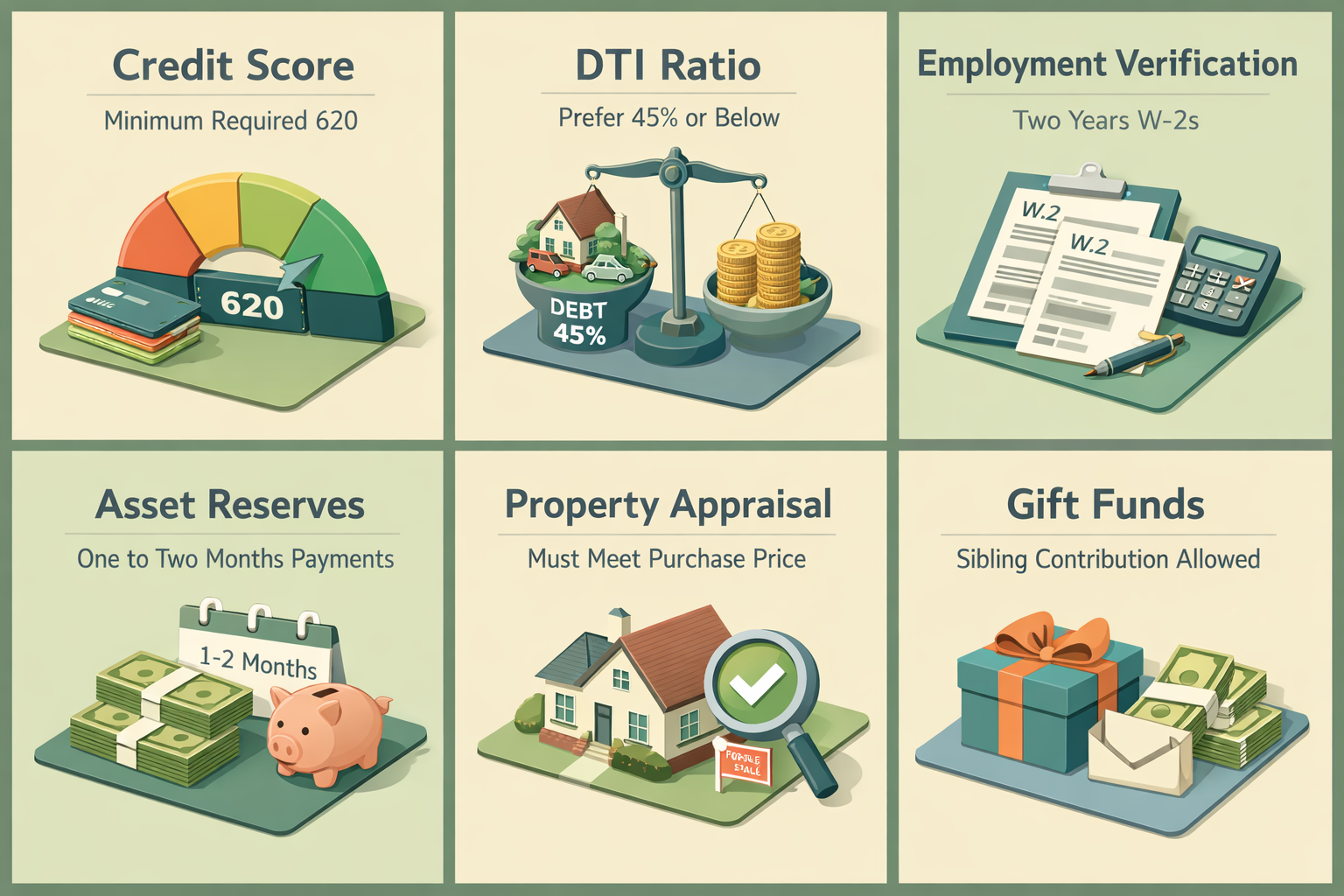
Using gift funds from a sibling addresses the down payment piece of the puzzle, but it doesn't change the fact that you — the borrower — still need to meet conventional loan with 5% down qualification standards on your own merits. Lenders will evaluate your full financial profile regardless of where your down payment originates.
Here are the key qualification areas lenders typically assess for a conventional loan with a 5% down payment:
- Credit score: Most conventional lenders require a minimum credit score of 620, though a higher score — ideally 700 or above — may help you qualify for better interest rates and terms.
- Debt-to-income ratio (DTI): Lenders generally prefer a DTI ratio of 45% or below, though some may allow up to 50% in certain circumstances with compensating factors. Your DTI compares your monthly debt obligations to your gross monthly income.
- Employment and income verification: You'll typically need to provide two years of W-2s, recent pay stubs, and possibly tax returns to verify steady, reliable income.
- Asset reserves: Even after your down payment and closing costs, some lenders may want to see that you have additional reserves — often one to two months of mortgage payments — in your account.
- Property appraisal: The home must appraise at or above the purchase price for the loan to move forward.
Meeting these standards is what makes you eligible for the loan itself. The gift simply helps bridge the gap on the upfront cash needed to close.
Common Pitfalls to Avoid When Using Sibling Gift Funds
Even when everything seems straightforward, borrowers using gift funds sometimes run into issues that could delay or derail their mortgage approval. Being aware of these common mistakes ahead of time could make a real difference.
- Treating it like a loan: If your sibling expects repayment — even informally — do not proceed until you understand the implications. Any repayment agreement, written or verbal, could be interpreted as an undisclosed liability.
- Late documentation: Waiting until the last minute to gather bank statements and transfer records can slow down underwriting significantly. Start collecting documents as soon as gift funds are discussed.
- Large unexplained deposits: If your sibling transfers money before you've coordinated with your lender, it could show up as a large unexplained deposit in your account — triggering additional scrutiny. Communicate with your loan officer before any money moves.
- Assuming all lenders treat gifts the same: Lender overlays can vary. One lender might require 60 days of bank statements; another might accept 30. Always clarify upfront.
- Forgetting closing costs: Gift funds may cover the down payment, but closing costs are a separate expense. Make sure you've budgeted for lender fees, title insurance, escrow, and other costs of closing — which can range from 2% to 5% of the loan amount.
How a Mortgage Professional Can Help You Navigate the Process
Navigating the requirements for conventional loan with 5% down payment from sibling on your own can feel overwhelming, especially when you factor in gift documentation, underwriting standards, and lender-specific overlays. Working with an experienced mortgage professional — whether a loan officer, mortgage broker, or licensed advisor — can make the process significantly smoother.
A knowledgeable mortgage professional can help you:
- Pre-qualify you based on your income, credit, and assets before you start shopping for a home
- Review your sibling's gift situation and advise on the correct documentation process
- Prepare or review the gift letter to ensure it meets all lender and agency requirements
- Identify potential red flags in your financial profile and suggest steps to address them before you apply
- Compare loan options across multiple lenders to find the most competitive rate and terms for your situation
Starting the conversation early — ideally before you make an offer on a home — gives you the best chance of a smooth, on-time closing. At LoanWise, our team is ready to help you understand your options and guide you through every step of the mortgage process with confidence.
●Conclusion
Using a sibling's generosity to help fund your home purchase is a perfectly legitimate and well-supported option under conventional mortgage guidelines. What matters most is that the process is handled correctly — with the right documentation, clear communication with your lender, and a strong personal financial profile. If you're ready to explore your options, connect with a LoanWise mortgage specialist today and take the next step toward homeownership.