
Buying a home is one of the most significant financial milestones many people will experience. But saving for a down payment can feel overwhelming, especially in today's housing market. The good news is that you don't always have to go it alone. If a sibling is willing to help by gifting you money toward your down payment, a conventional mortgage may still be within reach. Understanding the requirements for a conventional loan with 10% down payment gifted from a sibling is the first step toward turning that generosity into homeownership. This article breaks down everything you need to know — from eligibility rules to documentation — so you can move forward with confidence.
What Makes a Conventional Loan Different From Other Mortgage Types
Before diving into gift fund specifics, it helps to understand what a conventional loan actually is. Unlike FHA, VA, or USDA loans, conventional mortgages are not backed by a federal government agency. Instead, they're typically sold to or guaranteed by Fannie Mae or Freddie Mac, the two government-sponsored enterprises that set most of the underwriting guidelines lenders follow.
Because conventional loans operate under private market standards, their rules around credit scores, debt-to-income ratios, and down payments can be stricter than government-backed alternatives. However, they also come with certain advantages — such as no upfront mortgage insurance premium and greater flexibility in loan structures — which make them a popular choice for many homebuyers.
With a 10% down payment, borrowers fall into a category that typically requires private mortgage insurance (PMI) until the loan-to-value ratio drops to 80%. That said, a 10% down payment is generally considered an acceptable threshold for conventional financing, and it's also a tier where gift funds from family members may be permitted under Fannie Mae and Freddie Mac guidelines.
Who Qualifies as an Eligible Gift Donor for a Conventional Mortgage
Not everyone can gift you money for a conventional loan down payment. Fannie Mae and Freddie Mac both specify that gift funds must come from an acceptable source, and the relationship between the donor and borrower matters significantly.
For conventional mortgages, eligible gift donors typically include:
- A spouse or domestic partner
- A parent, grandparent, or other direct relative
- A sibling — including biological siblings, step-siblings, and in some cases, half-siblings
- An aunt or uncle
- A child or other dependent
The great news is that a sibling is explicitly recognized as an eligible donor under conventional mortgage gift fund requirements. This means that if your brother or sister wants to contribute toward your 10% down payment, lenders can generally accept those funds as long as the proper documentation is in place. However, it's worth confirming with your specific lender, as overlays — additional lender-imposed rules — may apply in some cases.
One critical rule: the gift must be a true gift, not a loan in disguise. If the donor expects repayment, even informally, the funds cannot be classified as a gift. Lenders take this seriously because a hidden loan would affect your actual debt obligations and could misrepresent your financial profile.
The Gift Letter: Your Most Important Document
At the heart of conventional mortgage gift fund requirements is the gift letter. This is a signed document from your sibling — the donor — that confirms several key facts about the transaction. Without a properly completed gift letter, your lender cannot accept the funds, no matter how legitimate the gift may be.
A gift letter for a conventional loan typically must include:
- The donor's full name, address, and phone number
- The donor's relationship to the borrower (in this case, sibling)
- The exact dollar amount being gifted
- The address of the property being purchased
- A clear statement that no repayment is required or expected
- The donor's signature and the date
Some lenders may also require the donor to provide proof of their ability to give the funds — such as a recent bank statement showing the money was available prior to transfer. This helps underwriters verify that the gift is genuine and not a last-minute, sourced-from-nowhere deposit that could raise red flags during the review process.
It's wise to prepare the gift letter early in the mortgage process. Last-minute paperwork often causes closing delays, which is stressful for everyone involved.
Requirements for Conventional Loan With 10% Down Payment Gifted From Sibling: Documentation and Tracing the Funds
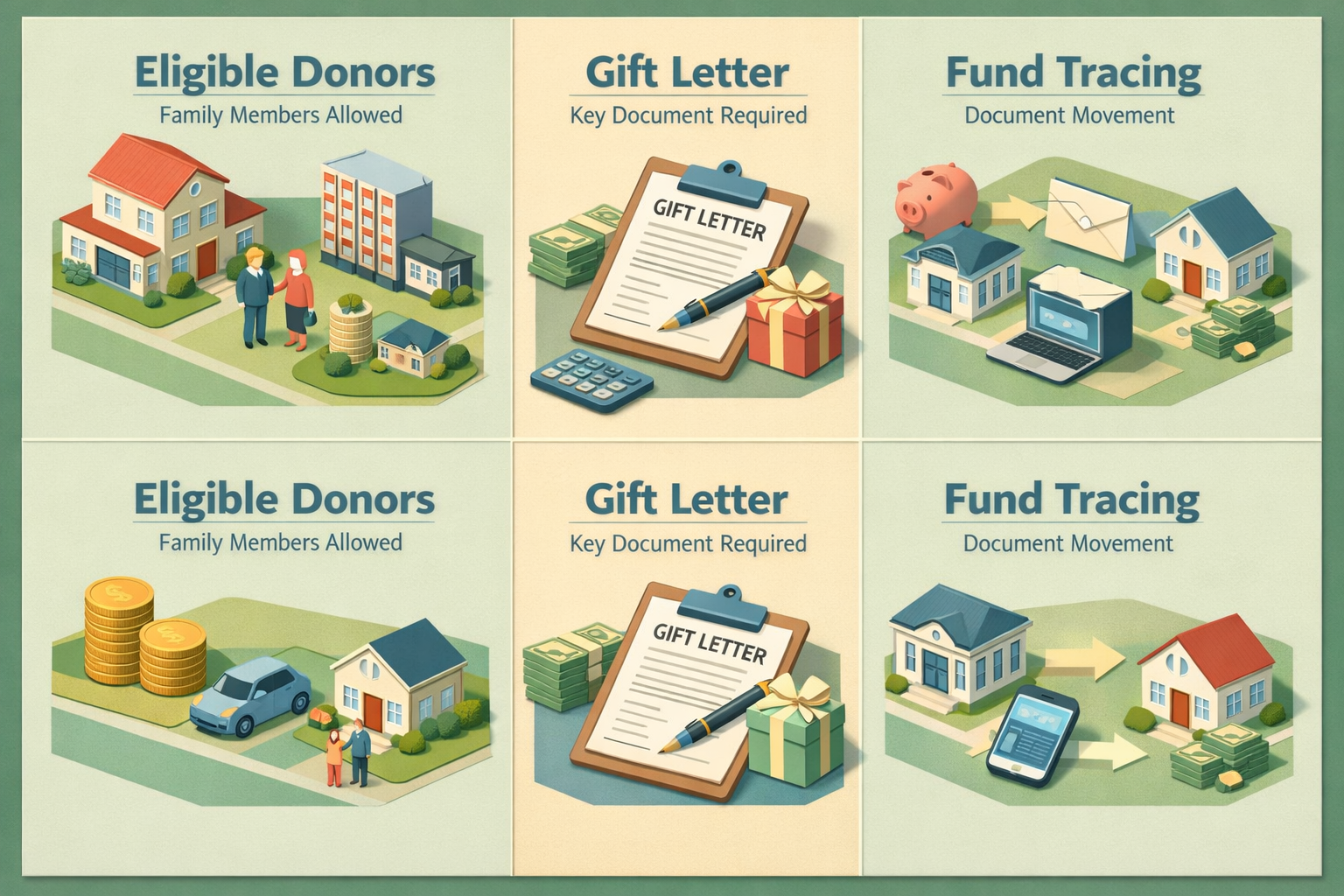
Beyond the gift letter itself, lenders and underwriters will want to trace the movement of funds from your sibling's account into your own. This process — often called a "paper trail" — is a standard part of conventional mortgage underwriting and helps confirm that the money's origin is legitimate.
Here's what that documentation process typically looks like:
- Donor bank statement: Your sibling may need to provide one or two months of bank statements showing the gifted funds were available in their account before the transfer.
- Transfer record: A wire transfer confirmation, cashier's check copy, or electronic transfer receipt showing the money moving from your sibling's account to yours.
- Borrower bank statement: Your own bank statement showing the deposit landing in your account.
Lenders may also ask for a written explanation if there are large or unusual deposits appearing alongside the gift. Keeping the gift transfer as clean and straightforward as possible — ideally a single transfer for the full gifted amount — makes the documentation process easier for both you and your underwriter.
If the gift funds are being wired directly to the escrow or title company at closing, the process can sometimes be simplified. Ask your loan officer which approach works best for your specific transaction.
How Your Credit Profile and Debt-to-Income Ratio Still Matter
Receiving a gift for your down payment doesn't change the fact that you are the borrower, and lenders will still evaluate your financial profile thoroughly. Even with a generous sibling helping with the 10% down payment, you'll need to meet the standard credit and income requirements for a conventional loan with 10% down payment.
Key borrower qualifications typically include:
- Credit score: Most conventional loans require a minimum credit score of 620, though higher scores — ideally 740 and above — may help you qualify for better interest rates.
- Debt-to-income (DTI) ratio: Lenders generally prefer a DTI ratio at or below 43%, though some automated underwriting systems may allow up to 50% in certain situations.
- Stable employment and income: At least two years of consistent employment history is typically expected, and your income must be verifiable through pay stubs, W-2s, or tax returns.
- Reserve funds: Some lenders may require you to have a certain number of months' worth of mortgage payments in reserve after closing — separate from the gift funds used for the down payment.
It's also worth noting that even if the full 10% down payment comes from your sibling's gift, conventional guidelines may require that you contribute at least some funds from your own resources depending on the loan scenario, property type, and lender overlay. A single-family, owner-occupied primary residence tends to have the most favorable rules, while investment properties or second homes may face stricter restrictions.
Private Mortgage Insurance and What to Expect at 10% Down
When a conventional loan is originated with less than 20% down, lenders typically require private mortgage insurance. At 10% down, PMI will likely be part of your monthly payment — at least until your loan balance drops to 80% of the home's original value.
PMI rates vary based on your credit score, loan amount, and lender, but they're generally a fraction of a percent of your loan balance per year. While it adds to your monthly costs, PMI is not permanent. Once you've built sufficient equity, you can request its cancellation — or it may be automatically removed when your balance reaches 78% of the original appraised value under the Homeowners Protection Act.
Some borrowers explore lender-paid PMI options or piggyback loan structures to avoid traditional PMI, though these alternatives come with their own trade-offs. Speaking with a mortgage professional can help you compare the total cost of each approach and determine what makes the most sense for your situation.
Working With a Lender Who Understands Gift Fund Transactions
Not all lenders handle gift fund transactions the same way. Some lenders may have stricter internal overlays that go beyond Fannie Mae or Freddie Mac guidelines, while others may offer more flexibility. Choosing a lender who is experienced with gift fund scenarios — and who clearly communicates what documentation they'll need — can make the entire process smoother and less stressful.
When shopping for a lender, consider asking:
- Do you accept gift funds from a sibling for a conventional loan with 10% down?
- What specific documentation will you require from both me and the donor?
- Are there any additional lender overlays that apply to gift fund transactions?
- Can the gift funds be wired directly to closing, or do they need to season in my account first?
The term seasoning refers to how long funds have been sitting in a borrower's bank account. Some lenders may want gift funds to be deposited at least 60 days before the loan application to avoid detailed sourcing requirements. Others are comfortable with recent transfers as long as the paper trail is clean. Asking these questions upfront saves time and prevents surprises later in the process.
●Conclusion
Using a sibling's generosity to help fund a home purchase is a meaningful and entirely legitimate pathway to homeownership — as long as the proper steps are followed. Understanding the requirements for a conventional loan with 10% down payment gifted from a sibling means knowing the documentation rules, preparing a thorough gift letter, maintaining a clean paper trail, and still qualifying on your own financial merits as the borrower. Conventional mortgage gift fund requirements exist to protect lenders and borrowers alike, ensuring that every transaction is transparent and sustainable. At LoanWise, we're here to help you navigate the process from start to finish. Whether you're a first-time homebuyer or an experienced homeowner exploring new financing options, connecting with a knowledgeable loan officer can help you put all the pieces together and move confidently toward closing day.