
Divorce is one of life's most challenging transitions, and deciding what to do with a shared home can make an already stressful situation even more complicated. For many homeowners, keeping the family home is a top priority — but doing so typically means taking full ownership of the mortgage. That's where understanding your options for refinancing mortgage to buy out ex-spouse becomes essential. A properly structured divorce mortgage refinance can allow one spouse to retain the home, compensate the other for their share of the equity, and move forward financially as an independent borrower. This guide walks you through how the process works, what lenders typically look for, and the key strategies available to you.
Why Refinancing Is Usually Required After Divorce
When a married couple purchases a home together, both spouses are typically listed as co-borrowers on the mortgage. This means both individuals share legal responsibility for repaying the loan. Even if a divorce agreement states that one spouse will take over the home, the other person's name remains on the mortgage until formal action is taken.
Simply removing a name from a deed does not remove it from a mortgage. Lenders are not bound by divorce decrees, and the original loan agreement stays in effect regardless of what the court orders. If the spouse who keeps the home stops making payments, the lender can still pursue the departing spouse for repayment — damaging their credit and financial standing.
This is why removing ex-spouse from mortgage loan through a formal refinance is often the most practical and financially sound solution. By refinancing, the staying spouse takes out a new loan solely in their own name, pays off the existing joint mortgage, and eliminates the other party's financial liability entirely.
Understanding Equity Buyouts and How They Work
Before exploring loan options, it's important to understand what a buy out spouse equity mortgage actually involves. Home equity is the difference between the current market value of the property and the outstanding balance on the mortgage. When one spouse keeps the home, the other is typically entitled to their share of that equity as part of the divorce settlement.
For example, if a home is worth $400,000 and the remaining mortgage balance is $250,000, the total equity is $150,000. If the split is equal, the departing spouse may be entitled to roughly $75,000. The staying spouse would need to refinance for enough to both pay off the existing mortgage and compensate their ex-partner for that equity share.
This type of transaction is commonly referred to as a cash-out refinance for divorce purposes. The new loan amount would be higher than the current mortgage balance to account for the equity payout. Lenders generally have guidelines around how much of the home's value can be borrowed in this situation, so it's worth confirming those limits with a mortgage professional early in the process.
- Get a professional home appraisal to establish the current market value before negotiations begin.
- Review your divorce settlement agreement to confirm how equity will be divided.
- Consult a mortgage lender early to understand what loan amount you may qualify for on your own income.
Your Main Options for Refinancing Mortgage to Buy Out Ex-Spouse
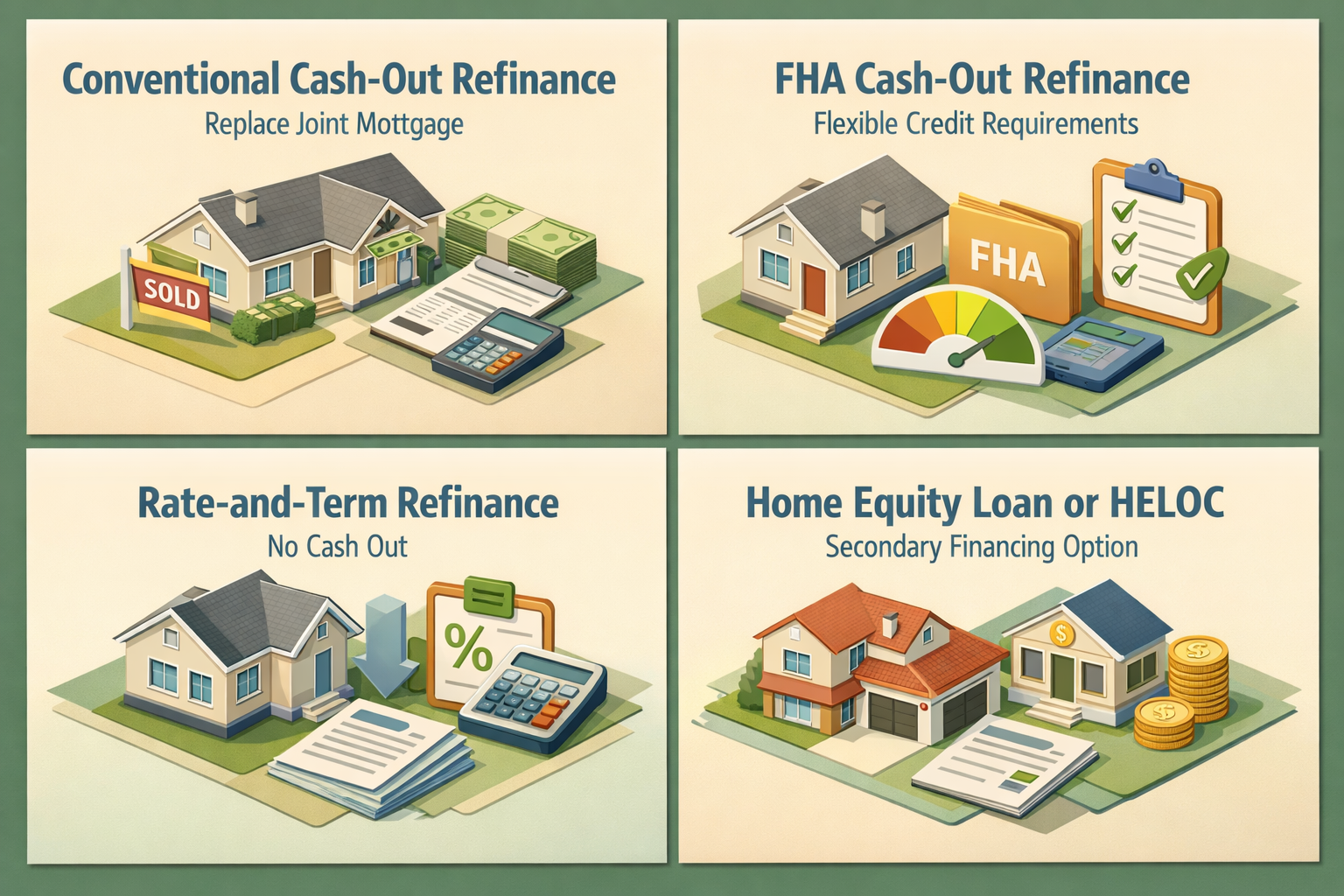
There's no single path when it comes to options for refinancing mortgage to buy out ex-spouse. The right approach depends on your credit profile, income, available equity, and the type of loan currently on the home. Here are the most common routes homeowners take.
Conventional Cash-Out Refinance
A conventional cash-out refinance is one of the most widely used tools in a divorce buyout scenario. This involves replacing the existing joint mortgage with a new, larger loan in only one spouse's name. The difference between the old loan balance and the new loan amount is paid out — often directly to the departing spouse as their equity share.
Lenders typically allow borrowing up to a certain percentage of the home's appraised value, often referred to as the loan-to-value (LTV) ratio. Requirements for credit score, debt-to-income ratio, and employment history will apply, and these will be based solely on the staying spouse's financial profile rather than the combined household income from the marriage.
FHA Cash-Out Refinance
For borrowers who may not qualify for conventional financing, an FHA cash-out refinance could be a viable alternative. FHA loans are insured by the Federal Housing Administration and often have more flexible credit requirements. However, they do require mortgage insurance premiums, which adds to the monthly cost. This option may suit borrowers who have a lower credit score or limited reserves after the divorce settlement.
Rate-and-Term Refinance with Equity Agreement
In some cases, there may not be enough equity in the home to fund a buyout through cash-out refinancing, or the staying spouse may prefer a different arrangement. A rate-and-term refinance simply replaces the existing loan with a new one — without pulling out additional cash. The equity payment to the departing spouse would then need to come from other marital assets or a separate financial arrangement agreed upon in the divorce settlement.
Home Equity Loan or HELOC as a Secondary Option
If refinancing the entire primary mortgage isn't favorable — perhaps because the current loan has a low interest rate worth preserving — a home equity loan or home equity line of credit (HELOC) might serve as a secondary tool. The staying spouse could use a second mortgage to access equity and pay off their ex-partner without disturbing the existing first mortgage. This approach works best when interest rate conditions make a full refinance less cost-effective.
What Lenders Evaluate When You Apply on Your Own
One of the biggest adjustments during a refinancing mortgage after divorce is that lenders will assess your application as a solo borrower. During the original home purchase, qualifying was likely based on two incomes. Now, the approval decision rests on your individual financial picture.
Here's what mortgage lenders typically look at during the underwriting process:
- Credit score: A strong credit score may help you secure a better interest rate and improve approval odds. If your credit has been impacted by joint debts during the marriage, it may be worth taking time to improve it before applying.
- Debt-to-income ratio (DTI): Lenders compare your monthly debt obligations to your gross monthly income. A lower DTI generally signals that you can comfortably manage the new mortgage payment on your own.
- Income verification: You'll need to document your income through pay stubs, tax returns, or other records. If you receive alimony or child support, these may be counted as qualifying income provided they are documented and expected to continue.
- Employment history: Lenders typically look for at least two years of stable employment or self-employment history.
- Reserves: Some lenders may want to see that you have savings or liquid assets available after closing, often measured in months of mortgage payments.
It's worth speaking with a lender well before the divorce is finalized. Understanding where you stand financially can help you negotiate a realistic settlement and avoid agreeing to keep a home you may not be able to refinance on your own.
Timing Your Divorce Mortgage Refinance Strategically
The timing of a divorce mortgage refinance can significantly affect the outcome. Refinancing too early — before the divorce is legally finalized — may create complications, since lenders typically want to see the finalized divorce decree and settlement agreement as part of the application. On the other hand, waiting too long can expose the departing spouse to continued financial risk if they remain on the mortgage.
Most legal and financial advisors suggest including a specific refinance deadline in the divorce settlement. For instance, the agreement might require the staying spouse to refinance within six to twelve months of the divorce being finalized. This protects both parties and gives the staying spouse time to prepare their finances.
Interest rate conditions also matter. If rates are considerably higher than when the original loan was taken out, the staying spouse will likely face a higher monthly payment — even if the principal amount stays similar. It may be worth running the numbers with a mortgage professional to understand the full cost of the new loan before committing to keeping the home.
Protecting Both Parties During the Transition
Until the refinance is complete and the joint mortgage is paid off, both spouses remain legally responsible for the loan. This creates risk for the departing spouse, particularly if the staying spouse misses a payment or falls behind. A missed payment can harm both credit profiles simultaneously.
To reduce this risk, consider the following protective measures:
- Include a refinance deadline in the divorce decree to create a legal obligation and timeline for completing the process.
- Set up automatic payments during the transition period to reduce the chance of a missed payment affecting either party's credit.
- Monitor the joint mortgage account until the refinance closes, so both parties are aware of the payment status.
- Work with a real estate attorney to ensure the deed transfer and mortgage removal are handled correctly and simultaneously.
For the departing spouse, it's also important to understand that simply being removed from the deed is not enough. The mortgage must be refinanced or paid off to eliminate liability. Keeping a copy of the finalized refinance documents provides proof that the obligation has been fulfilled.
●Conclusion
Navigating the financial side of a divorce is never easy, but having a clear understanding of your options for refinancing mortgage to buy out ex-spouse can make the process far more manageable. Whether you pursue a conventional cash-out refinance, an FHA loan, or a home equity product, the key is to act thoughtfully, involve the right professionals, and make decisions based on your individual financial capacity rather than emotion alone. Speaking with an experienced mortgage advisor early in the process could help you map out a realistic path forward — one that protects your credit, honors your settlement, and sets you up for long-term financial stability as an independent homeowner. At LoanWise, we're here to help you explore your refinancing options with confidence.