
A job change can feel like a fresh start — but if you're a homeowner with an adjustable-rate mortgage (ARM), it might also bring a wave of uncertainty about your refinancing plans. The good news is that a recent career move doesn't automatically close the door on your refinancing goals. Understanding your options for refinancing ARM mortgage with recent job change can help you approach lenders with confidence and make smarter decisions for your financial future. Whether you've switched employers, moved into a new industry, or gone from salaried to self-employed, there are pathways worth exploring — and this guide walks you through them.
Understanding How an ARM Works and Why Refinancing May Be Urgent
An adjustable-rate mortgage starts with a fixed interest rate for an initial period — often five, seven, or ten years — and then adjusts periodically based on a benchmark index. When your fixed period ends, your monthly payment could rise significantly depending on market conditions. For many homeowners, that upcoming rate adjustment is the primary motivation to refinance into a fixed-rate loan before payments become unpredictable.
If you've recently changed jobs, the urgency to lock in a stable rate before your ARM adjusts may feel even more pressing. A new job may mean a different income structure, a probationary period, or a gap in employment history — all of which lenders tend to scrutinize closely. That's why it's important to understand both the mechanics of your ARM and what lenders will be evaluating when you apply to refinance.
Refinancing an ARM into a fixed-rate mortgage is one of the most common strategies homeowners use to gain payment stability. It eliminates the risk of rate increases and gives you a predictable monthly obligation, which can be especially valuable when your income situation is in transition. Understanding the timeline of your ARM's adjustment schedule is the first step — if your rate is due to adjust soon, acting quickly may work in your favor.
What Lenders Evaluate After a Recent Job Change
When you apply to refinance, lenders will review your employment history, income stability, and overall financial profile. A job change doesn't automatically disqualify you, but it does add complexity to the approval process. Here's what mortgage lenders typically look at:
- Employment continuity: Lenders generally prefer a two-year history of stable employment in the same field. If you've changed jobs within the same industry or career path, that transition may be viewed more favorably than a complete change in profession.
- Income type: Moving from salaried to hourly, commission-based, or self-employed income can complicate how your earnings are calculated. Lenders may average income over a longer period or require additional documentation.
- Offer letters and contracts: If you've recently started a new job, a signed offer letter showing your salary or hourly rate may help demonstrate income stability to lenders — especially if you haven't yet received a full month's pay stubs.
- Probationary periods: Some lenders may be cautious about approving a refinance if you're still within a probationary employment period, though this varies by lender and loan program.
- Gaps in employment: A short gap between jobs could raise questions. Being prepared to explain the gap — and show that your new income is consistent — may help ease lender concerns.
It's worth noting that lender requirements can differ significantly depending on the loan type you're applying for and the specific underwriting guidelines of each institution. Speaking directly with a loan officer early in the process can help you understand exactly what documentation you'll need.
Options for Refinancing ARM Mortgage with Recent Job Change
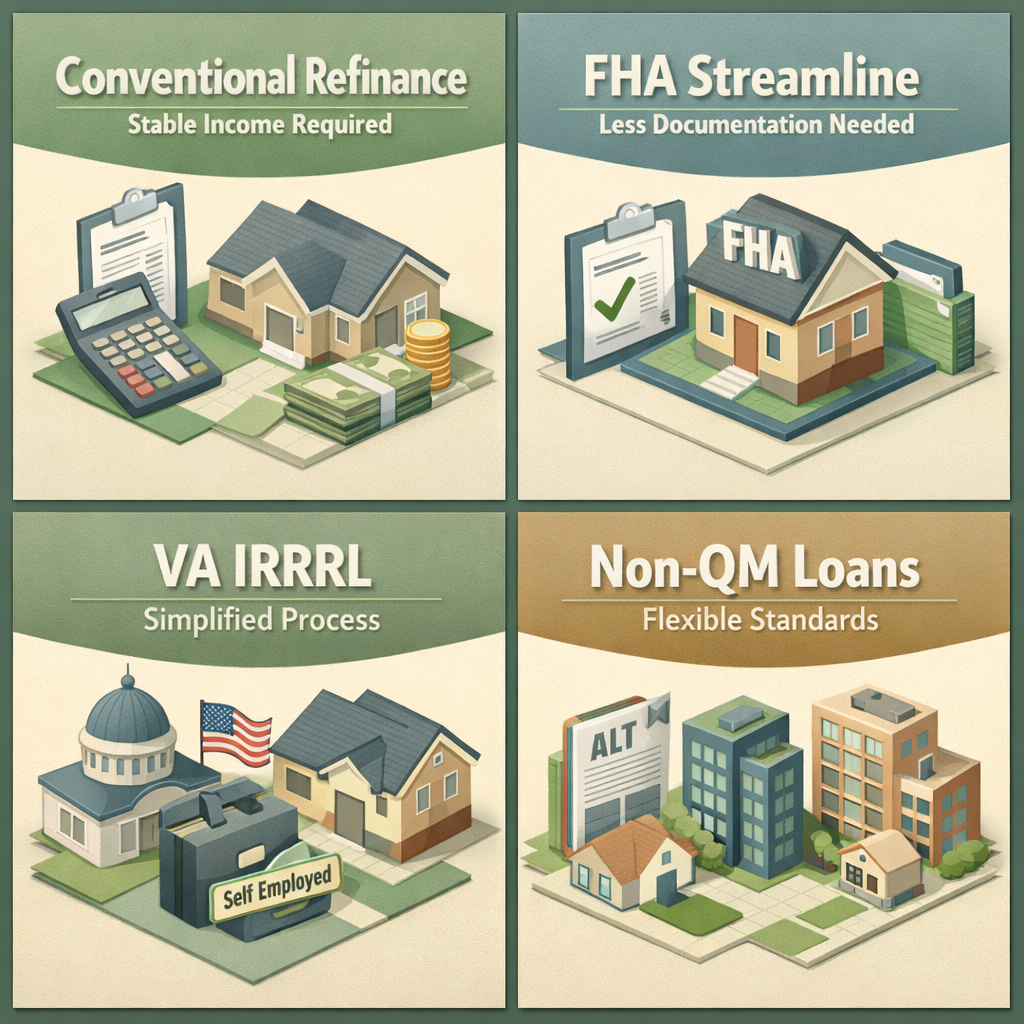
Even with a recent employment change, several refinancing options may be available to you. The right path depends on your credit profile, equity position, and the nature of your job transition.
Conventional Fixed-Rate Refinance
If your credit score is solid and you have sufficient home equity — typically at least 20% to avoid private mortgage insurance — a conventional refinance into a fixed-rate loan could be a strong option. Lenders will still want to verify your income, but if your new job is in the same field and your pay is consistent, you may qualify. Having at least one or two pay stubs from your new employer on hand can strengthen your application.
FHA Streamline Refinance
If your current mortgage is an FHA loan, you might be eligible for an FHA Streamline Refinance. This program is designed to simplify the refinancing process and typically requires less documentation. In some cases, it may not require a full income verification — though requirements can vary by lender. This could be a helpful route for homeowners who've recently changed jobs and may not yet have an extensive paper trail of new income.
VA Interest Rate Reduction Refinance Loan (IRRRL)
For eligible veterans and service members with a VA loan, the VA IRRRL — often called the VA Streamline — offers a simplified refinancing process. Like the FHA Streamline, it may require less documentation than a full refinance. If you've served and your current mortgage is a VA loan, this option is worth exploring regardless of your recent employment history.
Non-QM or Portfolio Loans
Non-qualified mortgage (Non-QM) loans and portfolio loans are offered by lenders who set their own underwriting standards outside of conventional guidelines. These products may be more flexible when it comes to employment history and income documentation. For example, bank statement loans allow borrowers to use personal or business bank statements instead of tax returns or pay stubs to verify income — which could benefit someone whose income structure has recently changed. However, these loans may come with higher interest rates or fees.
How Your Income Type After the Job Change Affects Your Application
The nature of your new income plays a significant role in how lenders assess your refinance application. Different income types are treated differently during underwriting, and being aware of these distinctions can help you prepare.
Salaried or Hourly Employment
If you've moved to a new employer but remain in a salaried or hourly position, this is generally the easiest income type to document. Lenders will typically request recent pay stubs, your offer letter, and possibly W-2s from prior years. Your transition may be viewed positively if you received a pay increase or moved into a higher-level role in your field.
Commission or Bonus-Heavy Income
If your new position relies heavily on commissions or performance bonuses, lenders may be more cautious. Because variable income can fluctuate, underwriters often average commission earnings over two years — meaning income from a brand-new commission role might not be fully counted until you've established a track record. In this case, having a strong base salary component can help offset that uncertainty.
Self-Employment After Leaving a W-2 Role
Transitioning to self-employment is one of the more challenging income changes when it comes to mortgage refinancing. Most conventional lenders want to see at least two years of self-employment history, verified through tax returns. If you've only recently gone out on your own, you may need to explore Non-QM options or wait until you've built a more established self-employment record. A knowledgeable loan officer can help you evaluate timing and strategy.
Strengthening Your Refinance Application During a Career Transition
Even if your employment situation is complicated, there are steps you can take to improve your chances of approval when you refinance ARM after job change. Preparation and documentation are your two most powerful tools.
- Build your credit profile: A strong credit score — generally 700 or above — can help offset some of the risk lenders associate with a recent job change. Paying down revolving balances and avoiding new credit inquiries before applying may help improve your score.
- Increase your home equity: If possible, making additional principal payments before applying could improve your loan-to-value ratio, which strengthens your application and may help you access better interest rates.
- Document everything: Gather your offer letter, employment contract, recent pay stubs, prior W-2s, and tax returns. The more organized and complete your documentation, the smoother the underwriting process may go.
- Write an explanation letter: If there's a gap in your employment or your job change looks unusual on paper, a brief, clear letter of explanation can provide context that helps underwriters understand your situation.
- Shop multiple lenders: Lender guidelines vary. One lender might view your recent job change as a red flag, while another with more flexible guidelines may see it differently. Comparing offers from multiple lenders could open doors that seem closed at first.
Timing Matters: When to Act on Your Refinance
One of the most strategic decisions you'll make is when to apply for your refinance. There's often a balance between waiting long enough to establish income stability at your new job and acting quickly enough to refinancing your ARM before it adjusts to a potentially higher rate.
If your ARM's fixed period is ending soon, waiting may cost you. A rate adjustment on an ARM could increase your monthly payment meaningfully — and refinancing after a rate spike may feel more urgent but could also happen in a higher-rate environment. On the other hand, if your fixed period still has a few years remaining, you might have more flexibility to wait until you have a few months of pay history at your new job, which could simplify your application.
It's also worth monitoring the broader interest rate environment. Refinancing makes the most financial sense when the new rate is meaningfully lower than your current rate — or when locking in a fixed rate provides long-term value even at a comparable rate to your ARM's current level. A loan officer or mortgage advisor can help you run the numbers and identify your break-even point, which is the time it takes for your monthly savings to offset the costs of refinancing.
●Conclusion
Navigating the options for refinancing ARM mortgage with recent job change requires a clear understanding of lender expectations, your income situation, and the loan programs available to you. While a job change does add complexity to the refinancing process, it doesn't have to derail your plans. With the right preparation, documentation, and guidance, many homeowners successfully refinance even after a career transition. The key is to act thoughtfully, explore multiple options, and work with a knowledgeable mortgage professional who can help tailor a strategy to your specific circumstances. At LoanWise, our team is ready to help you evaluate your refinancing options and find a path that works for your goals — no matter where you are in your career journey.