
Owning a home financed by an adjustable-rate mortgage can feel like walking a tightrope, especially when interest rates are on the rise. If your primary or supplemental income comes from selling rare books, whether through auctions, private collectors, or online marketplaces, you may wonder whether refinancing is even possible. The good news is that it often is. Understanding the options for refinancing an ARM mortgage with income from rare book sales requires knowing how lenders evaluate non-traditional earnings and which loan products might be the best fit for your financial profile. This article walks you through exactly that.
Why Homeowners With Adjustable-Rate Mortgages Consider Refinancing
An adjustable-rate mortgage, commonly referred to as an ARM, starts with a fixed interest rate for an introductory period, then adjusts periodically based on a benchmark index. While ARMs can offer lower initial payments, the uncertainty of future rate adjustments may create financial stress, particularly for homeowners with income that already fluctuates month to month.
For those earning money through variable rate mortgage investment income sources like rare book sales, the combination of an unpredictable mortgage payment and an unpredictable income stream can feel especially risky. Refinancing into a fixed-rate mortgage could provide more stable, predictable monthly payments, making it easier to budget and plan around the natural highs and lows of book selling income.
Beyond payment stability, refinancing may also allow homeowners to:
- Potentially lower their overall interest rate if market conditions are favorable
- Access home equity through a cash-out refinance
- Shorten or extend their loan term to better match their financial goals
- Consolidate debt or reduce financial exposure to rate volatility
Understanding your motivation for refinancing is the first step. For rare book sellers, locking in a predictable payment may be the most compelling reason to explore this path.
How Lenders Evaluate Irregular Income From Rare Book Sales
One of the biggest challenges in an ARM refinance with rare book income is demonstrating to lenders that your earnings are consistent enough to support a mortgage. Traditional lenders typically prefer W-2 income, but that doesn't mean self-employed or niche income earners are shut out of refinancing opportunities.
When your income comes from rare book sales, lenders will generally want to see a documented history of earnings. The most common documentation requirements may include:
- Two years of personal tax returns, including all schedules showing business or self-employment income
- Profit and loss statements if you operate as a sole proprietor or through a business entity
- Bank statements showing consistent deposits from book sales over a 12- to 24-month period
- 1099 forms if you sell through platforms that issue them
- Business licenses or seller registrations as proof of an established operation
Lenders typically average your income over two years to determine a qualifying figure. If your rare book sales fluctuate significantly, a high-earning year followed by a lower-earning year could result in a lower average income figure than you might expect. It's worth reviewing your tax returns carefully before applying.
Additionally, lenders may apply what's called an income continuance standard, meaning they want reasonable confidence that your income source will continue for at least three years. Being able to demonstrate ongoing relationships with collectors, dealers, or auction houses may help support this case.
Non-QM Loan Programs That Support Borrowers With Niche Income Streams
If traditional lending channels present too many hurdles, non-qualified mortgage (non-QM) programs may offer a more accessible path. These loan products are designed specifically for borrowers whose income doesn't fit neatly into conventional guidelines, making them potentially well-suited for rare book sellers exploring irregular income mortgage refinance options.
Non-QM lenders often use alternative documentation methods to assess a borrower's ability to repay. Common approaches include:
- Bank statement loans: Lenders analyze 12 or 24 months of bank statements to calculate average monthly deposits rather than relying solely on tax returns. This can be advantageous if your tax returns reflect deductions that reduce your reported income.
- Asset depletion loans: If you hold significant liquid assets, such as proceeds from rare book sales stored in investment or savings accounts, some lenders may allow those assets to be converted into a calculated monthly income figure for qualifying purposes.
- Profit and loss only loans: Some non-QM programs accept a CPA-prepared profit and loss statement as the primary income documentation without requiring full tax returns.
It's important to note that non-QM loans may carry higher interest rates or require larger down payments or equity positions compared to conventional loans. However, for borrowers with specialized income profiles, they may represent the most realistic path to refinancing out of a variable-rate mortgage. Working with a knowledgeable mortgage broker or lender who has experience with non-traditional income borrowers could make a significant difference in finding the right program.
Conventional Refinancing: When It Might Still Be Within Reach
Despite the challenges that come with irregular income, conventional refinancing may still be an option for rare book sellers who can document two or more years of consistent self-employment earnings. Fannie Mae and Freddie Mac, which set the guidelines for most conventional loans, do allow self-employed borrowers to qualify using averaged tax return income.
To improve your chances of qualifying for a conventional refinance, consider the following strategies:
- Maintain clean, organized tax records that clearly show your rare book sales as a legitimate, recurring business activity
- Minimize aggressive deductions in the years leading up to your refinance application, since higher reported income on your tax returns strengthens your qualifying profile
- Build equity in your home, as a lower loan-to-value ratio may make lenders more comfortable with the overall risk profile of your application
- Strengthen your credit score by paying down revolving debt and avoiding new credit inquiries before applying
Conventional loans backed by Fannie Mae or Freddie Mac typically offer competitive interest rates and do not carry the premium pricing sometimes associated with non-QM products. If your income documentation is solid and your financial profile is otherwise strong, a conventional refinance could be the most cost-effective option available to you.
FHA Refinance Options for Homeowners With Self-Employment Income
The Federal Housing Administration (FHA) offers refinance programs that may be accessible to self-employed borrowers, including those whose income comes from unconventional sources like rare book sales. FHA loans are known for their more flexible qualification standards compared to conventional programs, which can work in favor of borrowers with irregular income histories.
FHA guidelines generally require:
- A minimum credit score, which can vary by lender but is typically more lenient than conventional requirements
- Two years of self-employment history in the same field or industry
- Documentation showing that the business is likely to continue operating
- Income averaged over two years using tax returns and, in some cases, a year-to-date profit and loss statement
One FHA refinance option worth considering is the FHA Streamline Refinance, which is available to existing FHA loan holders. However, it's important to note that this program is only an option if your current mortgage is already an FHA loan. If your ARM is a conventional product, you would need to go through a full FHA refinance underwriting process rather than a streamlined one.
FHA refinances do come with mortgage insurance premiums, which add to the overall cost of the loan. Weighing these costs against the benefit of a stable fixed rate is an important part of the decision-making process for any homeowner considering this route.
Practical Steps to Prepare Your Refinance Application as a Rare Book Seller
Preparation is everything when you're pursuing the options for refinancing an ARM mortgage with income from rare book sales. Because your income may be viewed as non-traditional, taking proactive steps to organize and present your financial profile clearly can make a meaningful difference in the outcome of your application.
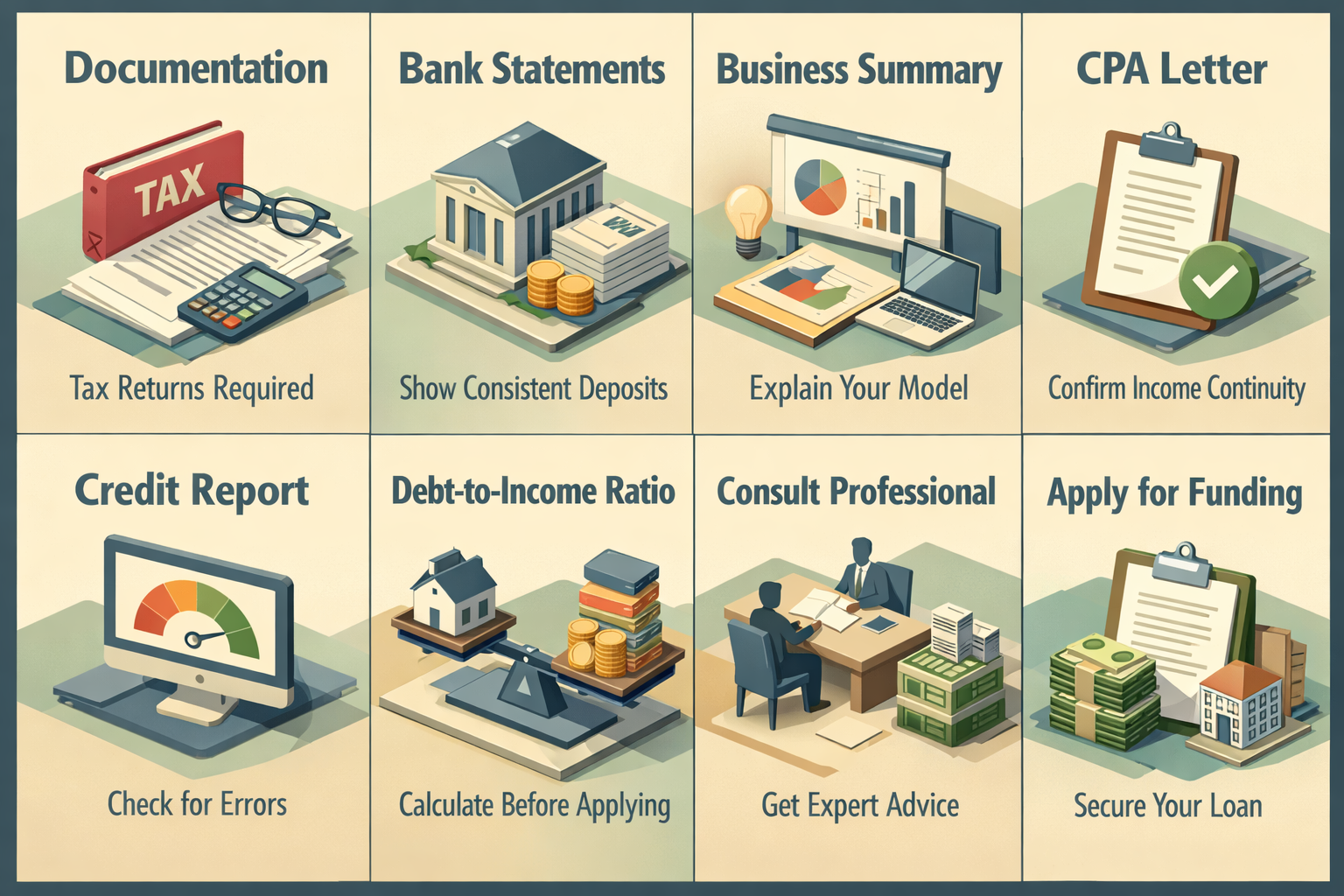
Here's a practical checklist to get started:
- Gather two years of personal and business tax returns, including all schedules and attachments
- Compile 12 to 24 months of bank statements showing consistent deposits tied to book sale activity
- Prepare a business summary that explains your rare book business model, your customer base, and how you source and sell inventory
- Request a letter from a CPA or accountant confirming the nature and continuity of your self-employment income
- Check your credit report for errors and address any discrepancies before applying
- Calculate your debt-to-income ratio using your averaged income figures to understand where you stand before approaching lenders
- Consult with a mortgage professional experienced in self-employed or non-QM borrower scenarios
Starting this preparation process well in advance, ideally six to twelve months before you plan to apply, gives you time to clean up your financial records and position your income in the strongest possible light.
●Conclusion
Refinancing an adjustable-rate mortgage when your income comes from rare book sales is undeniably more complex than a straightforward salaried borrower's application. But it's far from impossible. Whether you explore conventional programs, FHA options, or non-QM lending solutions, there are pathways available that may fit your unique financial profile. The key is understanding how lenders view your income, documenting it thoroughly, and working with a mortgage professional who understands the nuances of self-employment and irregular income situations. At LoanWise, we're here to help you navigate those options with clarity and confidence. Reach out to our team today to discuss which refinancing strategy may be the right fit for your goals.