
Owning a home in the United States while earning income from overseas investments is more common than many people realize. For homeowners with an adjustable-rate mortgage, the question of how to lock in a more stable loan product becomes especially pressing when interest rates are rising. But if a significant portion of your earnings comes from foreign dividends, you may find that standard refinancing paths aren't as straightforward as you'd hope. The good news is that there are real options for refinancing ARM mortgage with foreign dividend income — you just need to know where to look and how to prepare. This article walks you through the key considerations, loan programs, and strategies to help you move forward with confidence.
Why Adjustable-Rate Mortgages Often Prompt a Refinance Decision
An adjustable-rate mortgage, or ARM, typically starts with a lower fixed interest rate for an initial period — often five, seven, or ten years — before transitioning to a rate that adjusts periodically based on a market index. For many homeowners, this structure made perfect sense at the time of purchase. However, as the adjustment period approaches or begins, monthly payments can rise significantly, creating financial uncertainty.
Refinancing into a fixed-rate mortgage is one of the most common responses to this situation. A fixed-rate loan gives you a predictable monthly payment for the life of the loan, which can make budgeting far more manageable. For homeowners with variable or non-traditional income sources — like foreign dividend payments — this stability becomes even more important.
It's worth understanding that lenders assess your refinance application based largely on your ability to repay the new loan consistently. That means income documentation plays a central role in the approval process. If your income includes dividends from foreign corporations, investment accounts held abroad, or international holdings, you'll likely face additional scrutiny compared to borrowers with straightforward domestic W-2 employment income.
How Lenders View Foreign Dividend Income During Underwriting
Foreign dividend income can be a legitimate and substantial earnings source, but lenders tend to approach it carefully. The core concern is continuity and verifiability. Underwriters want confidence that your income will continue for at least the next three years, which is a common benchmark used by many conventional loan guidelines. Foreign dividends can sometimes be harder to verify than domestic income, and currency fluctuation adds another layer of complexity.
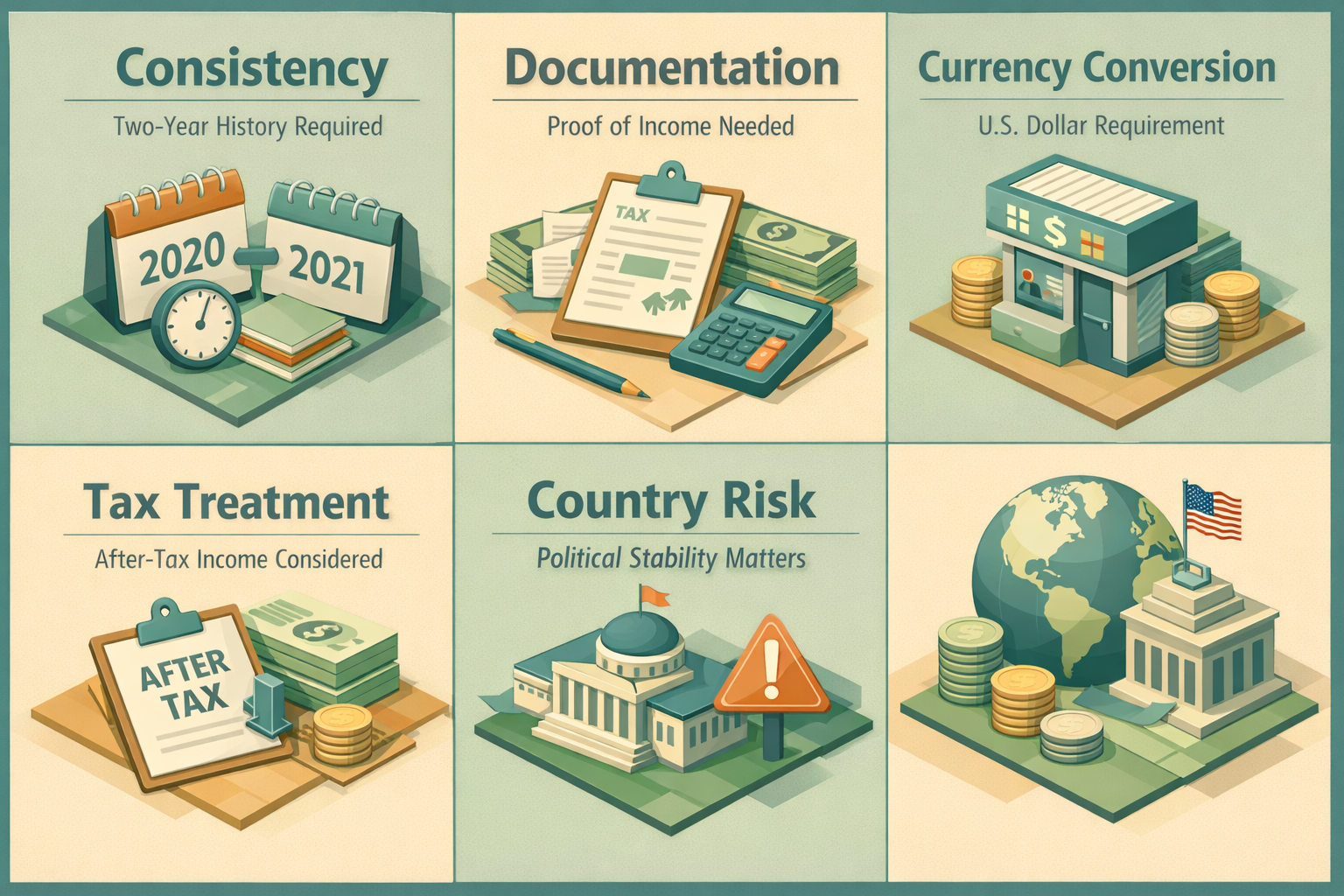
Here are some of the key factors lenders typically evaluate when reviewing foreign dividend income:
- Consistency: Lenders generally want to see at least a two-year history of receiving the dividend income. One-time or irregular payments may not be counted at all.
- Documentation: You may need to provide foreign tax returns, brokerage account statements, dividend statements, or a letter from a financial advisor confirming the income's source and expected continuance.
- Currency conversion: Any income reported in a foreign currency will need to be converted to U.S. dollars. Lenders may use a conservative exchange rate or an average over a period of time, which could reduce the effective income figure used in qualifying calculations.
- Tax treatment: Foreign dividends may be taxed differently depending on tax treaties between the U.S. and the country where the income originates. Lenders may factor in after-tax income rather than gross dividend payments.
- Country risk: Some lenders may be hesitant to accept income sourced from countries with political instability or strict currency controls, as this could affect the reliability of future payments.
Understanding these factors ahead of time helps you prepare a stronger application and avoid surprises during underwriting.
Conventional Loan Programs and Their Requirements for Non-Traditional Earners
Conventional loans backed by Fannie Mae or Freddie Mac do allow for foreign income, but their guidelines can be strict. Both agencies generally require that foreign income be documented thoroughly and that there's a reasonable expectation it will continue. If your dividend income can be clearly traced, is consistent across multiple years, and converts favorably into U.S. dollars, a conventional refinance may be a viable path.
That said, qualifying for a conventional loan also means meeting standard credit, debt-to-income, and loan-to-value requirements. Typically, lenders look for a credit score of at least 620 for conventional products, though better rates are often available to borrowers with scores above 740. Your debt-to-income ratio — the percentage of your gross monthly income that goes toward debt payments — is another critical figure. Most conventional lenders prefer this ratio to stay at or below 45%, though some flexibility may exist depending on other compensating factors.
If your foreign dividend income is your primary or sole income source, meeting conventional loan guidelines may be challenging but not impossible. The key is working with a lender experienced in handling non-traditional income documentation.
Non-QM Loans as a Flexible Path to Refinance ARM with Foreign Income
For homeowners whose income profile doesn't fit neatly into conventional or government-backed loan boxes, Non-Qualified Mortgage (Non-QM) loans can be a genuinely useful alternative. These loan products are offered by private lenders who set their own underwriting guidelines, allowing for greater flexibility when evaluating complex income situations.
When you refinance ARM with foreign income, a Non-QM lender may be willing to consider a broader range of documentation, including:
- Foreign bank statements covering 12 to 24 months as proof of income
- Asset depletion methods, where the lender calculates a monthly income figure based on your total investable assets
- Profit-and-loss statements prepared by a licensed accountant
- A letter from your financial institution or investment advisor confirming recurring dividend distributions
Non-QM loans typically come with higher interest rates compared to conventional products, and terms can vary widely between lenders. However, for a borrower with substantial foreign dividend income who cannot easily qualify through traditional channels, the trade-off may be well worth it. These loans can still be structured as fixed-rate mortgages, helping you escape the uncertainty of your adjustable-rate loan.
It's also worth noting that Non-QM products are not backed by Fannie Mae, Freddie Mac, or government agencies like the FHA or VA. This means they carry more risk for lenders, which is often reflected in the pricing. Shopping among multiple Non-QM lenders is especially important to ensure you're getting a competitive offer.
Jumbo Refinance Options for High-Value Properties and Investment Portfolios
Homeowners with higher-value properties may find that their refinance needs fall into jumbo loan territory — loans that exceed the conforming loan limits set annually by the Federal Housing Finance Agency. Jumbo lenders, particularly private banks and portfolio lenders, often have more experience working with internationally-sourced income, including foreign dividends.
Private banks in particular may offer what's sometimes called a private client or wealth management mortgage, where the lender evaluates your overall financial picture holistically. This might include your total investment portfolio value, your relationship with the bank, and your assets under management — alongside income documentation. If you hold substantial foreign investments and maintain accounts with a private banking institution, this could open doors that traditional mortgage lenders keep closed.
These relationships can be especially valuable when your dividend income fluctuates year to year, as a private lender may be more willing to view your broader financial health as a compensating factor. That said, jumbo loans typically require strong credit profiles and meaningful equity in the property being refinanced.
Practical Steps to Strengthen Your Refinance Application
Whether you're pursuing a conventional, Non-QM, or jumbo refinance, preparation is everything when foreign dividend income is involved. Here are some practical steps that may help improve your chances of approval:
- Organize two years of documentation: Gather foreign account statements, dividend notices, and any translated financial documents well in advance. Having a consistent paper trail is one of the most effective ways to demonstrate income stability.
- Work with a CPA familiar with international tax law: A tax professional who understands cross-border income can help ensure your U.S. tax returns accurately reflect your foreign earnings in a way that lenders can easily interpret.
- Get a certified translation if needed: If any of your financial documents are in a language other than English, you'll likely need certified translations for the underwriting process.
- Lower your debt-to-income ratio: If possible, pay down existing debts before applying. A lower DTI ratio makes you a more attractive borrower, even when income documentation is complex.
- Build or maintain strong credit: A solid credit score gives lenders more confidence in your borrower profile and may offset concerns about the complexity of your income source.
- Work with a mortgage broker: A broker with experience in non-traditional income scenarios can help you identify lenders who are genuinely comfortable underwriting foreign dividend income, saving you time and protecting your credit score from multiple hard inquiries.
These steps won't eliminate every challenge, but they can meaningfully improve your position before you submit a refinance application.
●Conclusion
Navigating the options for refinancing ARM mortgage with foreign dividend income requires patience, preparation, and the right lending partner. While the process may involve more documentation and a longer timeline than a standard refinance, it's entirely possible to transition out of an adjustable-rate mortgage and into a more stable loan product — even with complex international income. The key is understanding how lenders evaluate your earnings, knowing which loan programs offer the most flexibility, and presenting your financial story as clearly and completely as possible. If you're ready to explore your refinancing options, speaking with a knowledgeable mortgage professional at LoanWise can be a great first step toward financial stability.