
If you earn income as a freelancer, independent contractor, or gig worker, buying a home might feel more complicated than it does for a salaried employee. The good news is that homeownership is absolutely within reach — you just need to understand how lenders look at your earnings. Knowing how to calculate mortgage affordability with 1099 income from multiple clients is the first and most important step toward getting approved. This guide walks you through the process in plain language, so you can approach lenders with confidence and a clear picture of your financial profile.
Why 1099 Income Is Treated Differently by Mortgage Lenders
When a traditional W-2 employee applies for a mortgage, the lender can quickly verify their gross monthly salary through pay stubs and employer letters. For someone earning 1099 income from multiple clients, it's rarely that straightforward. Your income may fluctuate month to month, clients may come and go, and your tax return — not a pay stub — becomes the primary document lenders rely on.
Lenders treat self-employed borrowers with more scrutiny because variable income introduces more uncertainty. They want to see that your earnings are stable, consistent, and likely to continue. That means a single great year isn't always enough. Most lenders will want to evaluate at least two years of self-employment history before they feel comfortable approving a loan based on 1099 income.
It's also worth understanding that lenders typically use your net income — the amount left after business expenses are deducted — rather than your gross revenue. This is a key reason why some 1099 earners are surprised to find their qualifying income is lower than expected. If your tax strategy has involved significant write-offs, it may reduce your apparent income on paper, even if your cash flow feels healthy.
The Two-Year Average: How Lenders Calculate Your Qualifying Income
The most common method lenders use to determine qualifying income for 1099 workers is the 24-month average. Here's how it generally works: the lender adds up your net self-employment income from your two most recent federal tax returns and divides by 24 to arrive at a monthly figure. This monthly income number is then used in your debt-to-income (DTI) ratio calculation.
For example, if your Schedule C showed a net profit of $72,000 in Year 1 and $84,000 in Year 2, your total over two years is $156,000. Divided by 24 months, your qualifying monthly income would be approximately $6,500. This is the figure a lender would typically plug into their affordability model.
However, there are some important nuances to keep in mind:
- Declining income: If your income dropped significantly in Year 2 compared to Year 1, many lenders may only use the lower year — or even decline the application — because it suggests instability.
- Rising income: If your income is trending upward, some lenders may average both years, which could work in your favor.
- Less than two years self-employed: Some loan programs may allow approval with 12 months of 1099 income under specific conditions, though this is less common and often comes with stricter requirements.
Understanding this calculation is central to knowing how to calculate mortgage affordability with 1099 income from multiple clients — because your income from several clients gets pooled together on your tax return, and the net result is what lenders will examine.
Using a Self-Employed Mortgage Calculator to Estimate Your Budget
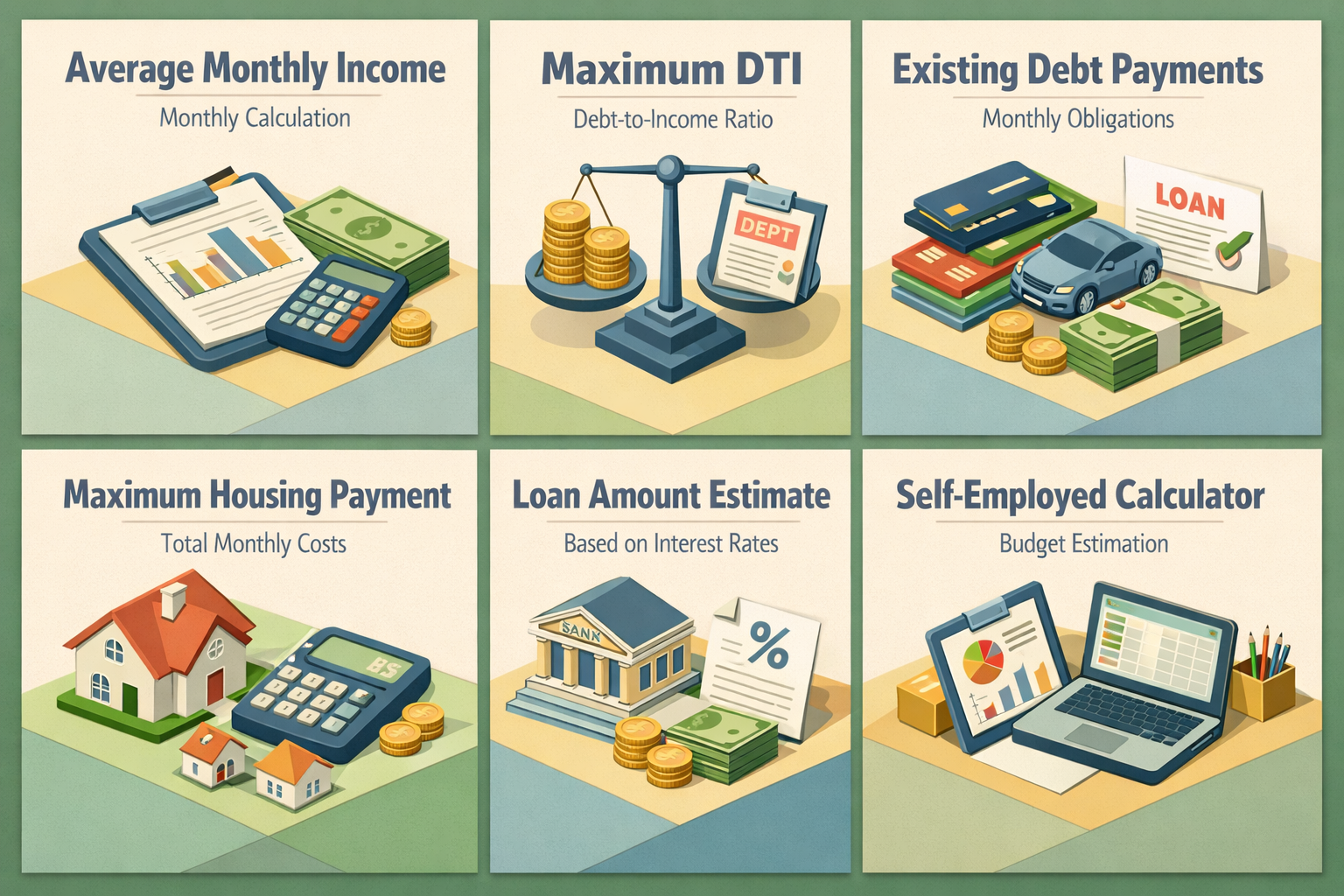
Before speaking with a lender, it's smart to run some numbers on your own. A self-employed mortgage calculator can help you estimate how much home you might qualify for based on your net income, existing debts, credit score, and down payment. These tools are widely available online and can give you a realistic starting point.
Here's a simplified way to estimate your mortgage affordability manually:
- Step 1 — Determine your average monthly net income: Add your net profit from the last two tax returns and divide by 24.
- Step 2 — Calculate your maximum DTI: Most conventional loans allow a maximum DTI of around 43% to 45%, though some programs may go higher or lower depending on other factors.
- Step 3 — Subtract existing monthly debt payments: Include car loans, student loans, credit card minimums, and any other recurring obligations.
- Step 4 — The remaining amount is your maximum monthly housing payment: This includes your principal, interest, taxes, insurance, and any HOA fees.
- Step 5 — Work backward to find your loan amount: Based on current interest rates, you can estimate the loan size that corresponds to your maximum monthly payment.
Keep in mind that a self-employed mortgage calculator provides estimates, not guarantees. Lenders may apply additional adjustments based on your specific loan program, credit profile, and the documentation you provide. Still, running these numbers ahead of time helps you walk into lender conversations fully prepared.
Key Documents You'll Need to Support Your 1099 Income Mortgage Approval
One of the most important things you can do as a 1099 borrower is get your documentation in order well before applying. Lenders will typically request a specific set of documents to verify your income, and being prepared can speed up the process significantly.
Common documents required for 1099 income mortgage approval include:
- Two years of federal tax returns (personal and business): This is the cornerstone of your application. Lenders will review your Schedule C (for sole proprietors), Schedule E (for rental or partnership income), or K-1 forms if you operate through a partnership or S-corporation.
- 1099 forms from all clients: These confirm the sources of your income and help lenders verify consistency across clients.
- Year-to-date profit and loss statement: A current P&L, ideally prepared by a CPA, shows your most recent earnings and can help bridge the gap between your last tax return and the present.
- Bank statements (typically 12–24 months): These demonstrate your actual cash flow and can supplement your tax return documentation.
- Business license or client contracts: Proof that your self-employment is ongoing and legitimate adds credibility to your application.
The more organized and complete your documentation is, the smoother your approval process is likely to be. Some lenders may also offer bank statement loans as an alternative, where 12 to 24 months of personal or business bank statements are used instead of tax returns — though these programs sometimes carry higher interest rates.
How Multiple Clients Affect Your Mortgage Application
Having income from multiple clients can actually work in your favor — as long as it's documented properly. Lenders are generally more comfortable when your income isn't dependent on a single source. If one client stops working with you, the presence of others suggests your earnings are more resilient.
That said, lenders will look at the overall pattern of your income rather than individual client relationships. What matters most is that your total net income, when averaged over two years, meets the threshold needed to support the loan amount you're requesting. Each client's payments will flow through your bank statements and ultimately appear as part of your total gross receipts on your tax return.
If you've recently added new clients and your income has grown, it's worth asking your lender whether they can consider a shorter averaging window or whether a rising-income scenario might benefit your application. Some lenders have more flexibility in how they structure their analysis, particularly for well-qualified borrowers with strong credit scores and substantial reserves.
It's also important to think about client concentration risk. If a large portion of your income comes from a single client, a lender might view that as a risk factor — similar to a salaried worker having only one employer. Diversifying your client base before applying for a mortgage could strengthen your overall profile.
Strengthening Your Application Beyond Income Documentation
Income documentation is critical, but it's not the only factor that determines whether your mortgage application succeeds. Several other elements can improve your chances of 1099 income mortgage approval and potentially unlock better loan terms.
- Credit score: A higher credit score signals to lenders that you manage debt responsibly. Aim for a score of 680 or above, though some programs may work with lower scores depending on other compensating factors.
- Down payment: A larger down payment reduces the lender's risk. Putting down 20% or more may also help you avoid private mortgage insurance (PMI), which lowers your overall monthly costs.
- Cash reserves: Lenders often feel more confident when borrowers have several months' worth of mortgage payments saved in liquid accounts. This demonstrates financial stability even in slower work periods.
- Debt-to-income ratio: Paying down existing debts before applying can significantly improve your DTI and increase the loan amount you qualify for.
- Consistent two-year self-employment history: Continuity in your self-employed work, with the same or growing income, is a strong positive signal to underwriters.
Working with a mortgage professional who has experience with self-employed borrowers can also make a meaningful difference. They can help you identify the right loan program, anticipate underwriter questions, and structure your application in the most favorable way possible.
Loan Program Options Worth Exploring for 1099 Earners
Not all mortgage programs handle 1099 income the same way, and it's worth exploring your options before committing to one path. Here are some programs that may be relevant to independent contractors and freelancers:
- Conventional loans (Fannie Mae/Freddie Mac): These are the most common mortgage type and typically require two years of self-employment history and full tax return documentation. They often offer competitive rates for well-qualified borrowers.
- FHA loans: Backed by the Federal Housing Administration, FHA loans may offer more flexible qualification criteria and lower down payment requirements, making them a popular option for first-time homebuyers with 1099 income.
- Bank statement loans (Non-QM): These non-qualified mortgage programs use bank deposits rather than tax returns to calculate income. They can be helpful if your write-offs have significantly reduced your taxable income. However, they may come with higher rates or stricter terms.
- Asset depletion loans: If you have substantial savings or investment accounts, some lenders may allow a portion of those assets to be counted as income. This could be useful if your documented income alone doesn't fully support the loan amount you need.
Understanding which program aligns best with your financial profile is a key part of learning how to calculate mortgage affordability with 1099 income from multiple clients. A knowledgeable lender can help you compare options side by side so you can make an informed decision.
●Conclusion
Buying a home as a 1099 earner is entirely possible — it simply requires a bit more preparation and a solid understanding of how lenders evaluate your income. By knowing how to calculate mortgage affordability with 1099 income from multiple clients, gathering your documentation early, managing your debt, and choosing the right loan program, you can position yourself for a successful approval. At LoanWise, we work with borrowers of all income types and are ready to help you navigate every step of the mortgage process. Start by exploring our self-employed mortgage resources or connect with one of our lending specialists today to discuss your specific situation.