
When your small business needs fast capital, the number of financing options available can feel overwhelming. Two of the most common choices entrepreneurs encounter are the merchant cash advance and the traditional term loan. On the surface, both put money in your hands — but the way they work, what they cost, and how they affect your cash flow can be dramatically different. Understanding those differences isn't just helpful; it could save your business thousands of dollars and prevent a financing mistake that's hard to undo. Whether you're a startup owner looking for quick funding or an established entrepreneur planning a major expansion, this guide will help you compare both options clearly and confidently.
What Is a Merchant Cash Advance and How Does It Work?
A merchant cash advance (MCA) is a form of revenue-based financing where a lender provides a lump sum of capital to a business in exchange for a percentage of future sales or daily bank deposits. It's not technically a loan — it's a purchase of future receivables. That distinction matters, and we'll explain why shortly.
Here's the basic flow: a lender advances you a set amount, say $50,000, and in return, you agree to repay a larger total — often referred to as the factor amount — through automatic daily or weekly deductions from your business bank account or credit card sales. The factor rate (commonly expressed as 1.2 to 1.5 or higher) determines how much you repay in total. So a $50,000 advance at a 1.4 factor rate means you'll repay $70,000 overall.
Because repayments are tied to your revenue, they can flex with your business performance. On slower sales days, the deduction may be smaller. On busier days, more gets pulled. This flexibility is one of the biggest selling points for seasonal businesses or those with unpredictable cash flow.
However, it's important to approach MCAs with clear eyes. The effective annual percentage rate (APR) on a merchant cash advance can be significantly higher than most other financing options — sometimes reaching triple digits when calculated on an annualized basis. Because MCAs aren't classified as loans in most states, they're often subject to less regulatory oversight, which means fewer consumer protections for the borrower.
Breaking Down the Traditional Business Term Loan
A term loan is what most people picture when they think of business financing. You borrow a fixed amount of money from a lender — a bank, credit union, or online lender — and repay it over a set period with regular installment payments that include both principal and interest.
Term loans typically come in two varieties: short-term loans (often 3 to 18 months) and long-term loans (which may extend several years). The interest rate may be fixed or variable, and the overall cost of borrowing is generally expressed as an APR, making it easier to compare options side by side.
Qualifying for a term loan usually requires more documentation than an MCA. Lenders typically want to review your business credit score, personal credit history, revenue records, tax returns, and sometimes collateral. This more rigorous process can be a barrier for newer businesses or those with challenged credit — but it also means the rates and terms are often more favorable for those who do qualify.
For small business owners and commercial borrowers who have established financial histories and need capital for long-term investments like equipment, real estate, or expansion, a term loan may offer a more cost-effective path. The structured repayment schedule also makes budgeting more predictable, which many entrepreneurs find valuable for managing operations.
Speed and Accessibility: Which Option Gets You Funded Faster?
One area where the merchant cash advance clearly stands out is speed. Many MCA providers can approve and fund a business within 24 to 72 hours. The application is typically short, documentation requirements are minimal, and approvals are often based primarily on your recent sales volume rather than your credit score or business age.
This makes MCAs particularly attractive for entrepreneurs who need emergency working capital — covering payroll during a slow month, restocking inventory ahead of a busy season, or addressing an unexpected equipment failure. If time is the primary constraint, an MCA might seem like the logical choice.
Term loans, on the other hand, may take anywhere from a few days (with online lenders) to several weeks (with traditional banks). The more thorough underwriting process is the main reason for this delay. Banks and credit unions in particular tend to move more slowly due to their stricter compliance and documentation requirements.
That said, several online lenders now offer term loans with streamlined applications and faster turnaround times — sometimes within two to five business days. So if speed is your top priority, it's worth exploring online term loan options before defaulting to an MCA purely for convenience.
Understanding the True Cost: Factor Rates vs. Interest Rates
This is arguably the most important section for any small business owner to understand. The way MCAs and term loans express their cost is fundamentally different — and that difference can make one option look deceptively affordable.
With a term loan, you pay interest, which is typically expressed as an annual percentage rate (APR). This standardized measure lets you compare loans across lenders on an apples-to-apples basis. A loan with a 12% APR costs you 12% of the outstanding balance per year.
With a merchant cash advance, the cost is expressed as a factor rate. A factor rate of 1.3 means you repay $1.30 for every $1.00 advanced — a 30% total cost. That might sound reasonable until you consider the time frame. If you repay the advance in four months, that 30% total cost translates to an effective APR well over 90%. The shorter the repayment period, the higher the effective rate.
Because MCAs aren't classified as loans in most jurisdictions, lenders aren't always required to disclose an APR, making cost comparisons harder for borrowers. Always ask an MCA provider to express the full repayment amount and the estimated repayment timeline before signing any agreement. If they can't or won't provide that information clearly, that's a red flag worth taking seriously.
Qualifying Criteria: Who Can Access Each Type of Financing?
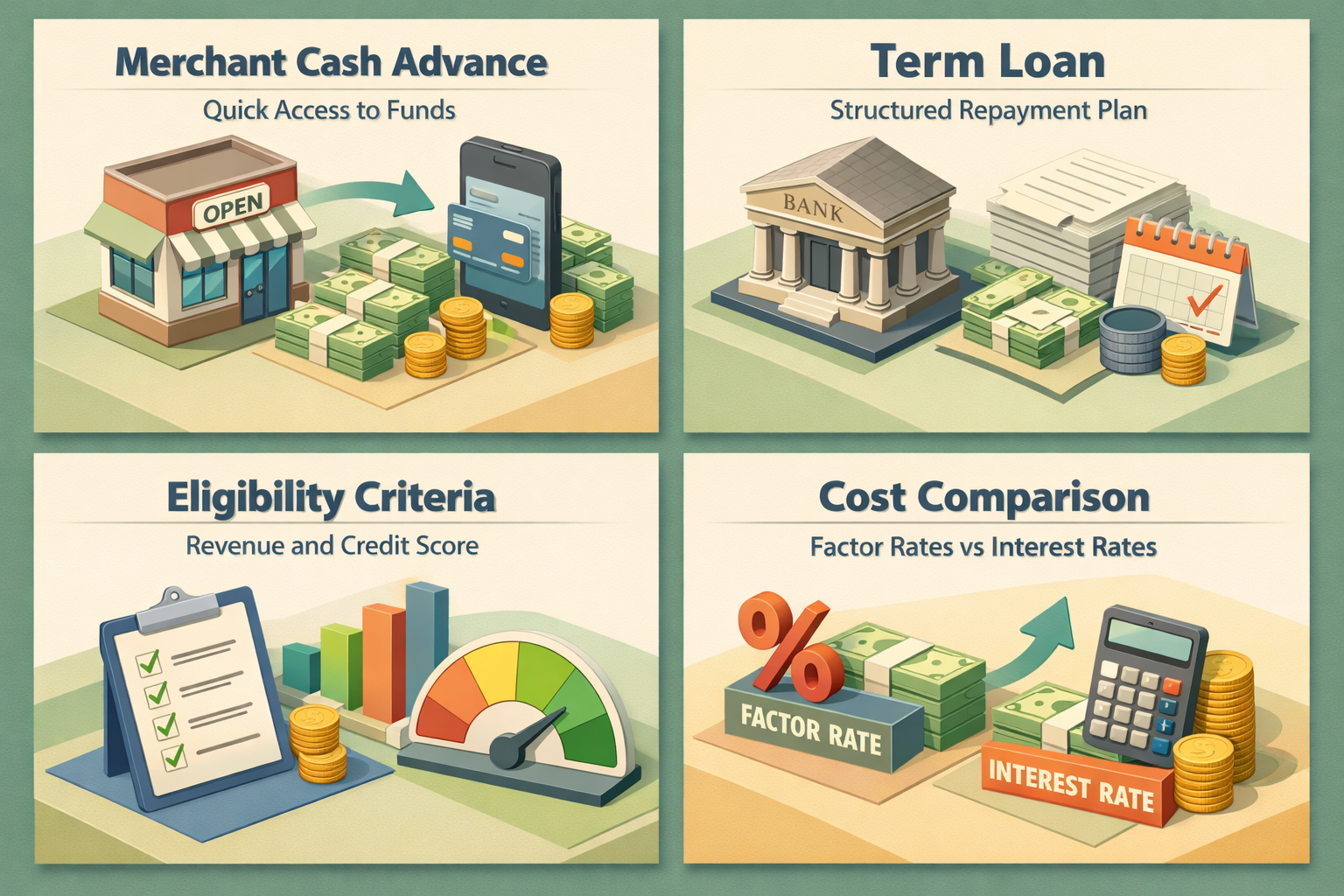
Eligibility requirements differ significantly between these two financing types, and knowing where you stand can save time and prevent unnecessary credit inquiries.
- Merchant Cash Advance: MCA providers typically focus on your monthly or annual revenue, often requiring a minimum of $10,000 to $15,000 in monthly sales. Credit score requirements are generally more lenient, and some providers may work with scores as low as 500. Businesses that have been operating for at least three to six months may qualify.
- Term Loan: Traditional lenders usually require a minimum credit score of 620 or higher, though some online lenders may accept lower scores with compensating factors. Most want to see at least one to two years in business and consistent annual revenue. Collateral may be required for larger loan amounts.
For startups and businesses with limited credit history, an MCA might be the only door that's open. But for established small businesses and commercial borrowers who've built a solid financial track record, pursuing a term loan first is typically the smarter move — the potential savings in financing costs are substantial over time.
It's also worth noting that some entrepreneurs use MCAs as a bridge — accessing quick capital now while working to build the creditworthiness needed to qualify for more affordable term loan options down the road.
When a Merchant Cash Advance Makes Sense — and When It Doesn't
Despite the higher costs, there are real scenarios where a merchant cash advance could be the right tool for the job. Consider these situations:
- You need funding within 24 to 48 hours and a term loan isn't a realistic option on that timeline.
- Your revenue is strong but your credit is weak, and traditional lenders have declined your application.
- You have a short-term, high-return opportunity — like purchasing discounted inventory that you're confident you can sell quickly at a profit that exceeds the MCA cost.
- Your sales are seasonal and you prefer repayments that flex with your revenue rather than fixed monthly installments.
On the other hand, a merchant cash advance is likely the wrong choice if:
- You need capital for a long-term investment where returns will take years to materialize.
- Your margins are already thin and daily deductions could strain cash flow.
- You're already carrying multiple forms of high-cost debt.
- You haven't compared the total repayment cost to what a term loan would cost you.
The key is matching the financing tool to the specific need — and being honest about your business's financial position before committing to any agreement.
Making the Right Call: A Practical Decision Framework for Entrepreneurs
Choosing between a merchant cash advance and a term loan isn't just a financial decision — it's a strategic one. Here's a simple framework to guide your thinking:
- Define your purpose: Is this a short-term cash flow need or a long-term investment? Short-term gaps may suit an MCA; growth investments typically call for a term loan.
- Calculate the total cost: Ask every lender — MCA or term loan — for the total repayment amount, not just the rate. Compare those totals, not just the monthly payment.
- Assess your eligibility: Check your credit score, revenue, and time in business before applying. This helps you target the right lenders and avoid wasted applications.
- Consider the cash flow impact: Daily deductions from an MCA can disrupt operations if your margins are narrow. Make sure you can sustain repayment without compromising daily business needs.
- Talk to a lending advisor: A knowledgeable commercial lending specialist can help you evaluate your options in context and identify programs you might not be aware of — including SBA loans, lines of credit, or equipment financing that could be a better fit.
The right financing partner won't just hand you money — they'll help you understand the full picture so you can make a confident, informed decision. At LoanWise, we work with small business owners and entrepreneurs to identify the financing solutions that truly align with their goals.
●Conclusion
Both the merchant cash advance and the term loan have a legitimate place in the small business financing landscape — but they serve very different purposes and come with very different costs. An MCA can be a lifeline when speed and accessibility matter most, while a term loan often offers more favorable economics for businesses with the creditworthiness to qualify. The most important step you can take is to slow down, compare your options carefully, and understand the full cost of any financing before you sign. If you're ready to explore what financing options might work best for your business, reach out to the LoanWise team today. We're here to help you borrow smarter and grow with confidence.