
Relocating for a new job is exciting — but it can also raise some serious questions when you're ready to buy a home. One of the most common concerns among relocated employees is whether their relocation bonus or job-change income will help or hurt their chances of getting a mortgage. If you're exploring government-backed financing, understanding how to qualify for FHA loan with recent job relocation bonus income is an important first step. FHA loans are known for their flexible qualification standards, but income verification still follows specific guidelines. The good news is that with the right documentation and a clear understanding of how lenders evaluate non-traditional income, many relocated employees can successfully secure FHA financing.
What Makes FHA Loans a Popular Choice for Relocated Homebuyers
FHA loans — backed by the Federal Housing Administration — are widely used by first-time homebuyers and individuals with moderate credit profiles. They typically require a lower down payment than conventional loans, often as little as 3.5% for borrowers with qualifying credit scores. This can be a significant advantage for employees who've recently relocated and may have spent a portion of their savings on moving expenses.
Beyond the down payment benefit, FHA loans also tend to have more flexible debt-to-income ratio thresholds compared to many conventional loan programs. This flexibility can be helpful when a borrower's income picture is somewhat complex — such as when part of their compensation includes a relocation bonus, signing bonus, or other one-time payments tied to a job change.
That said, flexibility doesn't mean anything goes. FHA lenders still follow specific guidelines when it comes to how income is calculated and verified. Understanding where relocation bonuses fit into that framework is essential before you apply.
How Lenders Define and Evaluate Relocation Bonus Income
When an employer covers the cost of an employee's move — or provides a cash bonus to offset relocation expenses — that payment is typically categorized as a relocation bonus or relocation assistance. While this sounds straightforward, lenders and FHA underwriters look at this type of income very carefully before deciding whether it can be counted toward your qualifying income.
The core principle FHA guidelines follow is that income used to qualify for a mortgage should be stable, reliable, and likely to continue. A one-time relocation bonus — meaning a lump sum paid specifically to cover moving costs — may not meet this standard on its own, because it's not expected to recur. In these cases, lenders may not count it as qualifying income for debt-to-income ratio purposes, though it might still be considered as a compensating factor or used to demonstrate financial reserves.
However, if a borrower receives a bonus as part of a broader compensation package that includes regular annual or performance bonuses, the picture can look quite different. Lenders may be willing to count bonus income if the borrower can demonstrate a consistent two-year history of receiving similar bonuses and if the employer confirms it's likely to continue. This is where documentation becomes critical.
FHA Loan Requirements for Relocation Bonus Income Documentation
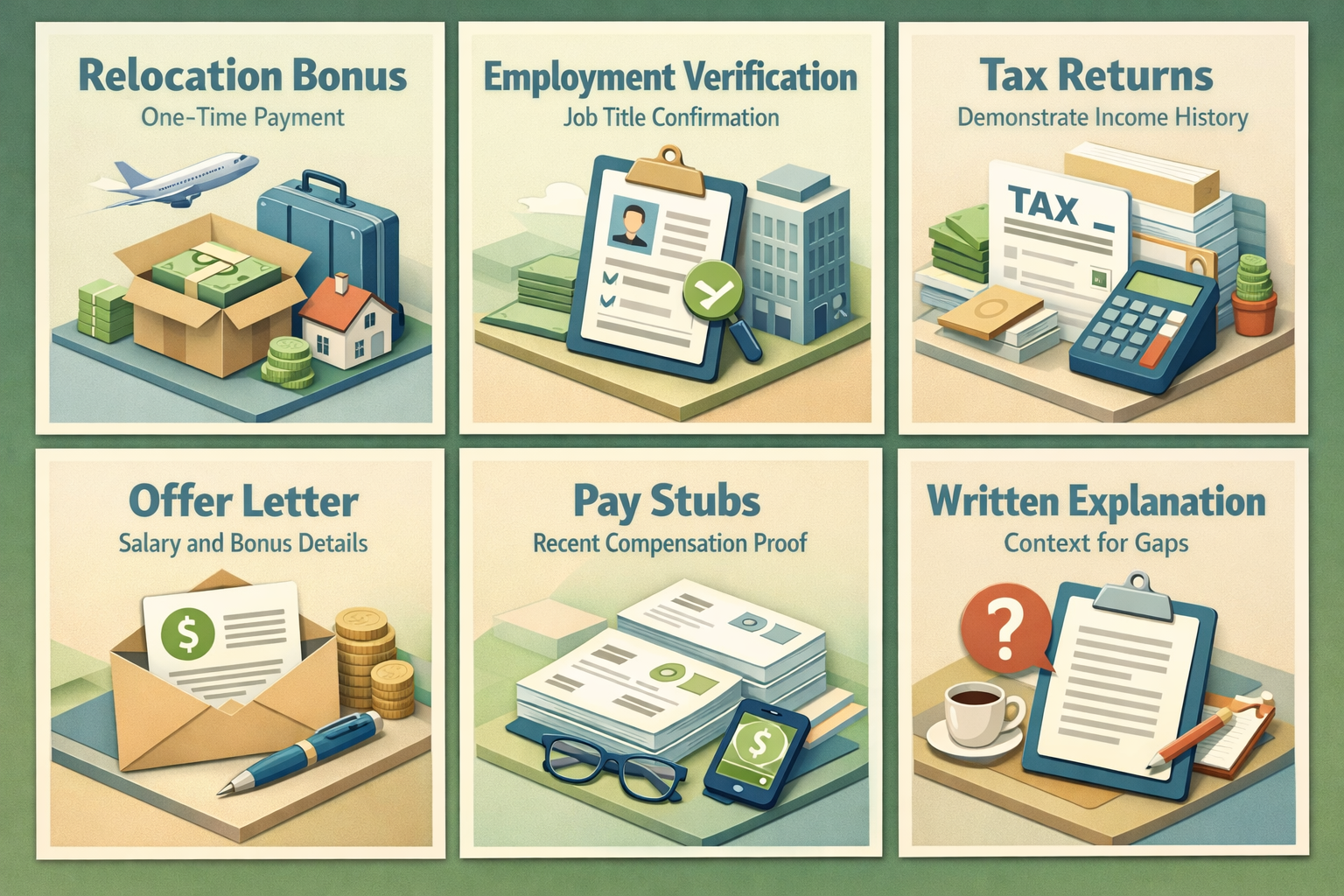
Meeting FHA loan requirements for relocation bonus income starts with having the right paperwork in order. Lenders will generally want to see evidence that supports both the existence of the income and its expected continuity. Here's what you may need to provide:
- Offer letter or employment contract: A signed offer letter from your new employer detailing your base salary, start date, and any bonus structure is often one of the first documents requested. If the relocation bonus is referenced in the letter, that context can help the underwriter understand its nature.
- Two years of tax returns: If you've been receiving bonus income in previous roles, your W-2s and federal tax returns can demonstrate a history of that income type.
- Recent pay stubs: Typically, lenders want to see the most recent 30 days of pay stubs, which helps confirm your current compensation level.
- Verification of employment (VOE): Your lender may contact your employer directly to verify your job title, start date, income, and the likelihood of continued employment.
- Written explanation letter: If your income history shows a gap due to relocation, a signed letter explaining the circumstances can help underwriters understand the full context.
Being proactive about gathering these documents can significantly reduce delays in your loan approval process. Lenders appreciate organized borrowers, and a well-prepared file often moves through underwriting more smoothly.
Navigating Employment Gaps and New Job Start Dates as an FHA Mortgage Applicant
One concern many relocated employees face is whether a recent job change — or a short gap between positions — will disqualify them from FHA financing. The short answer is: not necessarily. FHA loan requirements generally require a two-year employment history, but that doesn't mean you must have been with the same employer for two years. What matters more is that the overall employment picture shows consistency and stability.
For example, if you've worked in the same industry or field and simply changed employers due to relocation, many FHA lenders may view that transition favorably. A lateral move or promotion within your professional field is often seen as a sign of career continuity rather than instability.
On the other hand, if your relocation involved switching careers entirely, lenders may scrutinize the transition more carefully. In these situations, a strong offer letter showing a solid base salary — combined with a reasonable explanation for the career change — may still allow you to qualify.
Timing also plays a role. If you haven't yet started your new job at the time of application, some FHA lenders may allow you to qualify based on a non-revocable employment offer letter, provided the start date is within a reasonable window — often 60 days or less from closing. Policies can vary by lender, so it's worth asking about this early in the process.
How to Qualify for FHA Loan With Recent Job Relocation Bonus as Part of Total Income
Understanding how to qualify for FHA loan with recent job relocation bonus income requires a clear look at how your total compensation package will be evaluated. Lenders don't just look at individual income types in isolation — they consider your complete financial profile. Here are some strategies that may improve your position:
- Lead with your base salary: If your base salary alone covers the debt-to-income requirements, the relocation bonus becomes less of a concern. Focus on demonstrating that your regular monthly income is sufficient to support the mortgage payment.
- Use the bonus to strengthen your reserves: Even if the one-time relocation bonus can't be counted as recurring income, it can often be used to show strong financial reserves — meaning you have money left over after closing. This is a recognized compensating factor under FHA guidelines.
- Document bonus history if applicable: If you've received consistent bonus income in past jobs, that two-year history may make your new employer's bonus more credible to an underwriter.
- Work with an FHA-approved lender experienced in relocation cases: Not all lenders handle these situations the same way. Some may have overlays — additional internal requirements — while others are more comfortable with non-traditional income scenarios.
It's also worth noting that some employers offer a gross-up payment on relocation bonuses to offset the tax liability. If your employer does this, it could affect how the income appears on your pay stubs and tax documents. Be sure to disclose this to your lender so it can be properly accounted for.
Key Credit and Financial Factors That Support Your FHA Application
Even if your relocation bonus income doesn't count as qualifying income, a strong overall financial profile can significantly improve your chances of FHA approval. Lenders look at a combination of factors when assessing risk, and demonstrating strength in several areas can help offset complexity in others.
Credit score is one of the most influential factors. FHA guidelines generally allow credit scores as low as 580 for the standard 3.5% down payment option, though many lenders may require higher scores internally. If your score is strong — say, in the 680 or above range — it sends a positive signal to underwriters even when income documentation is more complex.
Debt-to-income ratio (DTI) is another key metric. FHA guidelines typically allow a back-end DTI of up to 43%, though some lenders may approve higher ratios with strong compensating factors. Keeping your existing debts — like car payments, student loans, and credit card balances — as low as possible before applying can help bring your DTI within acceptable range.
Cash reserves also matter. Having two to three months' worth of mortgage payments in savings after closing can reassure lenders that you can manage your obligations even if income temporarily fluctuates — a realistic concern for someone who recently relocated.
Working With the Right Lender Makes a Meaningful Difference
For FHA mortgage for relocated employees, the lender you choose may matter just as much as the documentation you provide. While FHA guidelines provide a national framework, individual lenders have discretion in how they apply those guidelines and may have their own internal policies that affect your options.
Some lenders specialize in working with borrowers who have complex income situations, including those with relocation packages, sign-on bonuses, or new employment arrangements. These lenders are often more familiar with how to document and present these income types in a way that satisfies underwriting requirements.
When shopping for a lender, consider asking the following questions upfront:
- Do you have experience working with borrowers who received relocation bonuses?
- Can you count an offer letter as income verification if I haven't started my job yet?
- How do you treat one-time bonus income versus recurring bonus income?
- What additional documentation will you need given my situation?
Getting clear answers early can save you time and prevent surprises later in the process. It's also a good idea to get pre-approved — not just pre-qualified — so you have a more realistic picture of what you can borrow before you start making offers on homes.
●Conclusion
Relocating for work is one of life's bigger transitions, and buying a home in a new city adds another layer of complexity. But with the right preparation, understanding of FHA income guidelines, and a lender who knows how to handle non-traditional compensation, qualifying for a mortgage is absolutely achievable. Whether your relocation bonus counts as recurring income or serves as a reserve asset, it can still play a meaningful role in your loan application. Take time to gather your documentation, understand how your full compensation package will be evaluated, and partner with a knowledgeable FHA lender who can guide you through the process with confidence. Ready to take the next step? Connect with a LoanWise lending specialist today to explore your FHA loan options.