
Buying a home after a recent job relocation can feel overwhelming, especially when shared equity arrangements are part of your financing picture. Many homebuyers assume that a new job or an equity-sharing agreement will disqualify them from government-backed financing — but that's not necessarily the case. Understanding how to qualify for FHA loan with recent job relocation and shared equity requires a clear look at FHA guidelines, lender expectations, and the documentation that supports your application. This article walks you through each piece of the puzzle so you can approach your mortgage journey with confidence.
What FHA Loans Offer Relocating Homebuyers
FHA loans are insured by the Federal Housing Administration and are widely regarded as one of the most accessible mortgage programs available to American homebuyers. They're particularly appealing because they typically require a lower down payment — often as low as 3.5% for borrowers with qualifying credit scores — and they tend to have more flexible underwriting standards compared to conventional loans.
For someone who has recently relocated for a job, these features can be a lifeline. Relocation often comes with upfront costs: moving expenses, temporary housing, security deposits, and the logistical burden of settling into a new city. Having a loan program that allows a smaller down payment and considers a broader range of borrower circumstances can make homeownership achievable sooner rather than later.
FHA loans are also available through FHA-approved lenders, which means you'll have a wide network of banks, credit unions, and mortgage companies to choose from. That competition can work in your favor when it comes to negotiating rates and terms. The key is knowing how FHA views your employment situation and any equity arrangements tied to your purchase.
How FHA Guidelines Treat a Recent Job Change Due to Relocation
One of the most common concerns among relocated homebuyers is whether a new job will hurt their mortgage application. FHA guidelines generally look for a two-year employment history, but this doesn't mean you must have been at the same employer for two years. What lenders typically want to see is a consistent pattern of employment — even if that includes a recent job change.
When a job change is related to relocation, lenders often view it more favorably than an unexplained gap or industry switch. If your new position is in the same field, offers equal or better compensation, and your employer can verify your start date and income, many FHA-approved lenders may be willing to move forward with your application.
Here are some documentation items that typically help in this scenario:
- Offer letter or employment contract from your new employer, clearly stating your start date, salary or hourly wage, and employment status (full-time, part-time, salaried, or hourly)
- Recent pay stubs covering the most recent 30-day period once you've started the new position
- Verification of Employment (VOE) completed by your new employer's HR department
- Two years of W-2s or tax returns from prior employment to establish your work history
- Relocation agreement or letter from your employer if applicable, which may strengthen your case by showing the move was employer-initiated
If you've recently transitioned from hourly or salaried employment and your new role involves variable income — such as commissions or bonuses — lenders may require a longer track record before counting that variable portion. It's worth having an honest conversation with your loan officer early in the process.
Understanding FHA Loan Requirements Around Shared Equity Arrangements
FHA loan requirements around shared equity financing are a growing topic in home financing. In a shared equity arrangement, a third party — such as a family member, employer, nonprofit, or private investor — contributes funds toward your home purchase in exchange for a share of the property's future appreciation. It's an approach that can help buyers bridge down payment gaps, but it introduces complexity when applying for an FHA loan.
FHA guidelines do permit certain types of shared equity transactions, but the structure matters significantly. The FHA has specific rules about who can contribute funds to a transaction and under what conditions. Generally, acceptable contributors include family members, employers, nonprofit organizations, and government entities. Each of these sources has its own documentation and seasoning requirements.
When a shared equity partner provides down payment funds or contributes to closing costs, lenders will typically need to verify:
- The source of the funds and that they're not a loan disguised as a gift
- A signed agreement outlining the terms of the equity share, including the contributor's interest in the property
- That the arrangement does not violate FHA's prohibition on interested-party contributions that exceed allowable limits
- Any recorded instruments such as subordinate liens or equity-sharing agreements that may affect the property's title
It's important to note that if the shared equity partner holds a recorded interest in the property, this may affect the loan-to-value calculation and the lender's title requirements. Working with an attorney who understands real estate and an FHA-approved lender familiar with shared equity structures is strongly advisable in these situations.
Credit Score and Debt-to-Income Ratio Expectations for FHA Applicants
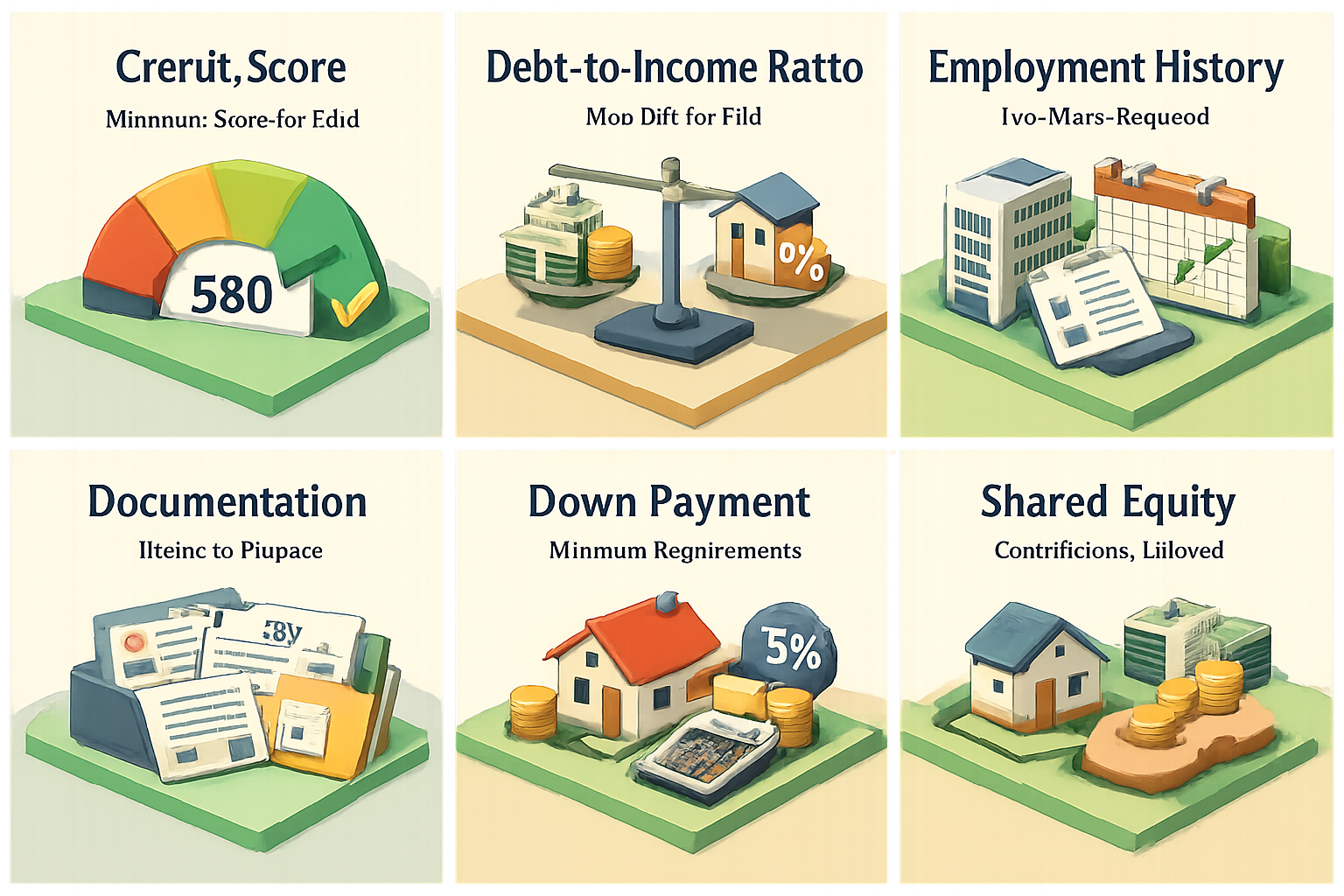
Even with flexible employment guidelines, FHA loans still have baseline credit requirements. Borrowers with a credit score of 580 or higher may qualify for the 3.5% down payment option. Those with scores between 500 and 579 may still be eligible but would typically need to put down at least 10%. Scores below 500 are generally not eligible under FHA guidelines, though individual lenders may apply their own overlays — meaning their standards could be stricter than the FHA minimum.
Your debt-to-income (DTI) ratio is equally important. FHA guidelines typically allow a DTI of up to 43%, though some lenders may approve borrowers with higher ratios if there are strong compensating factors, such as significant cash reserves, a low loan-to-value ratio, or a long history of on-time payments. If relocation costs have added to your short-term debt load, it's worth working to pay down balances before applying.
Here's a brief look at how these factors interact:
- Higher credit score — May offset concerns about a recent job change or non-traditional equity arrangement
- Lower DTI — Demonstrates that your monthly obligations are manageable relative to your new income
- Cash reserves — Having two to three months of mortgage payments in savings can serve as a compensating factor for lenders who are cautious about relocation-related employment gaps
Navigating the Appraisal and Property Eligibility Rules
FHA loans come with property eligibility requirements that are distinct from conventional financing. The home you're purchasing must be your primary residence — you cannot use an FHA loan for a vacation property or a standalone investment property. This is worth keeping in mind if you're relocating and consider renting out the home later.
An FHA-approved appraiser must assess the property to ensure it meets the Department of Housing and Urban Development's minimum property standards. The appraiser checks for things like structural soundness, working utilities, and the absence of hazards such as lead paint on surfaces accessible to children. If the property needs repairs to meet these standards, the seller may need to address them before closing, or you might consider an FHA 203(k) rehabilitation loan if the home requires significant work.
In shared equity arrangements, the appraisal becomes even more critical. The appraised value determines how much the equity contributor's share is worth and forms the basis for any equity-sharing agreements tied to future appreciation. Make sure the agreed-upon purchase price aligns realistically with appraised value — FHA will lend based on the lesser of the two.
Practical Steps to Strengthen Your FHA Application After Relocation
Knowing how to qualify for FHA loan with recent job relocation and shared equity starts with being proactive and organized. Here are several practical steps that may improve your chances of approval:
- Start the application process early. Don't wait until the last minute. Begin gathering your employment documentation, tax returns, and bank statements as soon as you arrive in your new city.
- Get pre-approved before you shop. A pre-approval letter from an FHA-approved lender tells sellers you're a serious buyer and gives you a realistic budget to work within.
- Work with a lender experienced in relocation cases. Not all loan officers handle relocated borrowers regularly. Seek out one who has navigated similar situations and understands how to document your employment transition effectively.
- Structure your shared equity agreement carefully. Have a real estate attorney draft or review the equity-sharing agreement to make sure it complies with qualify for FHA loan requirements and is clearly documented for the lender.
- Avoid large deposits or transfers right before closing. Lenders scrutinize bank statements closely. Unexplained deposits can raise red flags, especially when shared equity contributions are involved.
- Monitor your credit during the process. Don't open new credit accounts or make large purchases while your loan is in underwriting. Even small changes to your credit profile can affect your approval.
Working With LoanWise to Navigate FHA Loan Requirements for Relocation and Equity
Navigating FHA loan requirements relocation equity scenarios on your own can be complicated, but you don't have to do it alone. At LoanWise, our mortgage professionals understand the nuances of FHA lending — from employment transitions to shared equity structures — and we're committed to helping homebuyers find a path forward that works for their unique circumstances.
Whether you've just accepted a new position across the country or you're partnering with a family member to make your first home purchase more affordable, our team can walk you through your options, help you understand what documentation you'll need, and connect you with FHA-approved lenders who have experience with your situation.
Every borrower's story is different, and that's exactly why personalized guidance matters. A lender who takes the time to understand your relocation timeline, your income structure, and the details of your equity arrangement is far more likely to find a workable solution than one who applies a one-size-fits-all approach.
●Conclusion
Qualifying for an FHA loan after a job relocation — especially when shared equity is part of the picture — may seem complicated, but it's entirely achievable with the right preparation and the right team on your side. FHA programs are designed with flexibility in mind, and many of the concerns that relocated homebuyers have about employment gaps or non-traditional funding sources can be addressed through thorough documentation and careful planning. Start by understanding the guidelines, gather your paperwork early, structure any equity agreements properly, and work with a lender who specializes in these scenarios. Your new home in your new city could be closer than you think. Reach out to the team at LoanWise today to take the first step.