
Relocating for a new job is exciting, but it can also raise questions when you're ready to buy a home. One of the most common concerns homebuyers face in this situation is how their relocation bonus and new employment history will be evaluated by mortgage lenders. If you're wondering how to qualify for a conventional loan with a recent job relocation bonus, you're not alone. Many buyers go through this process each year, and the good news is that it's entirely possible to secure financing — as long as you understand what lenders are looking for and how to present your financial profile clearly.
What a Relocation Bonus Means to a Mortgage Lender
When a lender reviews your mortgage application, they're trying to determine two things: your ability to repay the loan and the stability of your income. A relocation bonus adds an interesting layer to that analysis because it's typically a one-time payment rather than a recurring source of income.
Lenders who follow Fannie Mae and Freddie Mac guidelines — the two agencies that back most conventional loans — generally treat non-recurring income, like a one-time relocation bonus, differently than base salary. In most cases, a single bonus payment that isn't expected to continue may not be counted as qualifying income for the loan. However, this doesn't mean it has no value in your application.
A relocation bonus can still play a meaningful role in your mortgage approval in several indirect ways:
- Down payment funds: If your relocation bonus has been deposited and seasoned in your bank account, lenders may count it as part of your assets for the down payment or reserves.
- Financial stability signal: A sizable bonus demonstrates that your employer values your contribution, which can support a positive overall picture of your finances.
- Debt payoff opportunity: Some buyers use relocation funds to pay down existing debts, which can improve their debt-to-income ratio before applying.
It's worth noting that if you've received relocation bonuses from the same employer over two or more consecutive years, a lender might consider averaging that income. That scenario is less common with a recent relocation but is worth discussing with your loan officer.
Employment History Requirements for Conventional Loan Approval
One of the key factors in understanding how to qualify for a conventional loan with a recent job relocation bonus is knowing what lenders expect from your employment background. Conventional loan guidelines typically look for a two-year work history, but that doesn't mean you must have been at the same job for two years.
What lenders care about more is continuity of income. If you left a job in one city and accepted a higher-paying role in a new location — especially in the same field or industry — that transition can often be viewed positively. Here's what matters most:
- Same or related field: Moving to a new employer in the same industry generally reflects career progression, which lenders view more favorably than an unrelated career switch.
- Salary or hourly income: If your new role offers a stable base salary, lenders can typically use that income to qualify for a conventional loan even if you've only been on the job for a short time, provided you have an offer letter or can demonstrate employment has started.
- Offer letter documentation: For buyers who haven't yet started their new role, some lenders will accept a written employment offer that confirms your start date, salary, and employment terms.
Starting a brand-new career in a completely different industry right before applying for a mortgage may complicate approval. In those cases, lenders may want to see at least a pay stub or two confirming that employment has actually begun before they'll proceed with underwriting.
Conventional Loan Relocation Bonus Requirements You Should Know
Understanding the specific conventional loan relocation bonus requirements can save you time, reduce surprises, and help you prepare your documentation before you ever sit down with a lender. While guidelines can vary slightly by lender, most follow Fannie Mae or Freddie Mac standards, which provide a useful baseline.
Here are several key requirements and considerations lenders typically apply when evaluating relocation-related income and assets:
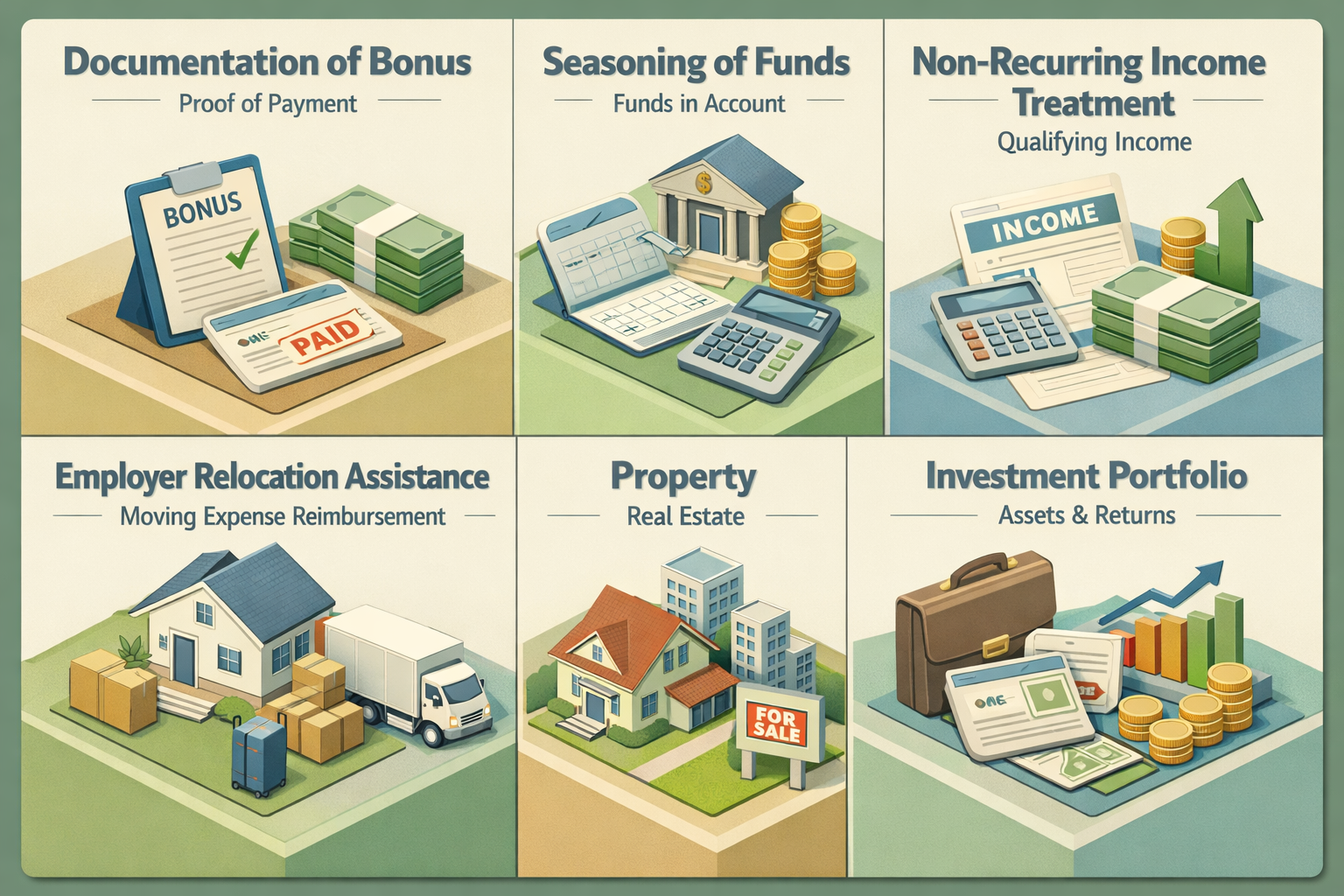
- Documentation of the bonus: Lenders will want to see proof that the bonus was received. This usually means bank statements showing the deposit, along with a letter from your employer explaining the purpose of the payment.
- Seasoning of funds: If you plan to use the relocation bonus toward your down payment, the funds generally need to have been in your account for at least 60 days. This is what's commonly referred to as "seasoning." Unseasoned funds may require a paper trail or employer letter to verify their origin.
- Non-recurring income treatment: As mentioned, a one-time bonus that isn't expected to repeat will typically not count toward your qualifying income. Lenders will focus on your base salary or other verified recurring income streams instead.
- Employer relocation assistance: If your employer is offering a formal relocation assistance package that includes reimbursement for moving expenses, those funds may also be documented separately and could affect how lenders assess your overall cash reserves.
It's always a smart move to ask your loan officer directly how your specific situation will be treated during underwriting. Every file is different, and experienced lenders can often find solutions that less seasoned originators might overlook.
How to Strengthen Your Mortgage Application After a Job Move
Even if your relocation bonus isn't counted as qualifying income, there are practical steps you can take to improve your chances of conventional loan approval. A well-prepared application tells a clear story — and that story should demonstrate stability, responsibility, and financial readiness.
Build Your Credit Profile Before Applying
Your credit score is one of the most influential factors in conventional loan approval. Most conventional loans require a minimum credit score of 620, though a score of 740 or higher typically unlocks better interest rates and terms. Before applying, consider reviewing your credit report for errors, paying down revolving balances, and avoiding new credit inquiries.
Keep Your Debt-to-Income Ratio in Check
Lenders look closely at your debt-to-income (DTI) ratio — the percentage of your gross monthly income that goes toward debt payments. For conventional loans, a DTI at or below 45% is often preferred, though some lenders may allow slightly higher ratios with compensating factors like strong reserves or a large down payment. If your relocation bonus helped you pay off credit cards or auto loans, that's a meaningful win for your DTI.
Save for a Larger Down Payment
A larger down payment — ideally 20% or more — can eliminate the need for private mortgage insurance (PMI) and signal financial strength to underwriters. If your relocation package included bonus funds, putting a seasoned portion of that money toward the down payment may be one of the best uses of those dollars.
Gather Documentation Early
Being organized can speed up the underwriting process significantly. Have your two most recent pay stubs, W-2s from the past two years, tax returns, bank statements, and your offer or employment letter ready to go. If there was a gap in employment due to relocation, be prepared to write a brief explanation letter.
Using Employer Relocation Packages Strategically in the Mortgage Process
Many employers today offer comprehensive relocation packages that go beyond a simple bonus check. These packages might include temporary housing allowances, moving expense reimbursements, home sale assistance, or even mortgage rate buydown contributions. Understanding how each component interacts with the mortgage process can help you plan more effectively.
For example, some relocation packages include a "gross-up" provision, where the employer pays additional funds to offset the taxes owed on the relocation bonus. This can sometimes result in a larger lump sum in your account than you initially expected. While this additional amount may still be considered a one-time, non-recurring payment, it could meaningfully increase your available reserves or down payment funds.
If your employer offers direct coordination with a relocation management company (RMC), ask whether they have preferred lender relationships. Some RMCs work with lenders who are experienced in handling relocation-related mortgage files and may process these applications with fewer friction points.
It's also worth noting that some lenders have specific programs for corporate transferees. These programs may offer more flexible income documentation standards or allow for offer-letter-only underwriting in certain situations. Asking your HR department whether your company has any preferred lending relationships is a step worth taking early in the homebuying process.
Common Mistakes to Avoid When Applying After a Relocation
Buyers who've recently relocated for work sometimes make avoidable errors that slow down or complicate the mortgage process. Being aware of these pitfalls can help you move through underwriting more smoothly.
- Spending the relocation bonus immediately: If you use your bonus for moving costs or furniture before applying, you may not have those funds available to meet reserve requirements or contribute to the down payment. Whenever possible, keep the funds liquid and documented in your bank account for at least 60 days before applying.
- Switching jobs again before closing: Even after you've been pre-approved, a job change can trigger a re-review of your employment status and could delay or derail the loan. Stability matters all the way through closing day.
- Failing to document the source of funds: Lenders need a clear paper trail for all assets. If your bonus was deposited in a lump sum, be ready to provide an employer letter or pay stub that explains the payment.
- Applying before employment has started: Some lenders require at least one pay stub before approving a loan if you've recently changed jobs. Applying too soon could result in a delayed decision.
- Overlooking state-specific guidelines: Some states have additional requirements or programs that may affect how your relocation scenario is treated. Working with a local lender who knows your market can be a real advantage.
●Conclusion
Figuring out how to qualify for a conventional loan with a recent job relocation bonus requires a clear understanding of how lenders evaluate non-recurring income, employment transitions, and asset documentation. While a one-time relocation bonus may not count as qualifying income on its own, it can still support your application in meaningful ways — from bolstering your down payment to reducing your debt load. The key is preparation: gather your documents early, understand how your bonus funds will be viewed, and work with an experienced loan officer who's handled relocation mortgage files before. With the right approach, your career move and your homeownership goals can absolutely happen at the same time. If you're ready to take the next step, reach out to the team at LoanWise today for a personalized consultation.