
Buying a high-value home is an exciting milestone, but financing it can feel more complicated when your income doesn't follow a predictable paycheck schedule. If you earn commissions, bonuses, freelance fees, or business profits, you may be wondering whether a jumbo loan is even within reach. The good news is that it often is — you just need to understand how lenders evaluate non-traditional income and what steps you can take to strengthen your application. This guide walks through everything you need to know about how to qualify for a jumbo loan with variable income, from documentation strategies to lender expectations.
What Makes a Jumbo Loan Different From a Conventional Mortgage
A jumbo loan is a type of mortgage that exceeds the conforming loan limits set by the Federal Housing Finance Agency (FHFA). Because these loans are too large to be purchased by Fannie Mae or Freddie Mac, lenders take on more risk — and that typically means stricter qualification standards compared to conventional financing.
For homebuyers targeting luxury properties, high-cost markets, or simply larger homes in competitive neighborhoods, jumbo loans are often the only financing path available. The loan amounts involved can range well into the millions, which is why lenders scrutinize borrower profiles more carefully.
- Higher credit score requirements: Most jumbo lenders prefer a credit score of 700 or above, though some may require 720 or higher depending on the loan size and down payment.
- Larger down payments: Borrowers may typically need to put down 10% to 20% or more, though this can vary by lender and program.
- Lower debt-to-income (DTI) ratios: Jumbo lenders often prefer DTI ratios below 43%, and many target 38% to 45% depending on overall financial strength.
- Significant cash reserves: Lenders commonly want to see several months — sometimes 12 or more — of mortgage payments held in liquid or semi-liquid assets after closing.
For borrowers with stable W-2 income, meeting these standards can be straightforward. But for those with variable income, the challenge lies in proving that their earnings are consistent and sustainable over time.
How Lenders View Variable Income on a Jumbo Loan Application
Variable income isn't disqualifying — but it does require a different approach to documentation and income calculation. Lenders want assurance that the income you receive today is likely to continue. For W-2 employees with a base salary, that's relatively easy to demonstrate. For commission earners, freelancers, real estate investors, and business owners, lenders need a broader financial picture.
When evaluating variable income mortgage applications, most jumbo lenders will look at a two-year history of earnings. They typically calculate an average of your income over that period rather than using your most recent year alone. This means that if your income has grown significantly, only a portion of that growth may be counted. Conversely, a strong multi-year average can still support a large loan even if one year was lower than the other.
Here's how lenders commonly handle specific income types:
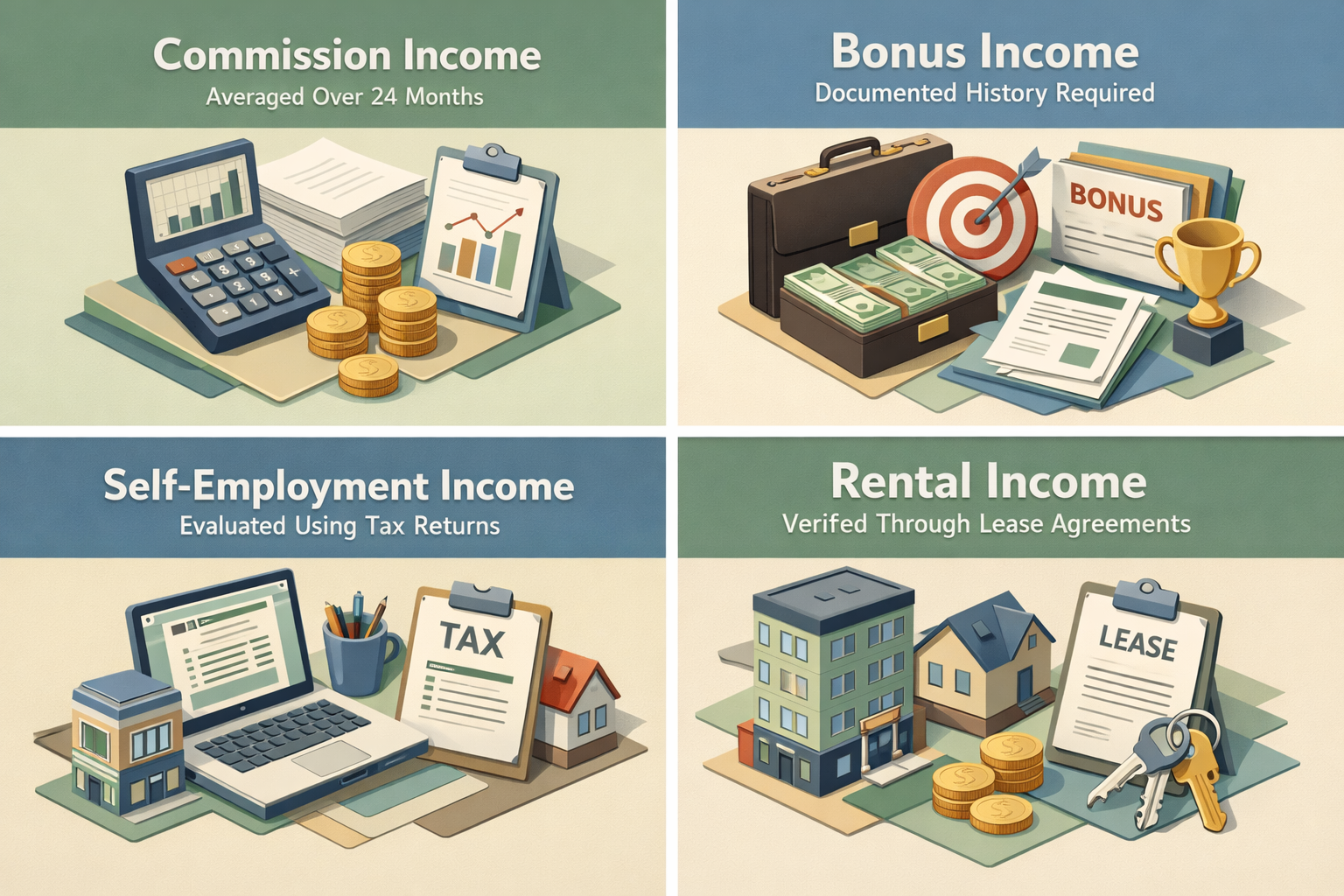
- Commission income: Usually averaged over 24 months using tax returns and employer verification. Some lenders may require the income to be ongoing and likely to continue.
- Bonus income: Often treated similarly to commissions — averaged over two years and typically only counted if there's a documented history of receiving it.
- Self-employment income: Evaluated using Schedule C, K-1s, and business returns. Lenders look at net income after deductions, which can be significantly lower than gross revenue.
- Rental and investment income: Generally verified through tax returns, Schedule E, and lease agreements, with vacancy factors sometimes applied.
The key takeaway is that lenders aren't simply looking at what you earned last month — they want to see a reliable pattern across multiple years.
Steps Commission Earners Can Take to Strengthen a Jumbo Mortgage Application
If you rely on a jumbo mortgage for commission earners, preparation is everything. Because your income fluctuates, the strength of your application often comes down to how well you document your earnings and how effectively you present your overall financial profile.
Build a Two-Year Paper Trail
Most lenders will want to see at least two years of consistent commission income before they're willing to count it toward your qualifying income. This means filing accurate tax returns that reflect your true earnings, keeping pay stubs and commission statements organized, and avoiding sudden income drops in the year before you apply.
Reduce Your Debt Load Before Applying
Because jumbo lenders are particularly sensitive to DTI ratios, paying down high-balance credit cards or installment loans before applying can make a meaningful difference. Even a modest reduction in monthly obligations could bring your DTI into a more favorable range.
Maximize Your Cash Reserves
One of the most effective ways to offset the perceived risk of variable income is to hold substantial liquid assets. Lenders may be more flexible on income calculations when they see that you have significant reserves — retirement accounts, brokerage accounts, or savings — that could cover months of mortgage payments if your income dipped temporarily.
Consider a Larger Down Payment
Putting more money down reduces the loan-to-value ratio, which lowers lender risk. For commission earners especially, a larger down payment can sometimes compensate for a higher DTI or a shorter income history, giving underwriters more confidence in approving the loan.
Self-Employed Borrowers and Jumbo Loan Qualification
For entrepreneurs and business owners, self-employed jumbo loan options require a slightly different lens. The main challenge is that self-employed borrowers often use legitimate tax deductions to reduce their taxable income — which is smart for tax purposes but can make qualifying income appear lower than actual cash flow.
Traditional jumbo underwriting uses adjusted gross income from tax returns, which may not capture the full financial strength of a successful business owner. Fortunately, there are loan structures designed with this reality in mind.
Bank Statement Loans
Some lenders offer bank statement mortgage programs specifically designed for self-employed borrowers. Instead of relying on tax returns, these programs evaluate 12 to 24 months of personal or business bank deposits to calculate average monthly income. This approach often results in a higher qualifying income figure for business owners who have strong cash flow but high deductions on paper.
Asset Depletion or Asset Dissipation Loans
Another option for high-net-worth borrowers is asset depletion lending. In this model, lenders take your total liquid assets and divide them over a set number of months — such as 60 or 84 — to calculate a monthly income figure. This can be particularly useful for retirees, investors, or business owners who have accumulated significant wealth but may not show high annual income on their returns.
Non-QM Jumbo Programs
Non-qualified mortgage (non-QM) programs offer additional flexibility for borrowers who don't fit standard underwriting guidelines. These programs might consider profit-and-loss statements, CPA letters, or alternative income documentation. While non-QM loans may carry slightly higher interest rates, they can be a practical pathway for self-employed buyers pursuing high-value properties.
Using a Variable Income Mortgage Calculator to Estimate Your Qualification Range
Before you approach a lender, it helps to have a realistic estimate of what you may be able to borrow. A variable income mortgage calculator can give you a working figure based on your averaged earnings, expected interest rate, anticipated down payment, and monthly debt obligations.
Here's a general approach to estimating your qualifying income as a variable earner:
- Step 1 — Average your income: Add your total income from the past two tax years and divide by 24 to get a monthly average. This is often the figure lenders use as your qualifying income.
- Step 2 — Calculate your maximum DTI: Multiply your monthly qualifying income by the lender's maximum DTI threshold (often 43% to 45%) to find your maximum allowable monthly debt payments.
- Step 3 — Subtract existing obligations: Deduct your monthly minimum payments on credit cards, student loans, car loans, and other recurring debts. The remainder is your available housing payment budget.
- Step 4 — Use a mortgage calculator: Input your estimated monthly payment, expected interest rate, and loan term to back into the loan amount you may qualify for.
Keep in mind that this is a rough estimate. Lenders also factor in property taxes, homeowners insurance, and HOA fees as part of your total housing expense. Working directly with a loan officer who specializes in jumbo lending can give you a far more accurate picture tailored to your specific income structure.
Qualifying for a Large Mortgage With Bonuses and Supplemental Earnings
Many professionals in industries like finance, technology, sales, and real estate receive a significant portion of their total compensation through year-end bonuses, profit-sharing, or performance incentives. Understanding how lenders handle these earnings is essential when qualifying for large mortgage with bonuses.
Lenders generally treat bonus income conservatively. To count toward qualifying income, most jumbo lenders want to see:
- A minimum of two years of documented bonus history from the same employer or income source
- Evidence that the bonus is likely to continue, often through employer verification or contractual documentation
- Consistency in the amount — large swings from year to year may lead to a more conservative income calculation
If your bonus history is strong and well-documented, it can meaningfully boost your qualifying for large mortgage amount and open the door to a significantly larger loan amount. Some borrowers find that even modest annual bonuses, when averaged over two years, add enough monthly income to comfortably meet DTI requirements on a jumbo loan.
It's also worth noting that supplemental income sources like stock option exercises, restricted stock unit (RSU) vesting, or side business revenue may be considered by some lenders — particularly portfolio lenders or those offering non-QM products. Each lender has its own guidelines, so shopping around and comparing how different institutions treat your specific income mix can be very worthwhile.
Choosing the Right Lender for a Jumbo Loan With Non-Traditional Income
Not all lenders are equally equipped to work with variable income borrowers seeking jumbo financing. Large retail banks may apply rigid underwriting standards that don't account for the full picture of a commission earner's or self-employed buyer's financial strength. Portfolio lenders — institutions that keep loans on their own books rather than selling them — often have more flexibility to evaluate applications holistically.
When searching for a jumbo lender as a variable income borrower, consider the following:
- Ask about their income documentation options: Does the lender offer bank statement loans, asset depletion programs, or non-QM products? The more options available, the better positioned you'll be to find a program that fits.
- Work with a mortgage broker: A broker with access to multiple wholesale lenders can match your specific income profile to the lender most likely to approve your application and offer competitive terms.
- Prioritize experience with jumbo lending: A loan officer who regularly handles jumbo applications for high-earning professionals will be better equipped to structure your file correctly and anticipate underwriter questions.
- Prepare a strong overall profile: Even with variable income, an excellent credit score, substantial reserves, and a significant down payment can go a long way toward making your application compelling.
Understanding how to qualify for a jumbo loan with variable income is ultimately about presenting your financial story as clearly and completely as possible. The right lender will appreciate the full context of your earnings rather than penalizing you for income that doesn't arrive on a fixed schedule.
●Conclusion
Variable income doesn't have to be a barrier to homeownership at the jumbo level. Whether you're a commission-based sales professional, a self-employed entrepreneur, or an executive who counts on annual bonuses, there are legitimate and well-established pathways to securing a jumbo mortgage. The key is preparation — building a clean income history, managing your debts strategically, accumulating strong reserves, and working with a lender who truly understands non-traditional income structures. If you're ready to take the next step toward financing a high-value home, consider speaking with a LoanWise mortgage specialist who can evaluate your unique financial profile and help you find the jumbo loan solution that fits your life.