
Buying a high-value home is an exciting goal, but financing one through a jumbo loan can feel overwhelming — especially when your income doesn't come from a traditional paycheck. If you're a freelancer, independent contractor, or commission-based professional, you might wonder whether lenders will even consider your application. The good news is that understanding how to qualify for a jumbo loan with commission-based freelance income is entirely possible with the right preparation. Lenders do have a path for non-traditional earners, and knowing what they're looking for puts you in a much stronger position from the start.
What Makes Jumbo Loans Different From Conventional Mortgages
A jumbo loan is a mortgage that exceeds the conforming loan limits set by the Federal Housing Finance Agency (FHFA). These limits are updated periodically and vary by location, but once your loan amount surpasses that threshold, it's considered a jumbo loan. Because these loans are larger, they carry more financial risk for lenders and therefore come with stricter qualification standards.
Unlike conventional conforming loans, jumbo mortgages aren't backed by Fannie Mae or Freddie Mac. That means lenders set their own underwriting guidelines, which can vary significantly from one institution to another. For freelancers and commission-based earners, this flexibility can actually work in your favor — some lenders are more accommodating of variable income than others.
Typical jumbo loan requirements may include a higher credit score (often 700 or above), a larger down payment (commonly 10–20% or more), lower debt-to-income ratios, and substantial cash reserves. Understanding these benchmarks helps you set realistic expectations and prepare accordingly.
How Lenders View Commission-Based and Freelance Income
Lenders approach non-traditional income sources with a closer eye on consistency and sustainability. When you earn commissions or freelance fees, your income can fluctuate from month to month, which makes lenders want to see a longer track record before they feel confident extending a large loan.
For most jumbo loan underwriters, two years of self-employment or commission-based income is the standard minimum. This is typically verified through your federal tax returns for the past two years, and lenders will often average your income over that period rather than using your most recent year's figures alone. If your income has been declining, that could raise a red flag — but if it's been growing, that trend can work strongly in your favor.
It's also worth noting that many freelancers and commission earners take advantage of business deductions on their taxes, which reduces their taxable income. While this is a smart tax strategy, it can lower the income figure lenders use for qualification purposes. Being aware of this tension between tax efficiency and loan eligibility is an important part of planning ahead.
Essential Documents You'll Need for Jumbo Loan Qualification as a Freelancer
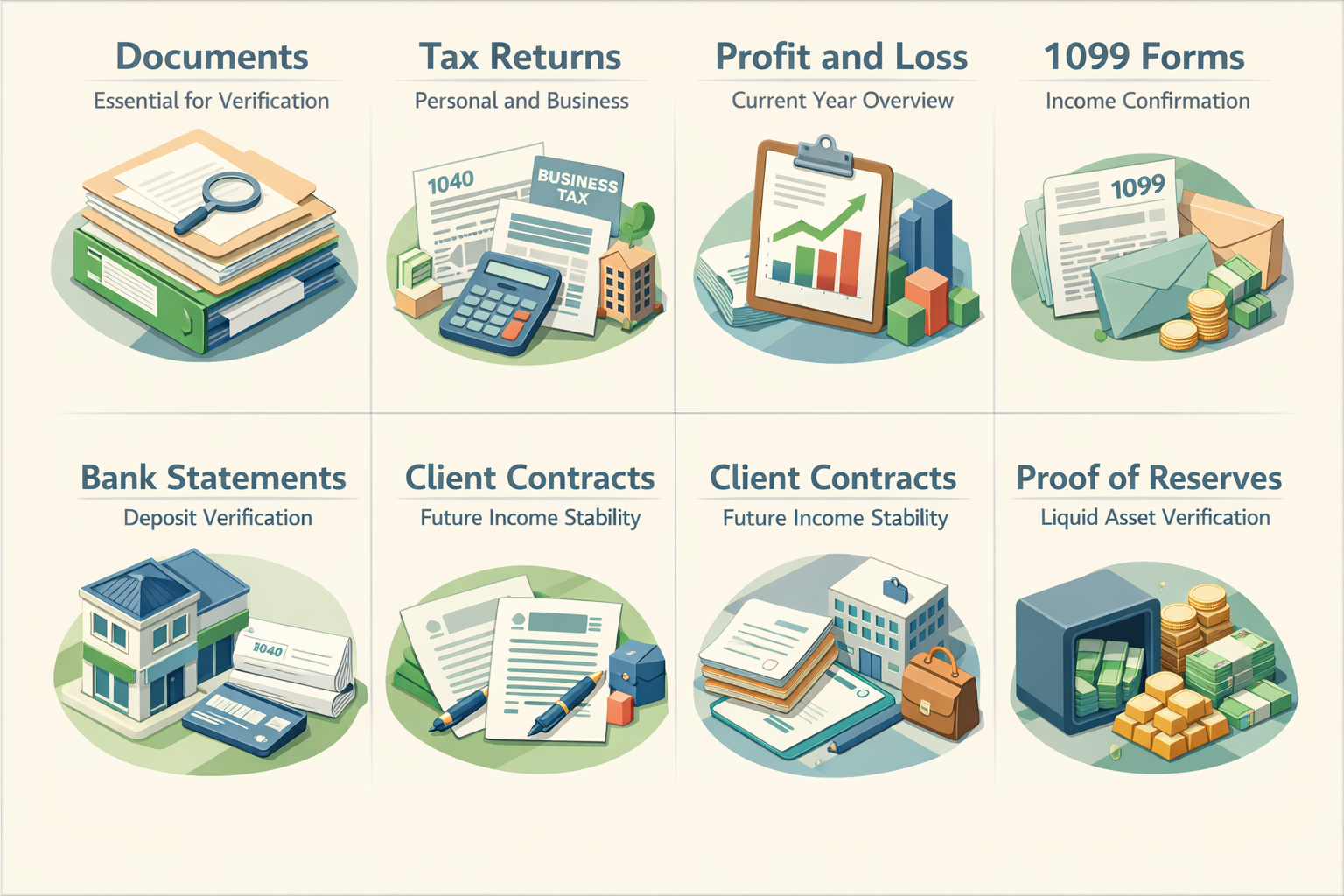
Documentation is everything when it comes to jumbo loan qualification with freelance or commission income. Lenders need to piece together a clear and credible picture of your financial life, so being organized and thorough can make a significant difference in how smoothly your application moves forward.
- Two years of personal federal tax returns: These are the foundation of your income verification. Lenders review your adjusted gross income and any business-related deductions.
- Two years of business tax returns (if applicable): If you operate as an LLC, sole proprietor, or S-Corp, your business returns provide additional context about your revenue and expenses.
- Year-to-date profit and loss statement: This document, ideally prepared by a licensed CPA, shows how your income is trending in the current year.
- 1099 forms: These confirm payments received from clients and support the income figures on your tax returns.
- Bank statements (12–24 months): Lenders may review these to verify deposits align with reported income and to assess cash flow consistency.
- Client contracts or letters of engagement: Some lenders may request these to confirm ongoing work relationships and future income stability.
- Proof of reserves: Jumbo loans often require you to demonstrate several months — sometimes up to 12 or more — of mortgage payments held in liquid assets.
Having all of these documents ready before you apply signals to the lender that you're organized and serious, which can contribute to a smoother underwriting experience.
Credit Score and Debt-to-Income Ratio Benchmarks for Jumbo Borrowers
Your credit profile carries significant weight in the jumbo loan process. Because these mortgages involve larger loan amounts and lack government backing, lenders typically look for borrowers who demonstrate a long history of responsible credit use. A credit score of 700 or higher is commonly expected, though some lenders may require 720 or even 740 for the most competitive rates.
Your debt-to-income (DTI) ratio is another major factor. This ratio compares your total monthly debt obligations to your gross monthly income. For jumbo loans, lenders often prefer a DTI of 43% or lower, though some portfolio lenders may allow slightly higher ratios depending on compensating factors like strong cash reserves or a large down payment.
For commission-based freelancers, maintaining a healthy DTI can be challenging because your income figure — as calculated by the lender — may already be reduced by tax deductions. Paying down existing debts like auto loans, student loans, or credit card balances before applying can help improve your DTI and strengthen your overall application profile.
Down Payment Strategies That Strengthen Your Application
A larger down payment not only reduces the loan amount you need but also signals financial stability to lenders — something that can be especially persuasive when your income is variable. Most jumbo loan lenders expect at least 10% down, and putting down 20% or more may help you avoid additional requirements and potentially access better interest rates.
For freelancers and commission earners, demonstrating that your down payment comes from seasoned funds — meaning money that has been sitting in your account for at least 60 to 90 days — is important. Lenders want to see that the funds aren't borrowed and reflect genuine financial accumulation over time.
Some borrowers in this category also consider leveraging investment accounts, retirement assets, or proceeds from the sale of another property. If you're using funds from non-traditional sources, be prepared to document the origin clearly. Gifted funds may also be acceptable depending on the lender's guidelines, but they'll typically require a signed gift letter confirming no repayment is expected.
Non-QM Loan Options and Portfolio Lenders Worth Exploring
If your financial profile doesn't perfectly fit standard jumbo loan underwriting guidelines, you may still have strong options through non-qualified mortgage (Non-QM) programs or portfolio lenders. These are lenders who hold loans on their own books rather than selling them to the secondary market, which gives them more flexibility in how they evaluate borrowers.
Non-QM jumbo loans may allow for bank statement qualification, where lenders average 12 to 24 months of personal or business bank deposits instead of relying on tax returns. This approach can be particularly beneficial for freelancers whose tax returns understate their actual cash flow due to deductions.
Other alternative documentation options might include asset depletion loans, where significant investment assets are used to calculate qualifying income, or 1099-only programs that focus on gross commission income rather than net reported earnings. These programs often come with slightly higher interest rates to offset the additional lender risk, but they can be a viable path to homeownership for commission-based professionals who otherwise struggle to qualify for a jumbo loan through traditional channels.
Working with a mortgage broker who has experience in jumbo loan qualification for freelance and commission earners can be invaluable here. Brokers often have access to multiple wholesale lenders, increasing your chances of finding a program that fits your specific situation.
Practical Steps to Improve Your Chances of Approval
Knowing how to qualify for a jumbo loan with commission-based freelance income is one thing — actively improving your qualification profile is another. Here are practical steps you can take before and during the application process:
- Build and maintain strong credit: Pay all bills on time, keep credit card utilization low, and avoid opening new credit accounts in the months before applying.
- Grow your cash reserves: Lenders may want to see anywhere from 6 to 18 months of mortgage payments held in liquid or semi-liquid accounts. Start building these well in advance.
- Work with a CPA who understands mortgage qualification: A knowledgeable accountant can help you balance tax efficiency with the income documentation lenders need. In some cases, it may make sense to reduce deductions in the one or two years before applying.
- Maintain consistent income history: Try to avoid major gaps in client work or commission cycles leading up to your application. A stable two-year trend is far more convincing than a single strong year.
- Get pre-qualified before house hunting: Understanding your realistic borrowing power early helps you focus your search and avoids the disappointment of falling in love with a home that's out of reach financially.
- Shop multiple lenders: Jumbo loan guidelines vary widely between lenders, especially for non-traditional borrowers. Comparing offers from banks, credit unions, and mortgage brokers increases your options considerably.
Patience and preparation are the most powerful tools available to freelancers navigating the jumbo loan process. The more thoroughly you document your income and financial strength, the more confident lenders will feel about extending you a large mortgage.
●Conclusion
Qualifying for a jumbo loan as a freelancer or commission-based earner is genuinely achievable — it simply requires more intentional preparation than a traditional W-2 borrower might need. By understanding what lenders look for, organizing your documentation thoroughly, managing your credit and reserves proactively, and exploring flexible options like Non-QM programs, you put yourself in a real position to succeed. LoanWise is here to help you navigate every step of this process. Whether you're just starting to explore your options or you're ready to apply, connecting with an experienced mortgage professional who understands non-traditional income can make all the difference. Your dream home may be closer than you think.