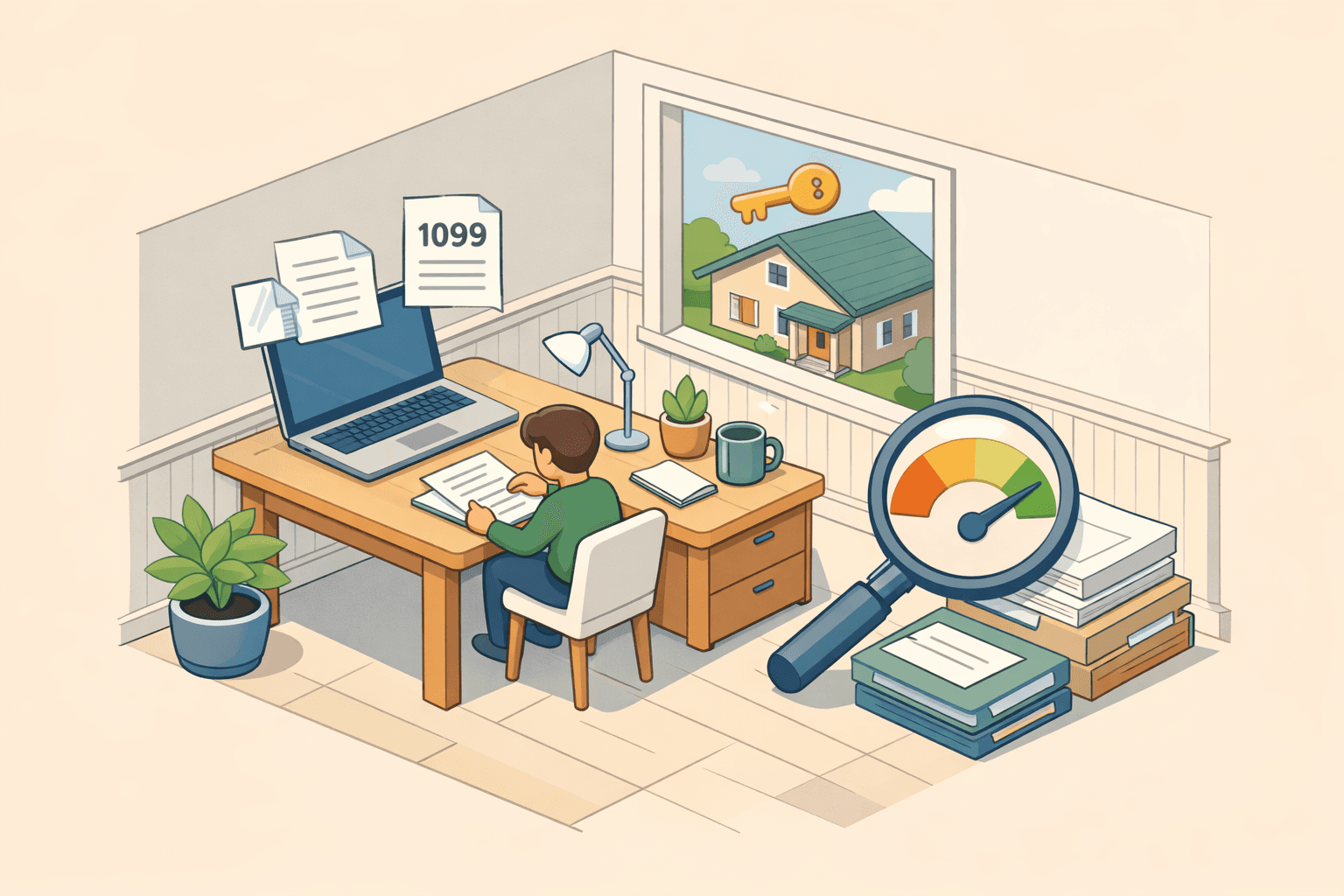
Buying a home as a freelancer can feel like an uphill climb. Unlike salaried employees who hand over a pay stub and call it done, independent contractors and self-employed workers must piece together a more complex financial picture to satisfy lenders. If you've been researching how to qualify for a conventional loan with 1099 freelance income and low credit score, you're not alone. Millions of Americans earn a living through gig work, consulting, and contract assignments — and many of them dream of homeownership. The good news is that qualification is absolutely possible. It simply requires preparation, documentation, and a clear understanding of what lenders are actually looking for.
What Makes Conventional Loans Different for Freelancers
A conventional loan is a mortgage that isn't backed by a government agency like the FHA, VA, or USDA. Instead, it typically conforms to guidelines set by Fannie Mae or Freddie Mac, the two government-sponsored enterprises that purchase mortgages from lenders. Because these loans aren't government-insured, lenders tend to apply stricter documentation standards — especially when it comes to income verification.
For W-2 employees, income verification is straightforward. For 1099 contractors and freelancers, lenders must work harder to establish that your income is stable, consistent, and likely to continue. This is the core challenge. It's not that freelance income is disqualifying — it's that lenders need to see a reliable pattern before they'll commit to a 15- or 30-year loan.
Conventional loan guidelines from Fannie Mae generally require self-employed borrowers to have at least two years of self-employment history. This two-year window allows lenders to average your income across multiple tax cycles and assess whether your earnings are trending upward, holding steady, or declining. A declining income trend may raise red flags even if your gross earnings appear strong.
It's also worth noting that conventional loans come in two broad forms: conforming and non-conforming (also called jumbo loans). Most freelancers seeking a primary residence will target conforming conventional loans, which must stay within loan limits set annually by the Federal Housing Finance Agency.
How Lenders Calculate 1099 Income for Mortgage Qualification
Here's where many freelancers get caught off guard: lenders don't use your gross 1099 earnings when calculating qualifying income. Instead, they look at your net income after business expenses, as reported on your federal tax returns — typically Schedule C for sole proprietors or Schedule E for certain pass-through entities.
If you've been aggressively writing off business expenses to minimize your tax bill (a very common and legal strategy), your reported net income may be significantly lower than what you actually earn. While this saves money at tax time, it can work against you when applying for a mortgage. The income figure that drives your debt-to-income ratio is the one the IRS sees, not the total deposited into your bank account.
Lenders typically average your net self-employment income over the most recent two years. For example, if you earned a net of $60,000 in year one and $80,000 in year two, your qualifying monthly income may be calculated at approximately $5,833 — the average of $140,000 divided by 24 months. Some lenders may add back certain non-cash deductions like depreciation, which can help increase your qualifying income. It's worth asking your lender specifically which deductions they add back.
To support your income claim, you'll typically need to provide:
- Two years of personal federal tax returns (all schedules)
- Two years of business tax returns, if applicable
- Year-to-date profit and loss statement prepared by a CPA
- 1099 forms from clients
- Bank statements showing regular income deposits
Some lenders may also request a letter from a licensed CPA or enrolled agent confirming the nature and continuity of your business. Preparing these documents well in advance can significantly speed up the approval process.
Addressing a Low Credit Score as a Freelance Borrower
Credit score requirements for conventional loans tend to be higher than those for government-backed programs. While FHA loans may accept scores as low as 500 with a larger down payment, most conventional lenders prefer a minimum score of 620 — and borrowers with scores in the mid-to-upper 700s typically receive the most favorable interest rates.
If your credit score is on the lower end, understanding conventional loan requirements for 1099 income and low credit means recognizing that the two challenges — non-traditional income and below-average credit — compound each other in a lender's eyes. Each factor individually raises the perceived risk. Together, they require a more deliberate strategy.
Here are several steps that may help improve your credit standing before applying:
- Pay down revolving balances: Credit utilization — the percentage of your available credit you're using — is one of the most influential factors in your score. Keeping balances below 30% of your credit limits, and ideally below 10%, may help boost your score meaningfully.
- Dispute inaccurate items: Review your credit reports from all three bureaus (Equifax, Experian, and TransUnion) for errors. Outdated collections, duplicate accounts, or incorrectly reported late payments can all be disputed and potentially removed.
- Avoid opening new credit accounts: Each hard inquiry can temporarily lower your score. In the months leading up to a mortgage application, try to avoid applying for new credit cards, auto loans, or other financing.
- Bring delinquent accounts current: If you have past-due accounts, getting them current may stop further damage and, over time, begin to improve your profile.
- Become an authorized user: Being added to a family member's or trusted friend's credit card account with a long, positive history could help strengthen your own credit profile.
It's also worth noting that some lenders use a process called rapid rescore, which allows recent positive changes to be reflected in your credit report more quickly than the standard 30-day update cycle. This can be useful if you've just paid down a large balance and need your score updated before a rate lock expires.
Strengthening Your Application Beyond Income and Credit
When income and credit scores present challenges, compensating factors can make a meaningful difference in how a lender views your overall application. Underwriters are trained to evaluate the full picture — and a strong showing in other areas may help offset weaknesses elsewhere.
Down payment size is one of the most powerful compensating factors available. Conventional loans technically allow down payments as low as 3%, but putting down 10%, 15%, or 20% reduces the lender's exposure and may help you qualify for a conventional loan even with a lower credit score or variable income history. A larger down payment also eliminates the need for private mortgage insurance (PMI) once you reach 20% equity, reducing your monthly costs.
Cash reserves are another significant positive signal. Lenders like to see that you have savings beyond your down payment and closing costs. Reserves — typically measured in months of mortgage payments — demonstrate that you could continue making payments even during a slow business period. For freelancers, showing three to twelve months of reserves can be especially reassuring to underwriters.
Debt-to-income ratio (DTI) is a critical metric in any mortgage application. Your DTI compares your total monthly debt obligations to your gross qualifying income. Most conventional loan programs prefer a back-end DTI of 43% or lower, though some automated underwriting systems may allow higher ratios with strong compensating factors. Paying off a car loan or credit card before applying could help lower your DTI enough to clear approval thresholds.
Length of self-employment history beyond the minimum two years also adds credibility. If you've been filing 1099 income for five or more years with consistent earnings, that track record speaks volumes about business stability.
Alternative Loan Options Worth Considering for 1099 Earners
If a conventional loan proves difficult to qualify for right now, there are alternative paths that may help you achieve homeownership while you work on strengthening your profile.
FHA loans are government-backed mortgages that allow lower credit scores and more flexible income documentation in some cases. Self-employed borrowers can still use tax returns to qualify, and the minimum credit score threshold is generally lower than conventional loans. However, FHA loans require both an upfront and annual mortgage insurance premium regardless of your down payment size.
Bank statement loans are a popular non-QM (non-qualified mortgage) product specifically designed for self-employed borrowers. Rather than relying on tax returns, these programs use 12 to 24 months of personal or business bank statements to calculate average monthly deposits as qualifying income. This can be a strong fit for freelancers who earn well but have heavily deducted tax returns. Non-QM loans typically carry higher interest rates and may require larger down payments, but they can bridge the gap for borrowers who don't fit the conventional mold.
1099-specific loan programs have also emerged in recent years from specialty lenders who recognize the growing freelance economy. Some programs allow qualification based on 1099 forms alone without requiring full tax returns, which can be advantageous for borrowers whose reported net income doesn't reflect their true earnings capacity.
Exploring these alternatives doesn't mean giving up on a conventional loan permanently. Many borrowers use a non-QM or FHA loan to get into a home, build equity, improve their credit score, and then refinance into a conventional mortgage within a few years when their financial profile is stronger.
Working With the Right Lender Makes a Real Difference
Not all lenders approach self-employed borrowers the same way. Some have overlays — additional requirements beyond Fannie Mae or Freddie Mac guidelines — that make it harder for 1099 earners to qualify. Others specialize in non-traditional income borrowers and have underwriters experienced in evaluating freelance income profiles.
When shopping for a lender, it's worth asking directly: Do you have experience working with self-employed or 1099 borrowers? The answer will tell you a lot. A lender who regularly closes loans for freelancers will know which documentation to request, how to structure the file, and how to present your income story to underwriting in the most favorable light.
Working with a mortgage broker can also be advantageous in this situation. Brokers have access to multiple wholesale lenders and can match your specific profile — including your income type and credit score — with the lender most likely to approve you at competitive terms. This can save significant time compared to applying to individual banks one by one.
It's also a smart idea to get a pre-approval letter before beginning your home search. For freelancers, pre-approval involves a more thorough income review than a basic pre-qualification, which means you'll surface potential issues early and have time to address them before you're under contract and facing a closing deadline.
●Conclusion
Learning how to qualify for a conventional loan with 1099 freelance income and low credit score is really about understanding what lenders need and giving it to them in the most organized, compelling way possible. Your income may be non-traditional, and your credit may need some work — but neither of those facts makes homeownership out of reach. With two years of documented self-employment history, well-prepared tax returns, a plan to strengthen your credit, and the right lending partner in your corner, a conventional mortgage approval is a realistic goal. Start by pulling your credit reports, reviewing your tax returns with a CPA, and reaching out to a mortgage professional who has hands-on experience with freelance borrowers. The path to your own front door is closer than it might seem.