
More families today are choosing to live together under one roof — grandparents, parents, adult children, and sometimes even extended relatives sharing a single home. It's a lifestyle shift driven by rising housing costs, cultural traditions, and the desire to care for aging loved ones while keeping everyone close. But larger homes that can comfortably house multiple generations often carry price tags that exceed conventional loan limits. That's where understanding how to get a jumbo loan for a multi-generational home becomes essential. This guide walks you through the financing process step by step, so your family can find the right home — and the right loan to go with it.
What Makes a Home Multi-Generational and Why It Affects Financing
A multi-generational home is typically a property designed or adapted to house two or more adult generations of the same family. These homes often feature separate entrances, in-law suites, dual kitchens, or additional living quarters that give each generation a degree of privacy while still sharing a single structure.
From a mortgage standpoint, these properties frequently fall into a higher price bracket. Larger square footage, additional amenities, and location in suburban or semi-rural areas where land is plentiful can push purchase prices well above the conforming loan limits set by the Federal Housing Finance Agency (FHFA). In most parts of the country, the conforming loan limit sits around $766,550 for a single-unit property, though high-cost areas may have higher thresholds. Any loan amount exceeding that limit is generally classified as a jumbo mortgage — a loan that doesn't conform to Fannie Mae or Freddie Mac guidelines.
Because jumbo loans carry more risk for lenders — since they can't be sold to government-sponsored enterprises — they come with stricter qualification standards. Understanding this distinction early can help your family prepare long before you submit a loan application.
Core Requirements Lenders Look for in Jumbo Mortgage Applicants
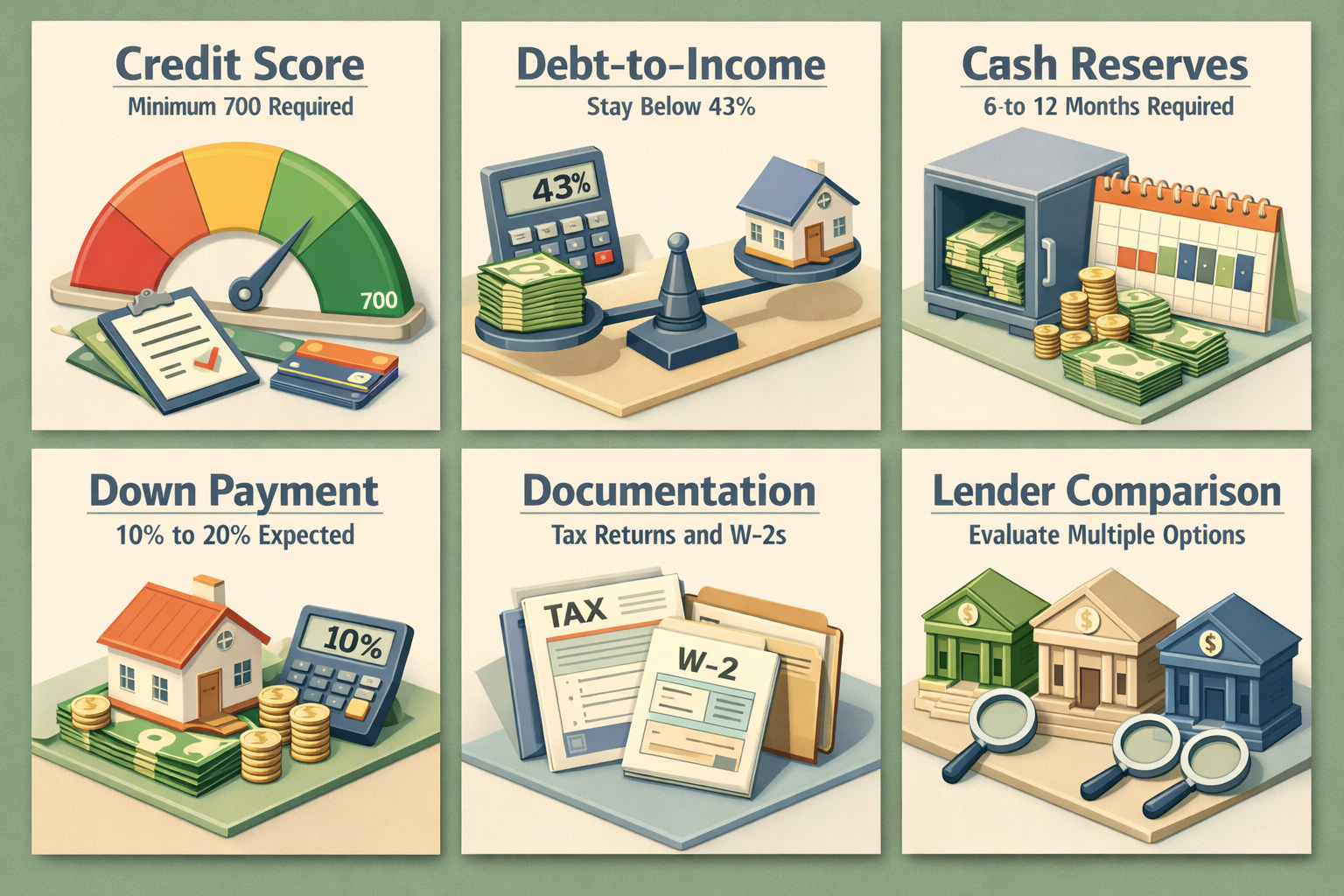
Qualifying for a jumbo mortgage is more demanding than securing a conventional loan, and it's important to know what lenders typically expect. While every lender sets its own standards, there are common benchmarks that tend to apply across the board.
Credit Score Expectations
Most jumbo lenders look for a credit score of at least 700, and many prefer scores of 720 or higher. A strong credit history signals to lenders that you're a low-risk borrower, which matters even more when large loan amounts are involved. If your score is below these thresholds, it may be worth taking a few months to pay down balances, dispute any errors on your credit report, and avoid opening new lines of credit before applying.
Debt-to-Income Ratio
Lenders typically want your total monthly debt obligations — including the proposed mortgage payment — to stay below 43% of your gross monthly income. Some jumbo lenders may allow slightly higher ratios depending on your overall financial profile, but keeping your debt-to-income (DTI) ratio as low as possible will generally strengthen your application.
Cash Reserves
One distinguishing feature of jumbo lending is the reserve requirement. Lenders often want to see that you have enough liquid assets to cover 6 to 12 months of mortgage payments after closing. This gives them confidence that you can continue making payments even if your income is temporarily disrupted.
Down Payment
Expect to put down at least 10% to 20% on a jumbo loan, with many lenders requiring 20% or more for larger loan amounts. A higher down payment not only improves your chances of approval but may also help you secure a more competitive interest rate.
How to Get a Jumbo Loan for a Multi-Generational Home Using Combined Income
One of the most practical strategies for qualifying for a jumbo mortgage for large families is leveraging the income of multiple borrowers. When multiple working adults in the family plan to co-own the property, their combined income can significantly strengthen the loan application.
For example, if a parent and an adult child plan to share the home and both contribute to the mortgage, a lender may be able to count both incomes when calculating the DTI ratio. This can make a loan amount that would otherwise be out of reach for one borrower entirely manageable for two.
However, it's important to understand that adding a co-borrower also means adding their debt and credit profile to the equation. If a co-borrower has a lower credit score or significant existing debt, it could offset the benefit of the additional income. Lenders will typically review the credit and financial history of all borrowers on the application, so every person listed should be in solid financial standing.
Families should also think carefully about the legal and financial implications of co-ownership. It may be helpful to work with a real estate attorney to draft a co-ownership agreement that outlines how expenses, equity, and eventual sale proceeds will be handled.
Exploring Non-QM and Portfolio Loan Options for Unique Property Needs
Not every multi-generational property fits neatly into a lender's standard underwriting box. Some homes may be classified as multi-family dwelling financing scenarios if they have separate utility meters, two kitchens, or distinct living units — even if the family intends to occupy the entire structure together.
In these cases, a conventional jumbo loan might not be the right fit. That's where non-qualified mortgage (Non-QM) products and portfolio loans can offer flexibility. Portfolio lenders hold loans on their own books rather than selling them to the secondary market, which means they can set their own underwriting criteria. This can be particularly helpful for:
- Self-employed borrowers who document income differently
- Families with complex financial structures or multiple income streams
- Buyers purchasing properties with accessory dwelling units (ADUs) or dual living configurations
- Investors or co-owners who may not qualify under traditional debt-to-income rules
Non-QM jumbo loans may come with slightly higher interest rates to account for the added flexibility, but they can open doors that standard products keep closed. It's worth asking your mortgage broker or lender whether these options are available for your situation.
Documentation You'll Need to Gather Before Applying
Jumbo loan applications typically require more documentation than conventional loans. Being organized and prepared before you start the process can save time and reduce stress. Here's what most lenders will ask for:
- Tax returns: Usually the last two years of personal federal returns for all borrowers
- W-2s and pay stubs: To verify employment income and consistency
- Bank and investment statements: Typically covering the last two to three months, showing assets and reserves
- Proof of down payment: Lenders want to confirm where your down payment is coming from and that it isn't borrowed
- Gift letters: If family members are contributing to the down payment, a signed gift letter may be required
- Self-employment documentation: If any borrower is self-employed, profit-and-loss statements and business bank statements may be needed
The more complete and consistent your documentation, the smoother the underwriting process is likely to go. Gaps or inconsistencies in financial records can cause delays or additional scrutiny, particularly with jumbo loans where lenders are taking on more risk.
Comparing Jumbo Lenders to Find the Best Fit for Your Family's Situation
Not all jumbo lenders are created equal, and shopping around can make a meaningful difference — both in terms of rates and in how well a lender understands your specific needs. Here are some practical steps to compare your options effectively:
Work With a Mortgage Broker
A broker who specializes in jumbo or non-QM lending can connect you with multiple lenders at once, saving you time and potentially finding more competitive terms. This is especially useful when your situation is complex, such as when multiple borrowers are involved or the property has an unusual configuration.
Request Loan Estimates
Once you've identified a few lenders, request formal Loan Estimates so you can compare interest rates, closing costs, and loan terms side by side. Even a small difference in rate on a large jumbo loan can translate to significant savings over the life of the loan.
Ask About Lender Overlays
Some lenders add requirements on top of standard jumbo guidelines — these are called overlays. One lender might require a 720 credit score while another accepts 700. Knowing these differences can help you identify the lenders you're most likely to qualify with.
Evaluate the Lender's Experience With Multi-Generational Properties
Look for lenders who have experience with multi-family dwelling financing or properties with in-law suites, ADUs, or dual-living configurations. They'll be better equipped to handle any appraisal questions or underwriting nuances that come with this type of home.
Planning for the Long Term After Your Jumbo Loan Closes
Securing the loan is just the beginning. Once your family moves into your multi-generational home, it's worth thinking about how your financial situation may evolve — and how your mortgage fits into that future.
For instance, if interest rates drop significantly after you close, refinancing your jumbo loan into a lower rate could reduce your monthly payment. Keep in mind that refinancing a jumbo loan follows the same high standards as the original loan, so you'll want to maintain strong credit and reserves over time.
Families should also consider how the property will be handled if ownership needs to change — for example, if one co-borrower wants to be removed from the loan, or if the home is eventually passed down. These are conversations worth having with an estate planning attorney and a financial advisor alongside your mortgage planning.
Finally, think about how the home's value might grow over time. Multi-generational homes in desirable areas can appreciate well, and having equity in a property of this size can open up future options — including home equity lines of credit, cash-out refinancing, or even helping the next generation with their own homebuying goals.
●Conclusion
Learning how to get a jumbo loan for a multi-generational home takes preparation, patience, and the right team of professionals by your side. From understanding credit and income requirements to exploring flexible lending options and comparing lenders, every step you take brings your family closer to a home that works for everyone. The journey may be more involved than a standard mortgage, but for families seeking shared living and shared futures, it's absolutely worth it. Ready to take the next step? Connect with a LoanWise lending specialist today to explore jumbo mortgage options tailored to your family's unique needs.