
Saving for a down payment is one of the biggest hurdles homebuyers face today. But what if a family member or loved one wants to help? The good news is that using gift funds for a conventional mortgage is entirely possible — and more common than many people realize. Whether you're a first-time homebuyer or someone looking to purchase a new primary residence, understanding how to get a conventional loan with gifted down payment money can open doors you might not have known were available. This guide walks you through everything you need to know, from eligibility rules to documentation and beyond.
What Counts as a Gift Fund in Conventional Lending
Before diving into the process, it's important to understand exactly what qualifies as a gift in the eyes of a conventional mortgage lender. A gift is generally defined as money provided to the borrower with no expectation of repayment. This is a critical distinction — if the funds are actually a loan in disguise, lenders will treat them differently and may disqualify them from being counted toward your down payment.
Conventional loans backed by Fannie Mae and Freddie Mac typically allow gift funds from a specific group of acceptable donors. These donors generally include:
- Immediate family members such as parents, siblings, and children
- Grandparents and other relatives
- Domestic partners and fiancés
- Godparents and close family friends, depending on the lender's guidelines
It's worth noting that the list of acceptable donors can vary slightly between Fannie Mae and Freddie Mac guidelines, as well as from lender to lender. Always confirm with your loan officer which relationships are permitted under your specific loan program. Gifts from employers, non-profit organizations, or government agencies may also be allowed in certain scenarios, though these situations tend to come with additional documentation requirements.
How Much of Your Down Payment Can Be a Gift
One of the most frequently asked questions about conventional mortgage gift money rules is how much of the down payment can actually come from a gift. The answer depends largely on how much you're putting down and whether the property will be your primary residence, a second home, or an investment property.
For primary residences, conventional loan guidelines tend to be the most flexible. If you're putting down 20% or more, the entire down payment may be covered by gift funds. If you're putting down less than 20%, lenders typically require that at least some portion of the down payment comes from the borrower's own funds — though there are exceptions, and some programs allow 100% of a smaller down payment to come from gifts.
For second homes, lenders often require the borrower to contribute a minimum percentage from their own savings, with the gift funds supplementing that amount. Investment properties, on the other hand, generally do not allow gift funds for the down payment at all under standard conventional guidelines. If you're purchasing a rental property or an investment home, you'll likely need to rely entirely on your own source of funds for the down payment.
It's always a smart idea to speak directly with a mortgage professional to confirm how these rules apply to your specific loan scenario, since program overlays from individual lenders can sometimes be stricter than the base guidelines.
Writing a Proper Donor Letter for a Conventional Loan
Perhaps the single most important piece of documentation when using gift money is the donor letter for a conventional loan, sometimes called a gift letter. This document is required by virtually every lender and serves as formal written confirmation that the funds are truly a gift — not a loan that must be repaid.
A properly written gift letter typically needs to include the following information:
- The full name of the donor and their relationship to the borrower
- The specific dollar amount being gifted
- The address of the property being purchased
- A clear statement that no repayment is required or expected
- The donor's signature and the date
Some lenders may also request the donor's mailing address and phone number. It's important to draft this letter carefully, because any ambiguity — particularly around repayment — can trigger additional scrutiny from the underwriter. Your loan officer will often provide a template to make this process easier and ensure the letter meets the lender's specific requirements.
Keep in mind that a gift letter alone isn't always sufficient. Lenders will typically want to verify the source of funds for the down payment by reviewing bank statements from both the borrower and the donor. This paper trail helps underwriters confirm that the money truly came from the donor and wasn't borrowed from a third party.
Tracing and Documenting the Source of Gift Funds
Lenders take gift fund verification seriously, and for good reason. Undisclosed loans disguised as gifts can misrepresent a borrower's true debt load and pose a risk to the integrity of the mortgage. As a result, underwriters will carefully trace where the gifted money came from before approving its use toward your down payment.
Here's what the documentation process typically looks like:
- Donor's bank statement: The lender may ask for one to two months of bank statements from the donor's account to show that the funds were available and didn't appear suddenly from an unknown source.
- Transfer documentation: A copy of the wire transfer, cashier's check, or electronic payment confirming that the money moved from the donor's account to the borrower's account.
- Borrower's bank statement: To show the deposit of the gift funds into the borrower's account, often with a clear date and matching dollar amount.
If the gift funds are deposited well in advance — often referred to as being seasoned — some lenders may require less documentation because the money has already been sitting in the borrower's account long enough to be considered part of their regular assets. Typically, funds that have been in the borrower's account for two or more months may be treated as seasoned assets, though this can vary by lender and loan program.
Working with an experienced loan officer is key here. They can help you plan the timing of gift transfers to minimize documentation headaches and keep your loan on track.
Step-by-Step: How to Get a Conventional Loan With Gifted Down Payment
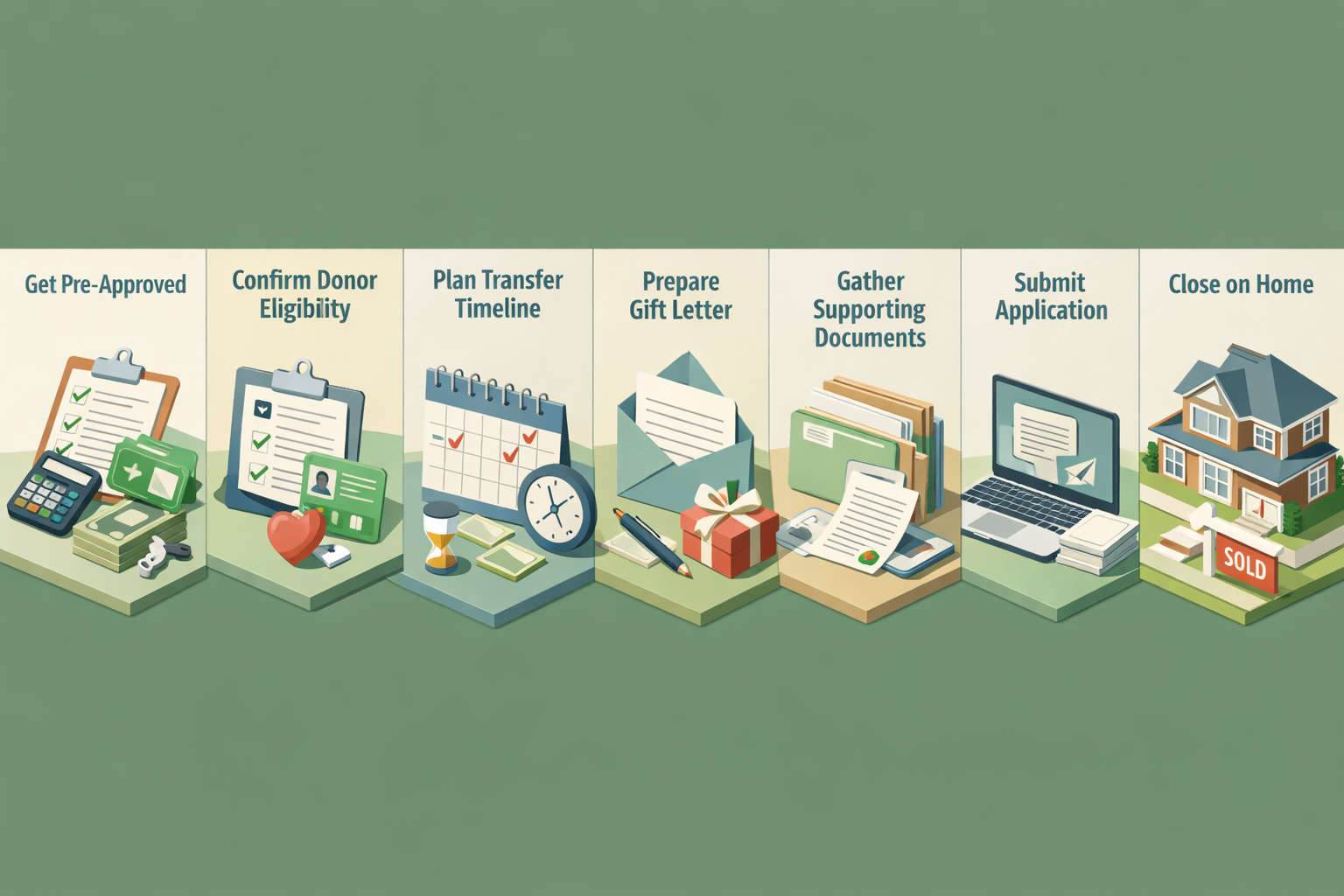
Now that you understand the rules and documentation involved, let's walk through the actual process of how to get a conventional loan with gifted down payment funds from start to finish.
- Step 1 – Get pre-approved: Start by connecting with a lender and getting pre-approved. Be upfront about your intention to use gift funds. Your loan officer needs to know this early so they can structure your loan correctly from the beginning.
- Step 2 – Confirm donor eligibility: Verify that your intended donor qualifies under your lender's guidelines. Not all relationships are automatically approved, so it's best to confirm before money changes hands.
- Step 3 – Plan the transfer timeline: Talk with your loan officer about the best time to transfer the gift funds. Timing matters for documentation purposes, and transferring funds too early or too late can complicate the process.
- Step 4 – Prepare the gift letter: Work with your donor to complete a proper gift letter using your lender's template or requirements. Make sure it's signed, dated, and clearly states that no repayment is expected.
- Step 5 – Gather supporting documents: Collect bank statements from both you and the donor, along with proof of the transfer. Your loan officer will tell you exactly how many months of statements are needed.
- Step 6 – Submit your full application: With your documentation in order, submit your complete mortgage application. Your underwriter will review the gift fund documentation as part of the approval process.
- Step 7 – Close on your home: Once the loan is approved and all conditions are satisfied, you'll move forward to closing. Your gift funds will be applied toward your down payment and potentially closing costs, depending on your loan terms.
Common Mistakes to Avoid When Using Gift Money for a Mortgage
Even well-intentioned borrowers and donors can make missteps that delay or derail the loan approval process. Here are some of the most common pitfalls to watch out for when using gift funds for a conventional mortgage:
- Not disclosing the gift upfront: Trying to hide gift funds or present them as your own savings is considered mortgage fraud. Always disclose gift funds to your lender from the very beginning.
- Accepting cash gifts: Physical cash is very difficult to document and trace. Most lenders prefer or require that gift transfers be made through verifiable electronic means such as wire transfers or certified checks.
- Getting a gift from an ineligible donor: Funds from sellers, real estate agents, or unrelated third parties may not qualify as gifts under conventional guidelines. Always confirm donor eligibility first.
- Skipping the gift letter: Even if the funds are clearly a gift, a signed gift letter is almost always required. Don't assume your lender will waive this requirement.
- Poor timing of transfers: Moving funds too close to your closing date can create documentation issues. Coordinate the timing with your loan officer to avoid unnecessary delays.
Staying proactive and communicating clearly with your mortgage professional throughout the process can help you sidestep these common errors and keep your path to home purchase on track.
●Conclusion
Using gift money toward a home purchase is a legitimate and widely accepted strategy in conventional lending — and when done correctly, it can make homeownership a reality much sooner than you might expect. By understanding the conventional mortgage gift money rules, preparing a proper donor letter for your conventional loan, and carefully documenting the source of funds for your down payment, you'll be well-positioned to move through the mortgage process with confidence. If you're ready to explore your options or want personalized guidance on how gift funds could work for your specific situation, the team at LoanWise is here to help. Reach out today and take the next step toward the home you've been working toward.