
Starting a new job in a new city is exciting — but it also comes with big financial decisions. If you've recently relocated for work and received a relocation bonus or package from your employer, you might be wondering how that money affects your ability to buy a home. The good news is that a relocation bonus could meaningfully strengthen your mortgage application. The key is knowing how to calculate mortgage affordability with a recent job relocation bonus the right way — before you start house hunting.
This guide walks you through what lenders typically look for, how relocation income is treated during the approval process, and how to use a mortgage calculator with relocation package details to get an accurate picture of what you can afford.
What Is a Relocation Bonus and Why It Matters for Mortgage Affordability
A relocation bonus — sometimes called a relocation package or relo allowance — is money an employer provides to help cover moving costs when an employee transfers to a new location. These packages can range from modest lump-sum payments to comprehensive packages covering moving expenses, temporary housing, and even home purchase assistance.
From a mortgage standpoint, this income matters for a few reasons:
- It may increase your down payment funds, reducing your loan-to-value ratio and potentially eliminating the need for private mortgage insurance (PMI).
- It could temporarily boost your cash reserves, which lenders often evaluate as a sign of financial stability.
- In some cases, it may be counted as qualifying income, depending on how the lender classifies it and whether it's expected to continue.
However, not every dollar of your relocation package will be treated equally by mortgage underwriters. Understanding the distinction between one-time bonuses and recurring income is critical when you're trying to get an accurate affordability estimate.
How Lenders Typically Classify Relocation Income During Underwriting
One of the most important things to understand is how a lender views relocation income. Mortgage underwriters generally divide income into two buckets: qualifying income and non-qualifying income. The classification of your relocation bonus could significantly influence your borrowing power.
One-Time Lump-Sum Bonuses
If your employer provides a one-time lump-sum relocation payment, lenders may not count it as part of your qualifying income. That's because qualifying income typically needs to be stable, predictable, and likely to continue for at least two to three years. A single relocation payment usually doesn't meet that standard on its own.
That said, a lump-sum bonus may still improve your mortgage profile by boosting your available assets. Lenders often review bank statements to verify that funds used for closing costs or a down payment have been properly sourced — and a documented relocation bonus is generally acceptable when it comes with a clear paper trail.
Employer-Paid Housing Allowances
Some relocation packages include a monthly housing allowance paid directly to the employee. If your employer provides this as an ongoing monthly benefit that's documented in your offer letter or employment contract, lenders might consider a portion of it as recurring income — though policies vary by lender and loan program. It's worth speaking with a loan officer early in the process to clarify how your specific package will be evaluated.
New Job Income and Employment History
Since relocation often coincides with a new job, lenders will also scrutinize your employment history. Many conventional loan programs prefer borrowers to have at least two years of consistent employment, though exceptions are often made for borrowers moving into the same field or with a signed offer letter from a credible employer. Your new base salary — not just your bonus — will likely serve as the primary foundation of your qualifying income.
How to Calculate Mortgage Affordability With a Recent Job Relocation Bonus Step by Step
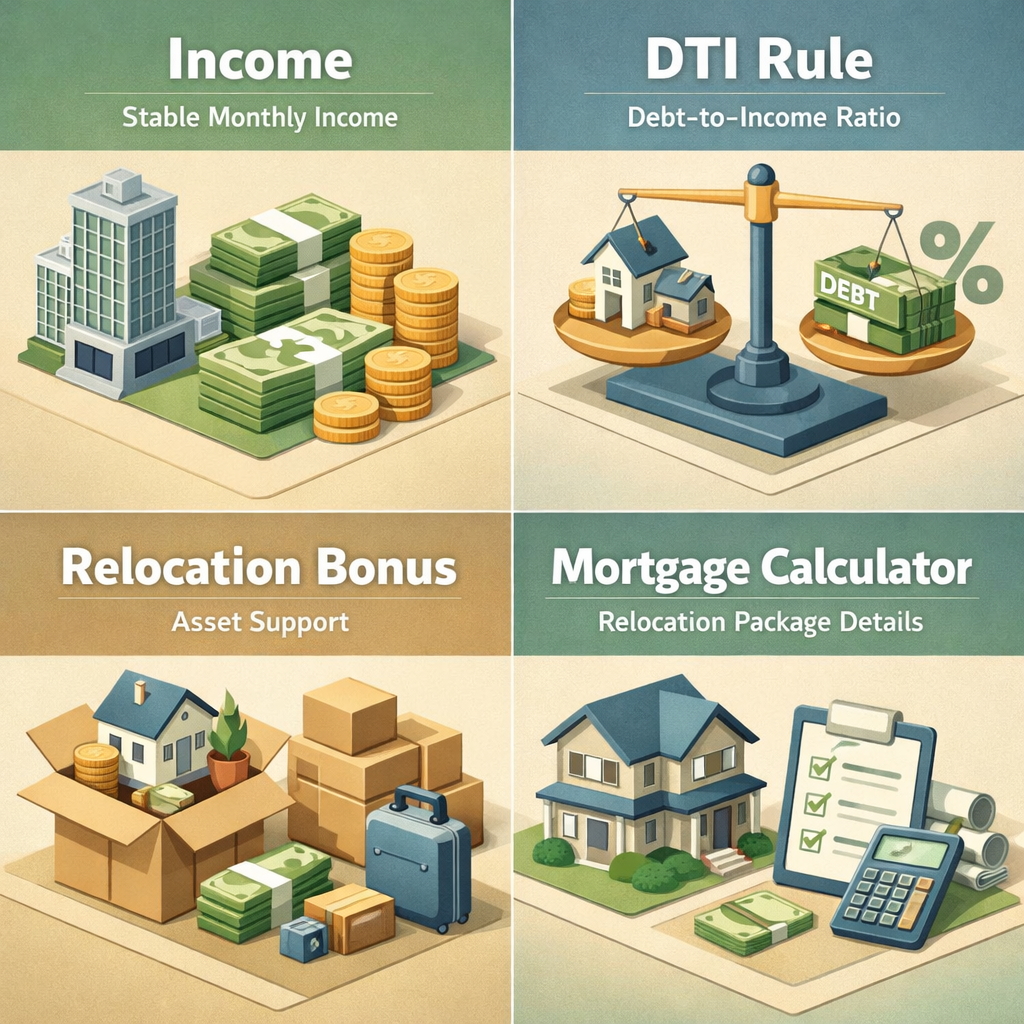
Now that you understand how lenders view relocation income, let's walk through how to calculate your mortgage affordability with a recent job relocation bonus in a practical, structured way.
Step 1: Establish Your Stable Monthly Income
Start with your new base salary. Divide your annual gross salary by 12 to get your gross monthly income. This is the number most lenders will use as their starting point. If your employment contract includes a guaranteed bonus structure, your lender may allow a portion of that to be included — but this typically requires documentation and a history of receiving bonuses in the same field.
Step 2: Apply the Debt-to-Income Ratio Rule
Lenders use your debt-to-income (DTI) ratio to determine how much of your monthly income can go toward housing costs. Most conventional mortgage programs prefer a DTI at or below 43%, though some programs allow slightly higher ratios with compensating factors. Here's a simplified formula:
- Take your gross monthly income.
- Multiply by the maximum DTI percentage (e.g., 0.43).
- Subtract your existing monthly debt obligations (car payments, student loans, credit cards).
- The result is the approximate maximum monthly mortgage payment you may qualify for.
For example, if your new salary gives you a gross monthly income of $7,000 and you have $500 in existing monthly debts, your maximum monthly mortgage payment might be around $2,510 at a 43% DTI threshold — though your actual lender will run their own calculations.
Step 3: Factor In Your Relocation Bonus as Asset Support
Even if your relocation bonus isn't counted as qualifying income, it could still help in meaningful ways. Use it to:
- Increase your down payment, which lowers your monthly payment and may eliminate PMI.
- Cover closing costs, reducing out-of-pocket expenses at the time of purchase.
- Build cash reserves, which can strengthen your overall loan file.
Documenting the source of these funds is essential. Lenders will typically ask for bank statements showing the deposit and a letter from your employer confirming the nature of the payment.
Step 4: Use a Mortgage Calculator With Relocation Package Details
Once you have your income and asset figures, plug them into an online mortgage calculator with relocation package considerations in mind. Most standard mortgage calculators ask for your loan amount, interest rate, loan term, and property tax and insurance estimates. For relocation situations, adjust the down payment field to reflect your relocation bonus contribution and see how it affects your monthly payment and PMI status.
Keep in mind that online calculators provide estimates. They don't account for all lender-specific requirements or adjustments that might come up during underwriting. Treat the output as a useful starting point — not a final approval figure.
Key Documents You'll Need When Applying After a Job Relocation
Applying for a mortgage after a recent relocation requires careful documentation. Lenders want to verify your income, employment status, and the source of your funds — especially when a relocation bonus is involved. Here are the documents you'll likely need:
- Signed offer letter or employment contract confirming your new position, salary, and start date.
- Relocation bonus letter from your employer explaining the amount, purpose, and payment method of the relocation package.
- Recent pay stubs from your new job showing actual earnings, if you've already started.
- Bank statements from the past two to three months showing receipt of the relocation funds and your overall financial picture.
- Tax returns and W-2s from the previous two years to establish your employment history and income continuity.
Being proactive about gathering these documents can speed up the underwriting process and reduce the chance of delays. If your relocation package includes any repayment clauses — meaning you'd owe the money back if you leave within a certain period — a lender may factor that contingent liability into their assessment as well.
How Relocation Timing Affects Your Mortgage Application
Timing is everything in mortgage lending, and a recent relocation adds another layer of complexity. Here's what to consider based on where you are in the process:
Applying Before You Start Your New Job
Some lenders will approve a mortgage based on a signed offer letter, particularly if you're moving within the same industry or profession. However, many prefer that you've received at least one or two pay stubs from the new employer before closing. If you're buying a home quickly after accepting a new role, be upfront with your lender so they can recommend the most appropriate loan program.
Applying Shortly After Starting Your New Job
This is often the sweet spot. You have documentation of your new salary, you may have received your relocation bonus, and you can demonstrate that the employment relationship has begun. Lenders tend to be more comfortable approving loans at this stage, especially if your credit profile is strong and your down payment is solid.
Applying Several Months After Relocation
If some time has passed since your relocation, your lender may want to verify that you've settled into your new role and that your income is stable. This is typically the most straightforward scenario, as you'll have recent pay stubs, a confirmed employment relationship, and a clearer financial picture.
Tips to Strengthen Your Mortgage Application as a Relocating Homebuyer
Buying a home after a job relocation is entirely achievable with the right preparation. Here are some practical strategies to improve your chances of a smooth approval:
- Get pre-approved early. Even before you find a home, a mortgage pre-approval gives you a realistic budget and shows sellers you're a serious buyer. It also helps you identify any documentation gaps before they become problems.
- Keep your relocation funds in a dedicated account. Separating your relocation bonus from everyday spending makes it easier to document the source of funds for your lender.
- Avoid large financial changes before closing. Don't open new credit accounts, make large purchases, or change jobs again during the mortgage process. These actions can raise red flags during underwriting.
- Work with a lender experienced in relocation scenarios. Not all lenders handle job-change mortgages the same way. An experienced loan officer can help you structure your application to present the strongest possible file.
- Be transparent about your situation. Trying to conceal a recent job change or the nature of your relocation income can cause serious issues during underwriting. Full disclosure upfront is always the better approach.
●Conclusion
Understanding how to calculate mortgage affordability with a recent job relocation bonus takes a bit more effort than a standard mortgage application — but it's very manageable with the right preparation. By clearly separating your stable qualifying income from one-time relocation funds, documenting everything thoroughly, and using a mortgage calculator with relocation package details to model your options, you can walk into the homebuying process with confidence.
Your relocation bonus may not count as qualifying income in every scenario, but it can still play a meaningful role in reducing your loan amount, eliminating PMI, or covering closing costs. The most important step is connecting with a knowledgeable mortgage professional who understands the nuances of your situation. At LoanWise, we help relocating homebuyers navigate the process from pre-approval to closing — so you can settle into your new home with peace of mind.