
Changing jobs is exciting — but if you're also planning to buy a home, it can raise a lot of questions. Will lenders trust your new income? Can you still qualify for a mortgage? The good news is that a job change doesn't automatically disqualify you from homeownership. However, it does change how lenders assess your financial situation. Understanding how to calculate mortgage affordability with recent job change scenarios in mind is a critical first step before you start house hunting. This guide walks you through the key calculations, lender requirements, and practical strategies to help you move forward with confidence.
What Mortgage Affordability Actually Means
Mortgage affordability refers to the maximum loan amount and monthly payment you can realistically manage based on your income, debts, and financial obligations. Lenders don't just look at your paycheck — they evaluate your entire financial picture to determine whether you're likely to repay the loan without hardship.
The two most important ratios lenders use are your front-end ratio and your back-end ratio, both of which fall under the broader category of debt-to-income (DTI) ratios.
- Front-end ratio: This measures your projected housing costs — including principal, interest, taxes, and insurance (PITI) — as a percentage of your gross monthly income. Most conventional lenders prefer this to be no higher than 28%.
- Back-end ratio: This includes all monthly debt obligations — housing costs plus car payments, student loans, credit card minimums, and other recurring debts — as a percentage of gross monthly income. Lenders typically prefer this to stay at or below 43%, though some programs may allow higher ratios.
When you've recently changed jobs, the income figure used in these calculations may look very different from what you expect. Lenders may not simply accept your new salary at face value — they often want documentation and, in some cases, a history of consistent earnings before they feel comfortable using a specific income figure in their calculations.
How Lenders View Income After a Job Change and Why It Matters
When you apply for a mortgage as a borrower with a new job, lenders focus on income stability and continuity. The way they evaluate your income depends heavily on the type of employment and whether your career has followed a consistent path.
Salaried Employees With a New Position
If you've moved into a new salaried role in the same field or industry, lenders may be more flexible. They'll typically require a current pay stub and an offer letter confirming your salary. In many cases, this may be enough to document qualifying income — especially if the job change represents a lateral move or a promotion within the same career track.
Hourly or Variable Income Earners
If your pay varies from week to week — due to overtime, shift differentials, or hourly fluctuations — lenders are generally more cautious. They may want to see at least one to two years of consistent earnings history before averaging your income for qualification purposes. A recent job change in this situation can make it harder to establish the income baseline lenders rely on.
Commission-Based or Self-Employed Borrowers
This is where things get more complex. If your new role includes a significant commission component, or if you've transitioned into self-employment, lenders typically require two years of tax returns to average your income. This is a common guideline for conventional and government-backed loan programs. A recent job change into commission or self-employment may delay your qualification timeline unless you have a strong history of similar earnings to support your application.
Understanding which category applies to you is essential before you begin calculating what you can afford — because the income number you use in your affordability formula must be one that your lender will actually accept.
Step-by-Step: How to Calculate Mortgage Affordability With Recent Job Change
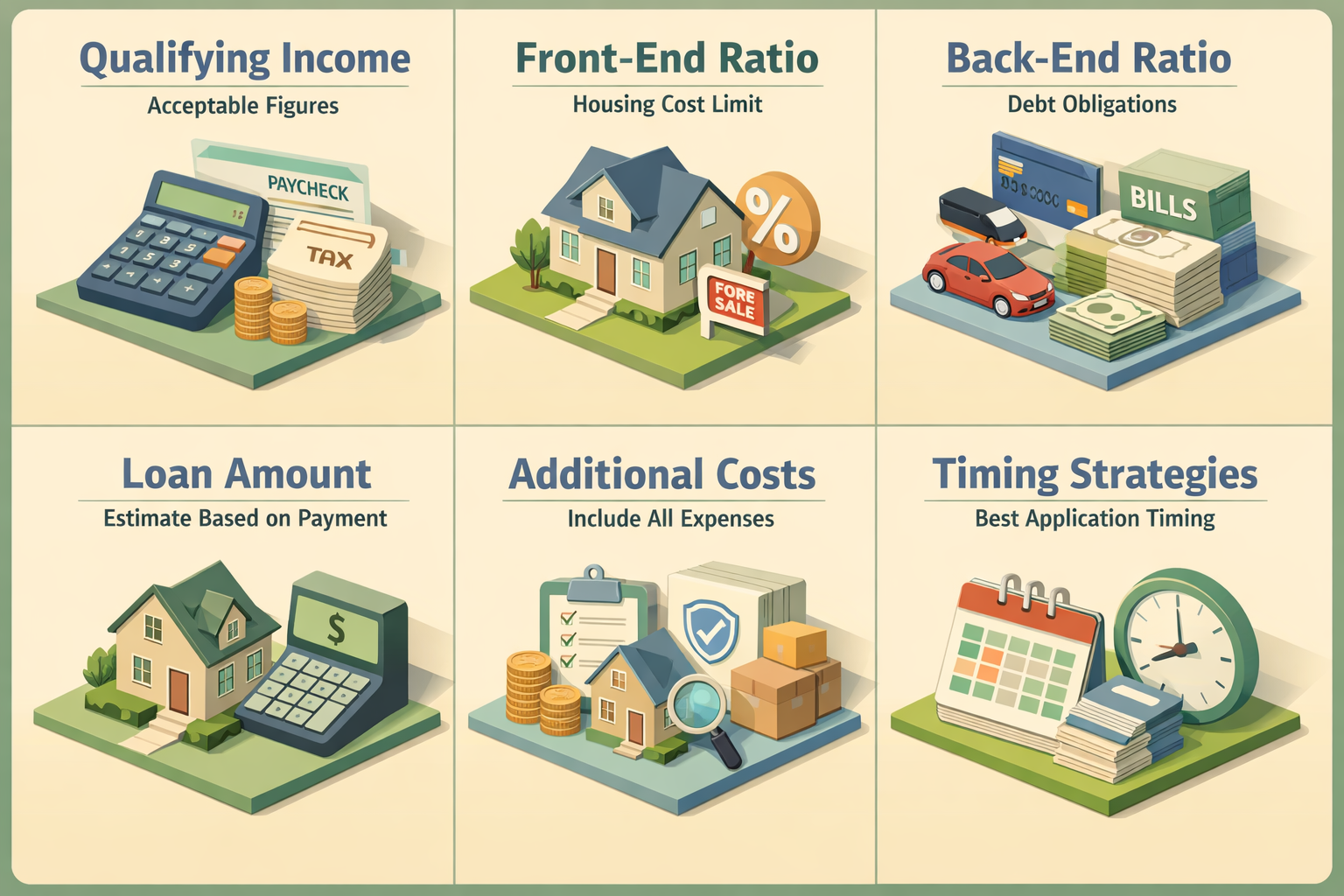
Once you know how your lender is likely to view your income, you can run a realistic affordability estimate. Here's a practical framework to guide your calculation:
Step 1 — Determine Your Qualifying Gross Monthly Income
Use the income figure your lender is most likely to accept. For a salaried employee with an offer letter, this is typically your new annual salary divided by 12. For hourly or variable earners, use a conservative average based on recent pay history. If there's any uncertainty, it's wise to consult a loan officer early — they can clarify what income is documentable and usable for qualification.
Step 2 — Apply the Front-End Ratio
Multiply your qualifying gross monthly income by 0.28 (or the front-end limit your lender uses). The result is the maximum monthly housing cost lenders may be comfortable with. For example, if your qualifying monthly income is $6,000, a 28% front-end ratio suggests a maximum housing payment of around $1,680 per month — including principal, interest, taxes, and insurance.
Step 3 — Apply the Back-End Ratio
Multiply your gross monthly income by 0.43 (or the applicable back-end limit). Then subtract your existing monthly debt obligations. The remaining figure represents how much room is left for a housing payment. If your monthly debts total $500 and your back-end limit is $2,580 (43% of $6,000), your maximum housing payment drops to $2,080 — but that ceiling is now bounded by the front-end result, making $1,680 the more conservative figure to use.
Step 4 — Estimate the Loan Amount
Use a mortgage calculator to work backward from your target monthly payment to a loan amount. At a given interest rate and loan term, a $1,680 monthly principal-and-interest payment could support a loan somewhere in the range of $250,000 to $350,000 depending on current rates — but this will vary based on market conditions. Adding your down payment to the loan amount gives you a rough estimate of the purchase price you can realistically target.
Step 5 — Factor in Additional Costs
Don't forget that your monthly housing payment includes more than just principal and interest. Property taxes, homeowner's insurance, and potentially private mortgage insurance (PMI) or HOA fees all count toward your front-end ratio. These costs vary significantly by location and property type, so be sure to include realistic estimates when running your numbers.
Key Factors That Can Strengthen Your Mortgage Application as a New Job Borrower
If you're a mortgage for borrowers with new job situations in mind, there are several ways to offset any income documentation concerns and improve your chances of approval.
A Larger Down Payment
Putting more money down reduces the lender's risk and may give you more leverage in the approval process. A larger down payment also reduces your loan-to-value ratio (LTV), which can help you avoid PMI and may unlock better interest rate options.
Strong Credit History
Your credit score remains one of the most influential factors in mortgage qualification. A high credit score signals responsible financial behavior and may help compensate for a shorter tenure at your new employer. Before applying, it's a good idea to review your credit report, address any errors, and avoid opening new lines of credit.
Cash Reserves
Lenders feel more comfortable when borrowers have savings beyond their down payment. Cash reserves — typically measured in months of mortgage payments — demonstrate that you could continue making payments even if your income were temporarily disrupted. This can be especially reassuring to underwriters when your job change is recent.
A Career-Consistent Job Change
If your new role is in the same field or industry as your previous position, lenders are generally more accepting. A job change that reflects career advancement or a higher salary in the same profession is viewed much more favorably than a transition into an entirely different industry or employment type.
- Stay in the same career field when possible
- Obtain a signed offer letter confirming salary and start date
- Avoid switching from salaried to commission-only income right before applying
- Keep your existing debts low to maintain a healthy DTI ratio
Loan Programs That May Offer More Flexibility for New Job Borrowers
Not all mortgage programs evaluate employment history the same way. Depending on your situation, certain loan types may be more accessible even with a recent career change.
FHA Loans
FHA loans, backed by the Federal Housing Administration, are known for being more accessible to borrowers with shorter employment histories or lower credit scores. While they still require income documentation and employment verification, they may offer more flexibility in how that income is assessed — particularly for borrowers who have moved to a similar type of job within the same field.
Conventional Loans
Conventional loans backed by Fannie Mae or Freddie Mac follow specific guidelines around employment history. However, they may still be an option if your job change is within the same profession and you can document your new income clearly. Some guidelines allow lenders to use a new salary if the borrower has a solid two-year employment background overall, even if the specific employer has changed recently.
Non-QM or Portfolio Loans
For borrowers who don't fit neatly into standard program boxes — such as those who are self-employed or have non-traditional income structures — non-qualified mortgage (non-QM) or portfolio loan products may be worth exploring. These loans are held by lenders rather than sold to the secondary market, which can allow for more flexible underwriting. However, they often come with higher interest rates and stricter equity requirements, so it's important to weigh the trade-offs carefully.
Speaking with a knowledgeable loan officer who understands multiple program types is one of the best ways to identify which path makes the most sense for your specific employment situation.
Timing Your Home Purchase Around Your Career Transition
In some cases, the smartest move may be to delay your mortgage application by a few months to allow your new employment situation to stabilize. While waiting isn't always ideal, it can make the qualification process significantly smoother.
As a general benchmark, many lenders prefer to see at least 30 days of pay stubs from your new employer before closing on a loan. For variable income, a longer history — often six months to a year — may be needed to establish a reliable average. For self-employed borrowers, two full tax years of self-employment income is typically required under most conventional and government-backed guidelines.
If you're in a position where you've already accepted a new offer and are eager to purchase, consider the following timeline strategies:
- Apply after your first paycheck: Having at least one or two pay stubs from your new employer demonstrates active income and may satisfy basic documentation requirements for salaried borrowers.
- Close before your start date — with caution: Some lenders may allow you to close on a mortgage using a confirmed offer letter, particularly if you're starting within 60 days. This is program-specific and requires careful coordination with your lender.
- Use a co-borrower: If a spouse or co-borrower has stable, well-documented income, that income may help carry the application while your employment situation is newer.
Timing matters — and a small adjustment to your purchase timeline could mean the difference between a straightforward approval and a more difficult underwriting process.
●Conclusion
Navigating how to calculate mortgage affordability with recent job change circumstances requires a clear understanding of lender expectations, income documentation standards, and how your specific employment situation is likely to be evaluated. The good news is that a new job doesn't have to derail your homeownership goals — it just means you'll want to be more prepared and strategic in your approach.
Start by determining which income figure a lender will realistically use, then run your front-end and back-end ratio calculations based on that number. Strengthen your application with a solid credit score, a meaningful down payment, and documented cash reserves. And if your situation is more complex, explore which loan programs might offer the flexibility you need.
At LoanWise, we're here to help you understand your options and find the right financing path — no matter where you are in your career journey. Connect with one of our mortgage specialists today to explore what's possible for you.