
Buying a home is one of the most meaningful financial decisions you'll ever make. But when your income includes bonuses or child support payments, figuring out how much you can actually borrow becomes a bit more involved. Lenders don't treat all income the same way, and understanding the rules around variable and supplemental pay can make a real difference in your approval odds. This guide walks you through how to calculate mortgage affordability with recent bonus income and child support so you can approach the process with confidence and clarity.
Why Lenders Look Beyond Your Base Salary
When a lender reviews your mortgage application, they're trying to answer one key question: can this borrower reliably make monthly payments over the life of the loan? To answer that, they look at your qualifying income — which may include more than just your regular paycheck.
For many homebuyers, total household income involves a mix of sources. A salaried employee might also receive annual performance bonuses. A divorced or separated parent might receive child support each month. These income streams can absolutely be counted toward your mortgage qualification — but only under specific conditions that lenders and loan programs require.
Understanding those conditions is the first step toward accurately calculating how much home you can afford.
How Bonus Income Is Evaluated During the Mortgage Process
Bonus income is considered variable income because it's not guaranteed to continue at the same level from year to year. Lenders typically handle it carefully, and there are a few important rules most programs follow.
The Two-Year History Requirement
Most conventional loan programs, including those backed by Fannie Mae and Freddie Mac, generally require that bonus income be documented over at least a two-year history. This helps lenders confirm that the bonus is a consistent and reliable part of your earnings rather than a one-time event.
If you've only been receiving bonuses for one year or less, lenders may be hesitant to count that income toward your qualifying amount. Some may require a written explanation or employer letter confirming the likelihood of continued bonus payments.
How the Average Is Calculated
When bonus income does qualify, lenders typically average it over 24 months. For example, if you earned a $10,000 bonus two years ago and a $14,000 bonus last year, the lender might average those together and use approximately $1,000 per month as your qualifying bonus income.
It's also worth knowing that if your most recent bonus was significantly lower than prior years, some lenders may use the lower figure — or decline to count the income entirely. Consistency and an upward trend in your bonus earnings tend to work in your favor.
Documentation You'll Likely Need
- Two years of W-2 forms or tax returns showing bonus income
- Recent pay stubs reflecting year-to-date bonuses
- A verification of employment letter from your employer, when requested
Being organized and proactive with your documentation can help move your application forward more smoothly.
Counting Child Support as Qualifying Income for a Mortgage
Child support can also be used to help qualify for a mortgage, but like bonus income, there are conditions that must be met. Lenders want to be confident that this income will continue long enough to be meaningful in the context of a home loan.
Continuity of Income Is Key
Most lenders follow guidelines that require child support income to continue for at least three years from the date of your mortgage application. If child support payments are scheduled to end within a shorter period, the lender may not be able to include that income in your qualifying calculations.
This three-year continuity rule is common across many loan programs, including conventional loans. It's designed to ensure that the income will actually help you sustain your mortgage payments over time — not just in the early months.
Proving Consistent Receipt of Payments
Simply having a court order or divorce decree isn't always enough. Lenders typically want to see evidence that child support payments have actually been received on a regular basis. This might include:
- Bank statements showing consistent deposits over six to twelve months
- A copy of the court order or legal separation agreement outlining payment terms
- Documentation from a state disbursement unit if payments are routed through one
If payments have been irregular or missed in the past, lenders may be less willing to count them, or may apply additional scrutiny to your application.
Child Support You Pay Can Also Affect Your Qualification
It's important to remember that child support works both ways. If you're the one paying child support, that obligation is counted as a monthly debt in your debt-to-income ratio (DTI). This reduces the amount of income available to qualify for a mortgage and can lower your maximum loan amount. Make sure to account for this when estimating your affordability range.
Understanding Debt-to-Income Ratio and Its Role in Affordability
One of the most important numbers in mortgage lending is your debt-to-income ratio, or DTI. This figure compares your total monthly debt obligations to your gross monthly income, and it's one of the primary ways lenders assess affordability.
DTI is expressed as a percentage. Lenders generally look at two versions:
- Front-end DTI: Your proposed housing payment (principal, interest, taxes, and insurance) divided by your gross monthly income.
- Back-end DTI: All monthly debt payments — including the proposed housing payment, car loans, student loans, credit card minimums, and child support — divided by gross monthly income.
Most conventional loan programs prefer a back-end DTI of 45% or lower, though some programs may allow higher ratios depending on compensating factors like strong credit or a larger down payment. FHA loans may also permit higher DTI thresholds in certain circumstances.
Here's a simplified example of how this works in practice. Suppose your gross monthly income — combining your base salary, averaged bonus income, and child support received — is $7,500. If your total monthly debts (excluding the new mortgage) are $1,000, a lender using a 45% back-end DTI limit might allow up to $2,375 per month for your total housing payment. That figure then helps determine the maximum loan amount you might qualify for at current interest rates.
This is why understanding how to calculate mortgage affordability with recent bonus income and child support matters so much — every dollar of verifiable income can meaningfully shift your qualifying range.
Practical Steps to Estimate How Much Home You Can Afford
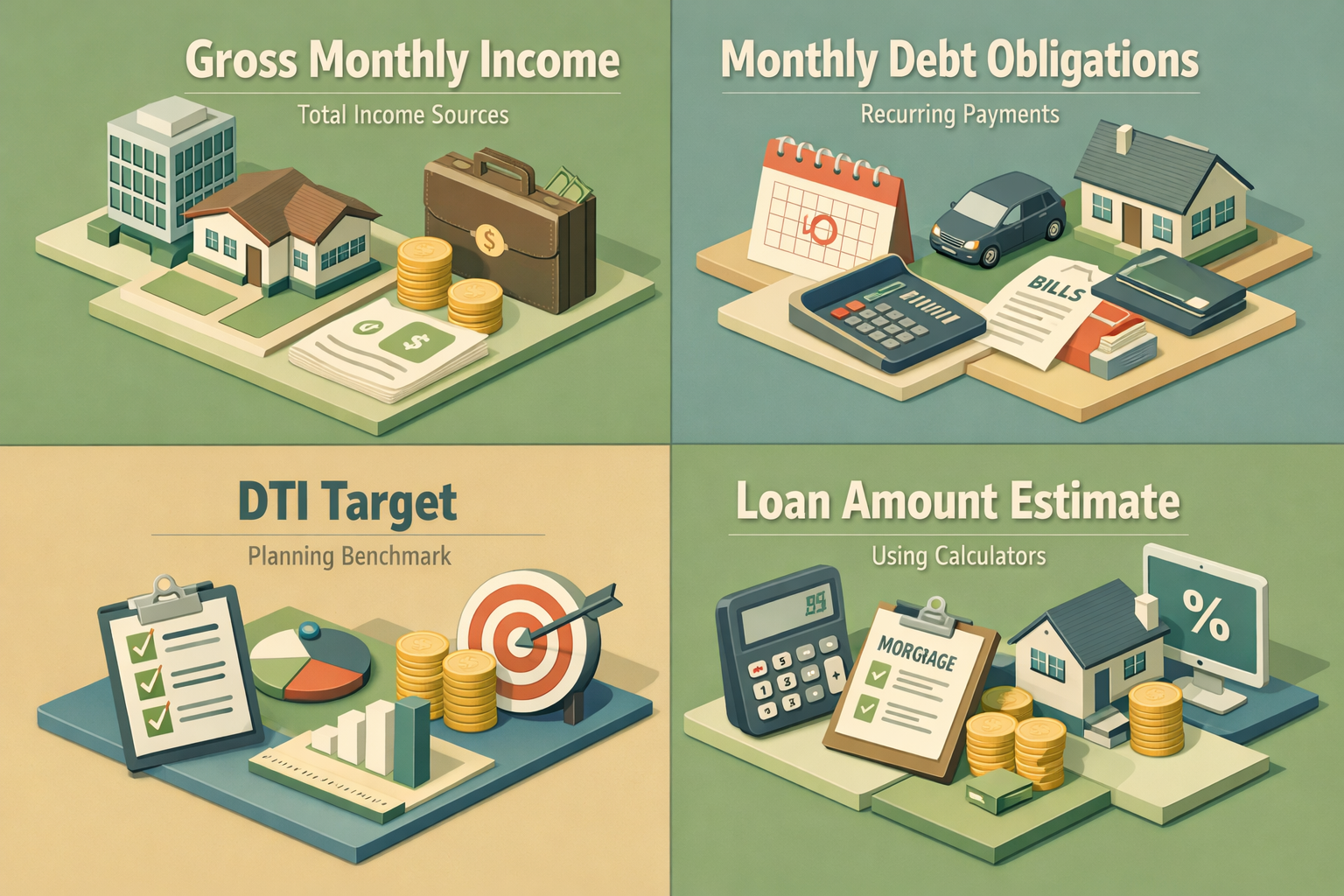
Once you understand how lenders view your income, you can start building a clearer picture of your buying power. Here's a practical approach to estimating your mortgage affordability.
Step 1: Calculate Your Gross Monthly Income
Add up all qualifying income sources on a monthly basis:
- Base salary divided by 12
- Averaged bonus income divided by 12 (using the two-year average)
- Regular child support received, if it meets continuity requirements
- Any other qualifying income such as rental income or part-time work
Step 2: Subtract Monthly Debt Obligations
List all recurring monthly obligations that would appear on your credit report, plus any child support or alimony you're required to pay. Subtract this total from your income to understand your financial breathing room.
Step 3: Apply a Realistic DTI Target
Use a back-end DTI target of around 43% to 45% as a planning benchmark. Multiply your gross monthly income by this percentage and subtract existing debts. The result is an estimate of what you could allocate toward housing costs each month.
Step 4: Work Backward to a Loan Amount
Using a mortgage affordability calculator or speaking with a loan officer, convert your estimated monthly housing payment into a loan amount. Remember to account for property taxes, homeowner's insurance, and possibly private mortgage insurance (PMI) — these are all part of your monthly payment.
Online mortgage calculators can be a helpful starting point, but a licensed mortgage professional can give you a more accurate picture based on current rates and your complete financial profile.
Tips to Strengthen Your Application When Using Variable Income
If your income picture includes bonuses or child support, there are a few strategies that may improve your standing with lenders.
Build a Strong Credit Profile
A higher credit score can open doors to better loan programs and may give lenders more flexibility when evaluating borderline income situations. Pay down existing balances, avoid opening new credit accounts before applying, and review your credit report for any errors that could be dragging your score down.
Save for a Larger Down Payment
A bigger down payment reduces the loan-to-value ratio and demonstrates financial discipline. Lenders may be more willing to work with complex income situations when a borrower brings more equity to the table from the start.
Get Pre-Approved Early
Speaking with a lender before you start shopping for homes gives you a realistic sense of your budget and surfaces any documentation issues while there's still time to resolve them. Pre-approval also strengthen your application when making offers in a competitive market.
Consider the Right Loan Program
Different loan programs handle variable income and support payments differently. FHA loans, conventional loans, and certain non-QM (non-qualified mortgage) programs each have their own guidelines. A knowledgeable mortgage advisor can help you identify which program aligns best with your income profile.
●Conclusion
Navigating mortgage affordability bonus child support considerations doesn't have to be overwhelming. When you understand how lenders view each income source — and what documentation they expect — you're in a much stronger position to plan accurately and apply with confidence. Whether you're receiving child support that bolsters your buying power or counting on consistent bonuses to qualify for the home you want, the key is preparation and documentation.
At LoanWise, we're here to help you make sense of your complete financial picture and find a mortgage solution that truly fits your life. Connect with one of our mortgage specialists today to get personalized guidance and take the next step toward homeownership.