
Going through a divorce is already one of life's most stressful transitions — and trying to buy a home shortly after can feel even more overwhelming. Whether you're receiving alimony or paying it, this financial detail plays a significant role in how lenders evaluate your mortgage application. Understanding how to calculate mortgage affordability with recent alimony payments can mean the difference between getting approved for the home you want or being caught off guard at the closing table. In this guide, we'll walk through exactly how lenders treat alimony, how it affects your debt-to-income ratio, and what steps you can take to put your best financial foot forward.
What Lenders Mean by Alimony in a Mortgage Context
Before diving into the numbers, it helps to understand how the mortgage industry defines and categorizes alimony. Alimony — also called spousal support or spousal maintenance — is a court-ordered payment made from one former spouse to another following a legal separation or divorce. Lenders treat alimony differently depending on whether you're the one receiving it or paying it.
For mortgage qualification purposes, alimony received may be counted as qualifying income, which can boost your borrowing power. Alimony paid, on the other hand, is typically treated as a recurring monthly liability — similar to a car payment or student loan — and is factored into your debt-to-income (DTI) ratio, which can reduce the loan amount you qualify for.
It's worth noting that lenders generally require documentation proving the alimony arrangement is stable and likely to continue. Most conventional loan guidelines suggest that the income or obligation must have a remaining term of at least three years to be considered in the qualification process. That said, lender policies can vary, so it's always wise to confirm requirements with your loan officer early in the process.
Using Alimony Income to Strengthen Your Mortgage Application
If you're receiving alimony, you may be able to use it as qualifying income — and that could meaningfully improve your ability to afford a mortgage. However, lenders will want to verify that the income is consistent and dependable before including it in their calculations.
Documentation Lenders Typically Require
- Divorce decree or separation agreement: This establishes the legal basis for the payments and confirms the agreed-upon amount.
- Payment history: Bank statements or payment records showing that alimony has been received consistently — usually for at least six to twelve months, depending on the loan program.
- Remaining duration: Evidence that payments are scheduled to continue for a meaningful period, often three or more years.
Once lenders have confirmed these factors, the alimony income can be added to your gross monthly income figure. This directly impacts your purchasing power by allowing you to qualify for a larger loan amount. For example, if your base salary produces $4,500 per month in qualifying your income and you receive $1,000 per month in documented alimony, your total qualifying income could rise to $5,500 per month — potentially opening doors to a significantly higher home price range.
Keep in mind that not all lenders handle this identically. FHA, VA, USDA, and conventional loans each follow slightly different guidelines for how alimony income is treated. Checking with a knowledgeable mortgage professional familiar with your specific loan type is always a smart move.
How Alimony Payments Affect Your Debt-to-Income Ratio
Your debt-to-income (DTI) ratio is one of the most critical factors in any mortgage approval decision. It measures what percentage of your gross monthly income goes toward monthly debt obligations. Lenders use this ratio to assess whether you can comfortably manage a new mortgage payment on top of your existing financial commitments.
If you're paying alimony, those payments are almost always counted as part of your monthly debt load. Here's a simplified example of how that works:
- Gross monthly income: $7,000
- Monthly alimony obligation: $800
- Other monthly debts (car, student loan): $600
- Proposed mortgage payment (PITI): $1,800
- Total monthly obligations: $3,200
- DTI ratio: $3,200 ÷ $7,000 = approximately 45.7%
Most conventional loan programs prefer a DTI at or below 43–45%, though some programs may allow higher ratios with compensating factors like strong credit or substantial reserves. In the example above, that alimony obligation is eating into the available DTI cushion — which means the borrower may need to look at a lower-priced home, make a larger down payment, or pay down other debts to improve their qualification profile.
Understanding this math is at the heart of learning how to calculate mortgage affordability with recent alimony payments. Knowing your DTI before you start shopping gives you a realistic picture of what you can afford — and that's where affordability calculations become especially valuable.
Step-by-Step: Calculating Your Mortgage Affordability with Alimony
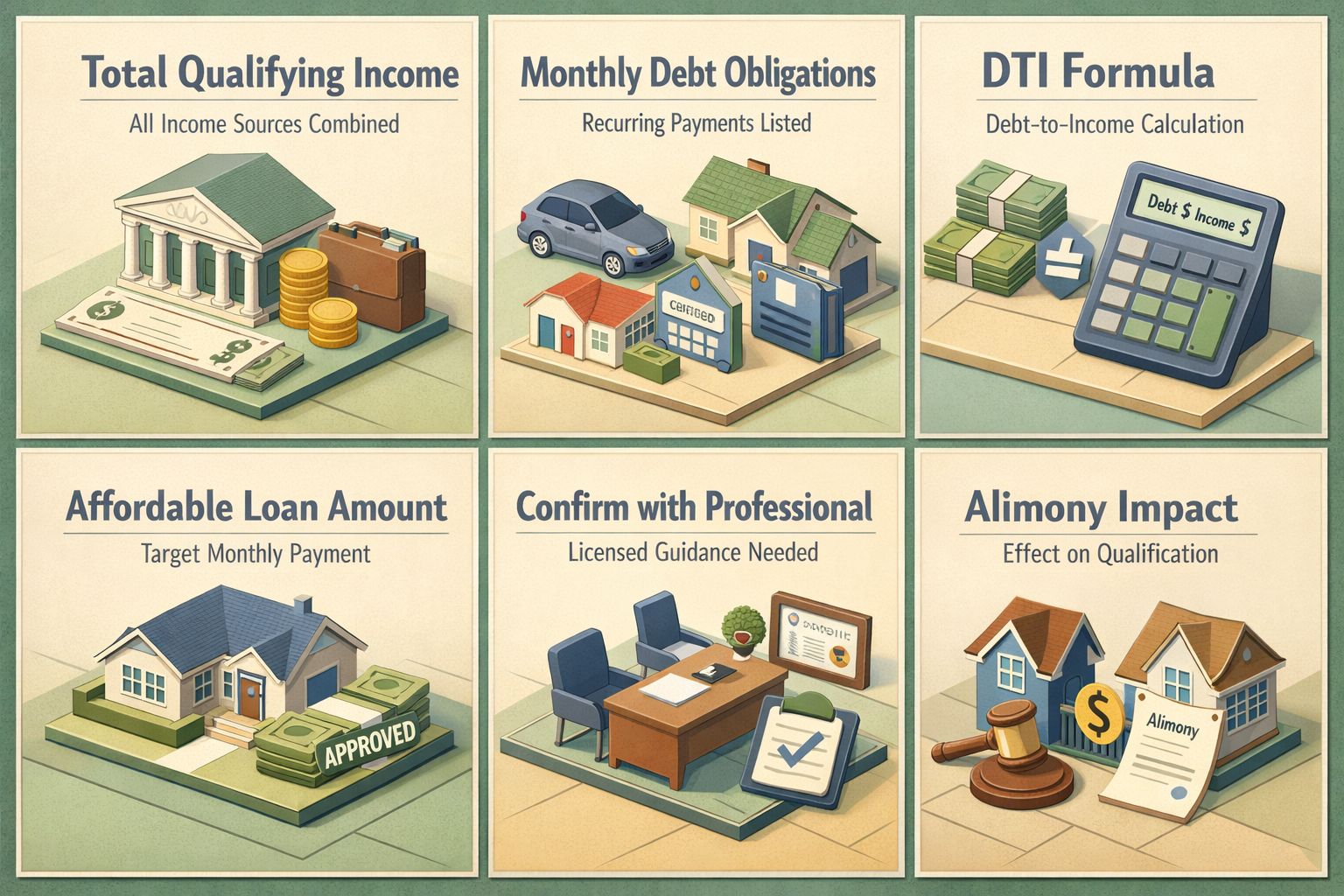
Whether you're receiving or paying alimony, here's a practical framework for estimating your mortgage affordability before speaking with a lender.
Step 1: Determine Your Total Qualifying Income
Add up all sources of verifiable monthly income. This may include your salary, self-employment income, rental income, and — if applicable — documented alimony received. Only include alimony that meets lender continuity requirements.
Step 2: List All Monthly Debt Obligations
Include every recurring debt payment: credit cards (minimum payments), auto loans, student loans, personal loans, child support, and alimony paid. Do not include utilities or subscriptions, as these are typically not factored into DTI calculations.
Step 3: Apply the DTI Formula
Divide your total monthly debts (including the estimated new mortgage payment) by your gross monthly income. Aim for a front-end DTI — just the housing payment — of around 28–31% of gross monthly income, and a back-end DTI — all debts combined — of no more than 43–45%, depending on the loan program.
Step 4: Estimate an Affordable Loan Amount
Work backward from your target monthly payment. Using an online mortgage calculator, input various loan amounts at current interest rates until you find a monthly payment that keeps your back-end DTI within an acceptable range. Remember to include estimated property taxes, homeowner's insurance, and any HOA fees in your housing cost estimate.
Step 5: Confirm with a Licensed Mortgage Professional
Online tools can give you a ballpark, but a licensed loan officer can run a full pre-qualification or pre-approval analysis using real rate data, your actual credit score, and program-specific guidelines. This step is especially important when alimony is involved, as documentation requirements can vary by lender and loan type.
Alimony Income Mortgage Qualification: Program-by-Program Overview
Different loan programs approach alimony income mortgage qualification in slightly different ways. Here's a general overview to help you understand where you may stand:
Conventional Loans (Fannie Mae / Freddie Mac)
Both Fannie Mae and Freddie Mac generally allow alimony to be counted as qualifying income, provided it's documented with a divorce decree, payment history, and evidence it will continue for at least three years. Alimony paid is counted as a monthly debt obligation in the DTI calculation.
FHA Loans
FHA guidelines similarly permit the use of alimony as qualifying income with appropriate documentation. FHA loans may be a good fit for borrowers with lower credit scores or smaller down payments. The same three-year continuity standard typically applies. Alimony paid is also included in the borrower's total monthly obligations.
VA Loans
For eligible veterans and service members, VA loans follow comparable guidance. Alimony received can count toward income if properly documented and stable. Alimony paid counts as a liability. VA loans don't technically set a hard DTI cap, but lenders typically look for a DTI under 41% as a general benchmark.
USDA Loans
USDA rural development loans also allow alimony income to be counted, subject to documentation and continuity requirements. However, USDA loans have household income limits, and alimony received may count toward total household income for eligibility purposes — which is an important nuance to discuss with your lender.
No matter which program you're pursuing, the key takeaway is that consistent documentation and a clear paper trail are essential for making alimony work in your favor during the mortgage qualification process.
Tips for Homebuyers Navigating Alimony and Mortgage Approval
If you're working through the mortgage application after divorce with alimony as part of your financial picture, a few strategic steps can help smooth the path to approval.
- Get organized early: Gather your divorce decree, separation agreement, and at least twelve months of alimony payment records before you start the application process. Having these documents ready can speed things up significantly.
- Monitor your credit score: Divorce often disrupts financial routines, and it's not uncommon for credit scores to dip during or after the process. A stronger credit score can offset some of the challenges that come with a complex income picture.
- Reduce other debts where possible: If alimony paid is pushing your DTI toward its limit, paying down a credit card or auto loan before applying may open up additional borrowing room.
- Avoid large financial changes before closing: Taking on new debt, changing jobs, or receiving large undocumented deposits can raise red flags during underwriting. Stability is key.
- Work with a lender experienced in divorce-related transactions: Not every loan officer has dealt with the nuances of alimony documentation. Finding one who has can save you time and reduce the risk of surprises.
It's also worth remembering that disclosing alimony is not required unless you want it to be considered as qualifying income. If you'd prefer to leave it out of the equation entirely — perhaps because the payments are new and documentation is thin — you can simply not include it, as long as your application still qualifies without it.
●Conclusion
Understanding how to calculate mortgage affordability with recent alimony payments gives you a genuine advantage as you navigate the homebuying process after a major life change. Whether alimony strengthens your income picture or adds to your monthly obligations, knowing how lenders view it — and preparing your documentation accordingly — puts you in a much stronger position at the application table. The math isn't complicated once you understand the framework: verify your qualifying income, account for all monthly obligations including alimony, and target a DTI that aligns with your chosen loan program. If you're ready to take the next step, connecting with a knowledgeable mortgage professional at LoanWise can help you turn those numbers into a clear, confident path to homeownership.