
Buying a home is one of the biggest financial decisions you'll ever make, and getting the numbers right before you apply for a mortgage can save you a lot of stress. If you earn overtime pay or carry student loan debt — or both — you may be wondering exactly how lenders view your financial picture. The good news is that overtime income can count toward your qualifying income, and student loan debt doesn't automatically disqualify you. What matters most is understanding how lenders calculate your debt-to-income ratio and how they treat each income and debt source. This guide walks you through how to calculate mortgage affordability with overtime pay and student debt so you can approach the homebuying process with clarity and confidence.
Why Mortgage Affordability Is More Than Just Your Salary
Many homebuyers assume that mortgage affordability comes down to one simple number — their base salary. In reality, lenders look at a broader picture that includes all verifiable income sources, recurring monthly debts, credit history, and available assets. Your gross monthly income forms the foundation of the calculation, but overtime pay, bonuses, part-time work, and even rental income may also factor in depending on how stable and consistent those earnings are.
At the same time, your monthly obligations — including student loan payments, car loans, credit card minimums, and the proposed new mortgage payment — are weighed against that income. This relationship is known as your debt-to-income (DTI) ratio, and it's one of the most important metrics lenders use to evaluate whether you can comfortably manage a mortgage. Understanding how each piece fits together is the first step toward knowing what you can realistically afford.
How Lenders Treat Overtime Income When Qualifying You for a Mortgage
Overtime pay can meaningfully boost your qualifying income, but lenders typically won't count it unless it meets certain consistency standards. Most conventional loan guidelines — including those backed by Fannie Mae and Freddie Mac — generally require that overtime income be documented for at least two years and that there's a reasonable likelihood it will continue. A single large overtime check or a recent uptick in hours usually won't be sufficient on its own.
When overtime is considered eligible, lenders will typically average it over a two-year period using your W-2 forms and recent pay stubs. For example, if you earned $8,000 in overtime in year one and $10,000 in year two, the lender might average those figures to arrive at approximately $750 per month in additional qualifying income. That extra income could make a notable difference in how much home you can afford.
Here are a few key points to keep in mind about overtime income:
- Documentation matters: Expect to provide two years of W-2s, recent pay stubs, and possibly a verification of employment letter confirming overtime is likely to continue.
- Declining overtime may raise flags: If your overtime earnings have been decreasing year over year, some lenders may discount or exclude that income entirely.
- Part-time and seasonal overtime follow similar rules: Consistency and a two-year history are typically required for any variable income source.
It's worth speaking directly with a loan officer early in the process to confirm how your specific employer and overtime situation will be evaluated under the loan program you're targeting.
DTI Calculation with Overtime and Student Debt: A Step-by-Step Breakdown
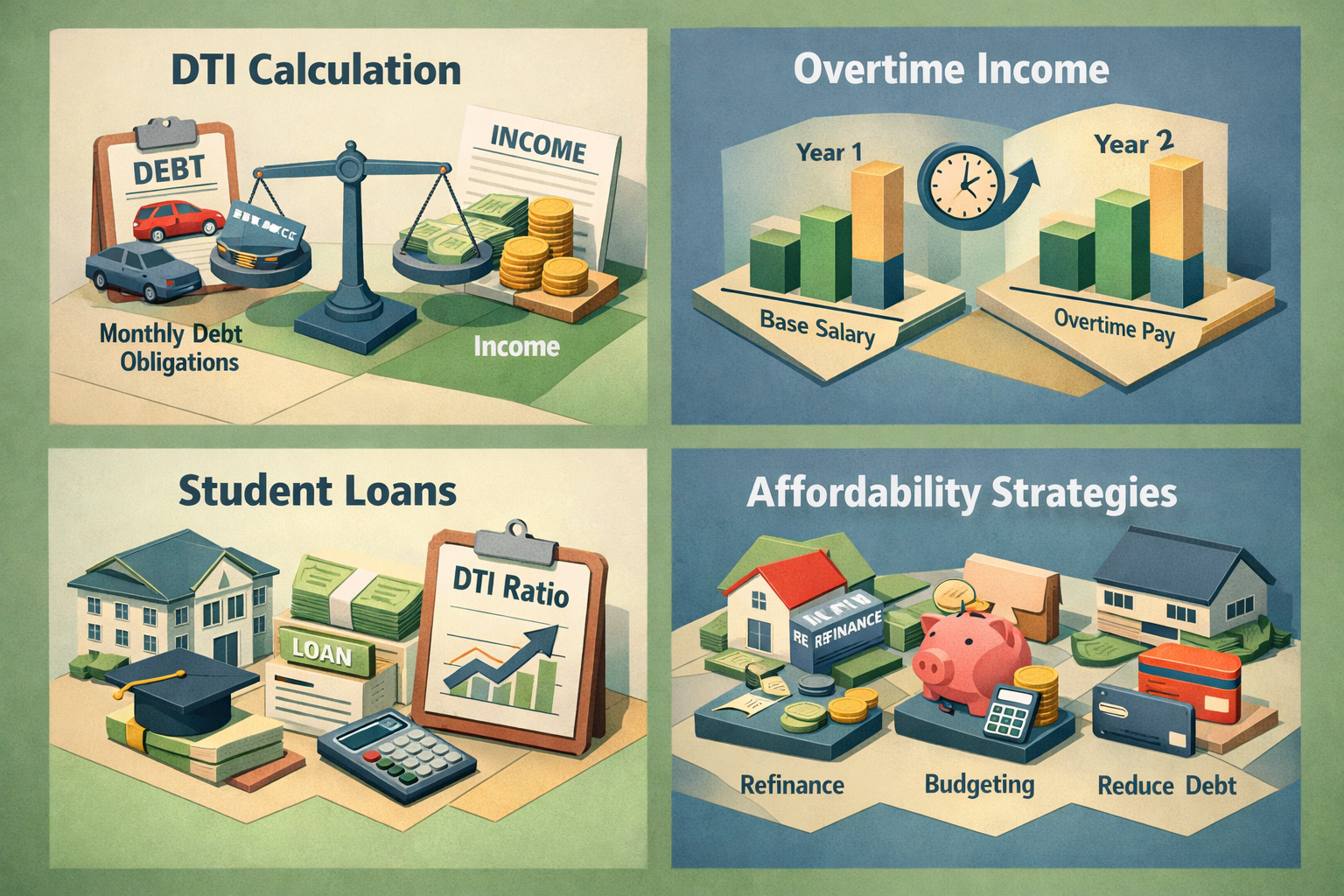
The DTI calculation for overtime and student debt follows a straightforward formula, even if the inputs feel complicated. Your DTI ratio is expressed as a percentage and calculated by dividing your total monthly debt obligations by your gross monthly income. There are actually two DTI figures lenders look at: the front-end ratio (housing costs only) and the back-end ratio (all monthly debts combined). The back-end DTI is usually the more critical of the two.
Let's walk through a simplified example:
- Base monthly salary: $5,000
- Averaged monthly overtime income: $750
- Total gross monthly income: $5,750
- Proposed monthly mortgage payment (PITI): $1,600
- Student loan monthly payment: $350
- Car loan payment: $300
- Credit card minimum: $75
- Total monthly debts: $2,325
- Back-end DTI: $2,325 ÷ $5,750 = approximately 40.4%
Many conventional loan programs prefer a back-end DTI at or below 43% to 45%, though some programs may allow higher ratios with compensating factors such as strong credit scores or larger down payments. FHA loans, for instance, may permit DTI ratios up to 50% in certain circumstances, depending on the lender and the borrower's overall profile.
This is exactly why using a mortgage affordability calculator for overtime and student loans can be so valuable — it lets you test different scenarios quickly and see how changing one variable (like paying off a debt or counting less overtime) shifts your overall affordability picture.
How Student Loans Are Counted in Your Mortgage Application
Student loan debt is one of the most nuanced areas of mortgage qualification, and the rules can vary depending on the loan program and whether your loans are in repayment, deferment, or on an income-driven repayment plan. Lenders must account for student loan obligations in your DTI, but how they calculate that monthly obligation can differ significantly.
Here's a general overview of how common loan programs may handle student debt:
- Conventional loans (Fannie Mae): If your loans are in deferment or forbearance, lenders may be required to use 1% of the outstanding balance as the assumed monthly payment if no payment is reflected on your credit report. If you're on an income-driven repayment plan with a documented monthly payment, some guidelines may allow that lower figure to be used.
- FHA loans: FHA guidelines have evolved over time. As of recent updates, FHA may allow lenders to use the actual monthly payment shown on your credit report, even if it's $0 under an income-driven plan, provided certain conditions are met. However, guidelines can change, so confirming current rules with a lender is advisable.
- VA loans: VA guidelines may allow deferred student loans to be excluded from DTI under specific circumstances, making VA loans potentially advantageous for eligible veterans carrying student debt.
- USDA loans: USDA typically requires a calculated payment to be included, often based on a percentage of the loan balance, even if payments are currently deferred.
Because the rules differ by program, comparing loan options side by side can help you identify which path gives you the most favorable DTI outcome given your student loan situation.
Practical Strategies to Improve Your Affordability Profile Before Applying
If your initial DTI calculation comes out higher than you'd like, there are several practical steps that could improve your mortgage affordability before you formally apply. None of these are quick fixes, but with a bit of planning, they can meaningfully shift what you qualify for.
- Pay down high-balance debts: Reducing or eliminating a car loan, credit card, or small personal loan can lower your monthly obligations and drop your DTI ratio in a meaningful way.
- Document overtime thoroughly: If you've been earning consistent overtime for at least two years, gather your W-2s and pay stubs proactively. A clear paper trail makes it easier for your lender to include that income.
- Explore income-driven repayment options: If you're not already on an income-driven repayment plan for your federal student loans, switching to one could reduce your monthly payment and, depending on your loan program, lower your counted DTI obligation.
- Increase your down payment: A larger down payment reduces your loan amount and can also serve as a compensating factor that allows lenders to approve slightly higher DTI ratios.
- Improve your credit score: A stronger credit score may unlock loan programs with more flexible DTI thresholds, and it typically results in better interest rate offers that reduce your monthly payment.
It's also worth noting that working with a knowledgeable mortgage professional can help you identify which loan program aligns best with your specific income and debt profile — something a general online calculator alone may not capture.
Using a Mortgage Affordability Calculator for Overtime and Student Loans
Online affordability calculators are a useful starting point, but most standard tools are built around a single, stable salary. If you earn overtime or carry student debt, you may need to adjust how you input your data to get a realistic estimate. Here's how to make these tools work better for your situation:
- Use your averaged overtime figure: Rather than entering your peak overtime earnings, calculate a two-year average and add it to your base income. This reflects what a lender is more likely to count.
- Enter your actual student loan payment: If you're on an income-driven plan, enter that monthly figure. If your loans are deferred, consider using 0.5% to 1% of your total balance as a conservative estimate of what the lender might apply.
- Include all monthly debts: Don't forget car payments, credit card minimums, personal loans, or any other recurring obligations. Missing a debt source can give you a false sense of how much you can borrow.
- Test multiple scenarios: Try lowering your target home price, increasing your down payment, or removing a debt to see how each change affects your estimated DTI and monthly payment.
A mortgage affordability calculator for overtime and student loans works best when you feed it accurate, lender-aligned inputs. Think of it as a planning tool rather than a final answer — actual lender underwriting will be more nuanced.
●Conclusion
Knowing how to calculate mortgage affordability with overtime pay and student debt puts you in a far stronger position as a homebuyer. You'll have realistic expectations going into the application process, you'll understand what lenders are looking for, and you'll be able to take targeted steps to strengthen your profile before you apply. While the math involves a few moving parts, the core principle is simple: document your income carefully, understand how your debts are counted, and compare loan programs to find the one that fits your financial picture best. If you're ready to take the next step, speaking with a licensed mortgage professional at LoanWise can help you turn these calculations into a personalized plan and move closer to the home you're working toward.