Buying a home is one of the most significant financial decisions you'll ever make — and for many people today, the path to homeownership looks a little different than it did for previous generations. More buyers are combining multiple income streams and non-traditional assets to make their homeownership dreams a reality. If you've recently received an inheritance or you're earning money through a side hustle, you might be wondering how these financial resources factor into what you can afford. Understanding how to calculate mortgage affordability with inheritance for down payment and side hustle income is a smart first step before you start shopping for a home. This guide walks you through everything you need to know — from how lenders view these income sources to the key numbers that determine your borrowing power.
Why Non-Traditional Financial Sources Are Becoming More Common
The modern financial landscape has shifted considerably. Rising home prices in many markets have made it harder for buyers to qualify using a single, traditional salary alone. At the same time, the gig economy has grown rapidly, with millions of Americans earning meaningful income through freelancing, rideshare driving, online selling, tutoring, content creation, and other side ventures.
Similarly, wealth transfers through inheritance have become a notable source of down payment funds for many homebuyers. Whether it's a modest sum from a grandparent's estate or a more substantial bequest, inherited money can dramatically change what's possible when it comes to buying a home.
The challenge, however, is that lenders don't always evaluate these financial resources the same way they evaluate a standard W-2 paycheck or a traditional savings account. Knowing how these sources are treated — and how to present them effectively — can make the difference between getting approved and getting turned down.
How Lenders Treat Inherited Money Used for a Down Payment
An inheritance used as a down payment is generally classified as a gift or an asset in mortgage underwriting, depending on its source and how it's documented. Most loan programs — including conventional, FHA, and others — permit the use of gifted funds for a down payment, but lenders typically require thorough documentation to verify where the money came from.
Here's what lenders may ask for when you use inherited funds:
- A copy of the estate settlement or probate documents showing the inheritance was legally distributed to you
- Bank statements reflecting the deposit of inherited funds into your account
- A gift letter if the funds are being treated as a gift, clarifying that repayment is not expected
- A paper trail showing the transfer of funds from the estate or a deceased person's account
One important point: lenders generally want to see that inherited funds have been seasoned in your bank account — meaning they've been sitting there for at least 60 days in many cases. This helps verify stability and reduces the risk of the funds being borrowed rather than gifted or inherited. If your inheritance was received recently, it's worth speaking with a loan officer early in the process to understand how the timing might affect your application.
Also note that the inheritance can often boost your overall asset picture, which lenders consider alongside your income and credit. A larger down payment from inherited funds may help you qualify for a lower loan-to-value ratio, which could improve your loan terms and potentially eliminate the need for private mortgage insurance.
Understanding How Side Hustle Income Is Evaluated by Mortgage Lenders
Side hustle income can be a powerful way to strengthen your mortgage affordability — but lenders approach it cautiously. Unlike a steady paycheck from an employer, self-employment and gig income can fluctuate significantly from month to month. Because of this, most lenders require a demonstrated history of earning before they'll count it toward your qualifying income.
Typically, lenders want to see at least two years of documented side hustle income before they'll include it in your debt-to-income (DTI) calculation. This is usually verified through:
- Two years of federal tax returns (both personal and, if applicable, business returns)
- IRS transcripts or 1099 forms from clients or platforms
- Profit and loss statements prepared by a licensed accountant
- Bank statements showing consistent deposits
It's worth noting that lenders often use the average of your side hustle income over two years rather than your most recent earnings. So if you earned significantly more in one year than the other, the number used in your affordability calculation may be lower than you expect. Additionally, if your side hustle involves deductible business expenses — as most do — the taxable income reported on your returns may be lower than your gross earnings, which could affect your qualifying amount.
If your side hustle is newer than two years, it may not be counted at all by traditional lenders. In that case, it might be worth exploring Non-QM (non-qualified mortgage) programs, which are designed for borrowers with non-traditional income profiles and may offer more flexible documentation requirements.
The Core Formula: How to Calculate Mortgage Affordability With Inheritance for Down Payment and Side Hustle Income
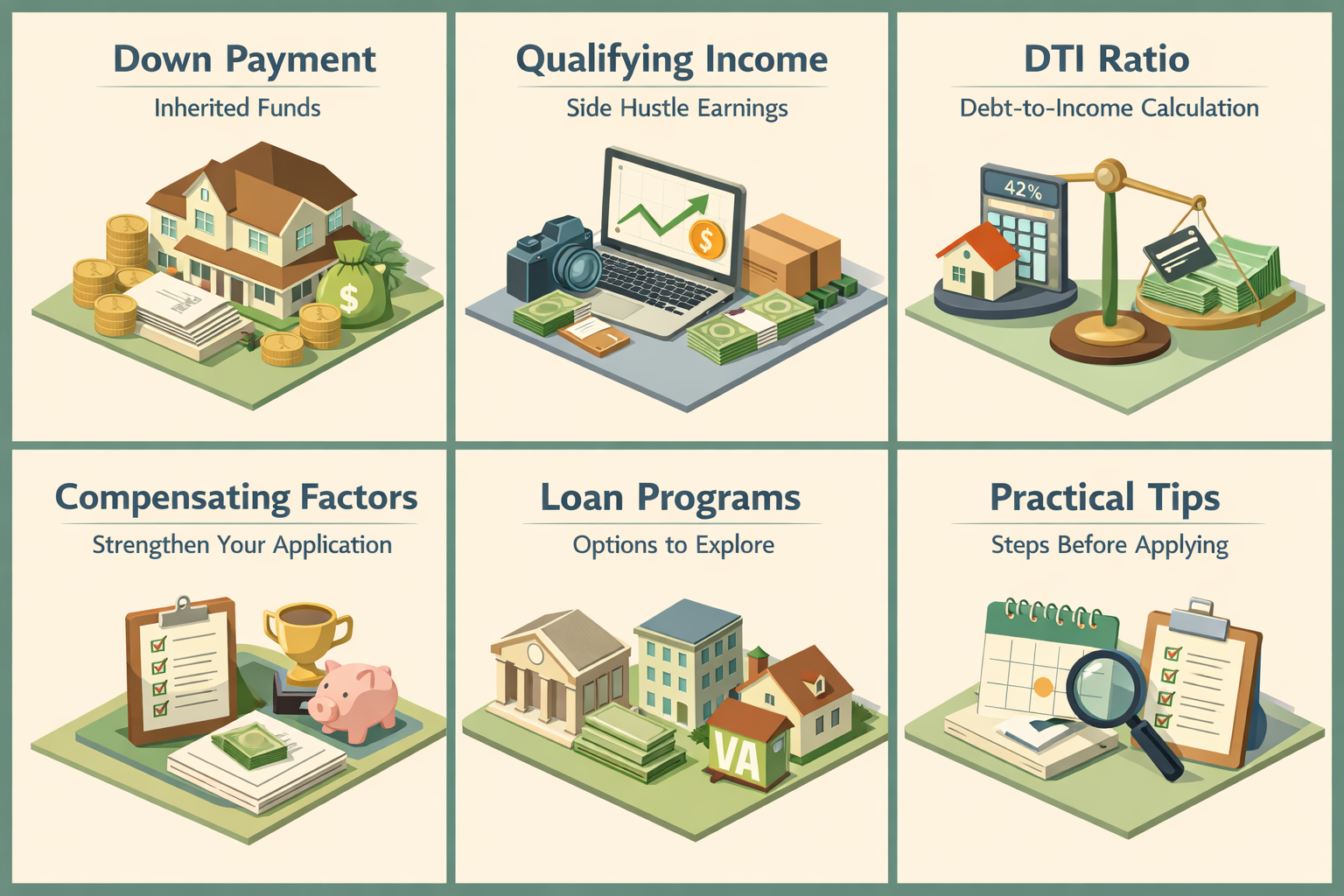
Now that you understand how lenders view these two financial elements separately, let's talk about how they work together. How to calculate mortgage affordability with inheritance for down payment and side hustle income comes down to three core variables: your down payment amount, your qualifying income, and your debt-to-income ratio.
Step 1 — Determine Your Down Payment Amount
Start with the net amount of the inheritance you plan to use. After accounting for any taxes owed on the estate (consult a tax professional for guidance), determine what amount you're comfortable putting toward a down payment. A larger down payment reduces the amount you need to borrow and can lower your monthly payment significantly.
Step 2 — Calculate Your Qualifying Income
Add your primary income (from employment or other verified sources) to your documented side hustle income. Remember, lenders typically use a two-year average for self-employment income. If your primary job pays you a gross annual salary and your side hustle averaged a certain amount annually over the past two years, combine those figures to estimate your total qualifying income.
Step 3 — Apply the Debt-to-Income Ratio
Lenders typically look for a total DTI ratio of 43% or lower for most conventional loans, though some programs may allow higher ratios with compensating factors. To estimate how much mortgage you might qualify for, multiply your gross monthly qualifying income by 0.43, then subtract your existing monthly debt payments (car loans, student loans, credit cards, etc.). The remaining figure represents your maximum allowable monthly housing payment, which includes principal, interest, taxes, and insurance.
Step 4 — Use a Mortgage Affordability Calculator
Once you have your estimated monthly payment budget and down payment amount, use a calculate mortgage affordability with inheritance side hustle income scenario to model different home prices, interest rates, and loan terms. Many online calculators allow you to input custom income figures and down payment amounts to get a realistic picture of your borrowing power.
Compensating Factors That Can Strengthen Your Application
Even if your side hustle income is inconsistent or your inheritance is newly received, there are compensating factors that can help your mortgage application stand out to lenders. These are positive financial characteristics that may offset potential weaknesses in your file.
- Strong credit score: A high credit score signals responsible financial behavior and can give lenders more confidence in your application, even if your income sources are non-traditional.
- Significant down payment: A larger down payment — often 20% or more — reduces lender risk and may make them more willing to work with complex income situations.
- Substantial cash reserves: Having several months of mortgage payments saved after closing (beyond your down payment) shows financial resilience.
- Low existing debt: A lower DTI ratio gives you more flexibility, especially if your qualifying income from the side hustle is being averaged down.
- Employment stability: A long tenure in your primary job or a consistent track record in your field can reassure underwriters about your overall income reliability.
Bringing these strengths to the table can make a meaningful difference, particularly if you're working with a lender who has experience in non-traditional income scenarios.
Choosing the Right Loan Program for Your Unique Situation
Not all mortgage programs are created equal — and some are better suited than others for buyers who are combining inherited funds with gig or freelance income. Here's a brief overview of options worth exploring:
- Conventional Loans: These typically require two years of self-employment income history. They offer competitive rates and flexible down payment options, and they allow gift funds for down payments with proper documentation.
- FHA Loans: FHA loans are often more accessible for buyers with lower credit scores or smaller down payments. They also allow gift funds for down payments and may be more lenient with certain income types.
- Non-QM (Non-Qualified Mortgage) Loans: These programs are specifically designed for borrowers who don't fit the standard mold. They may accept bank statement income, shorter side hustle histories, or other non-traditional documentation methods. Trade-offs can include higher interest rates or stricter reserve requirements.
- Jumbo Loans: If your inherited down payment is large and you're purchasing a higher-priced home, jumbo loans may come into play. These have stricter underwriting standards but can be appropriate for well-qualified buyers with complex income profiles.
Speaking with a knowledgeable mortgage professional who understands non-traditional income sources is one of the most valuable steps you can take early in the process.
Practical Tips Before You Apply for a Mortgage
Preparation is everything when your financial profile includes non-traditional elements. Here are some practical steps to take before submitting a mortgage application:
- Keep inherited funds in one account: Avoid moving inherited money across multiple accounts unnecessarily. A clear, traceable paper trail makes the underwriting process smoother.
- File taxes on time and accurately: Your tax returns are the foundation of your income documentation. Ensure they're filed on time and accurately reflect your earnings, including side hustle revenue.
- Avoid large unexplained deposits: During the mortgage process, lenders scrutinize your bank statements. Large, unexplained deposits — even from legitimate sources — can raise red flags and delay your closing.
- Work with a CPA familiar with self-employed income: A qualified accountant can help you present your side hustle income in the most favorable and honest light, ensuring your tax returns reflect your true earning capacity.
- Get pre-approved early: A mortgage pre-approval based on your actual income documentation and assets — including your inheritance — gives you a realistic budget and shows sellers you're a serious buyer.
- Explore multiple lenders: Different lenders have different appetites for complex income scenarios. Shopping around can help you find the most favorable terms for your unique profile.
●Conclusion
Buying a home with inherited funds and side hustle income is absolutely achievable — it just requires a bit more planning and preparation than a standard mortgage application. By understanding how lenders evaluate these resources, calculating your true affordability using the right formula, and selecting the loan program that fits your situation, you can move forward with confidence. Remember, how to calculate mortgage affordability with inheritance for down payment and side hustle income isn't a one-size-fits-all equation. Your unique combination of assets, income, and credit history creates a financial profile that the right lender can work with. At LoanWise, we're here to help you navigate that process every step of the way — reach out today to speak with a lending specialist who understands your full financial picture.