
Today's homebuyers don't always fit a traditional financial mold. Many people receive alimony payments, run a freelance business on the side, or earn 1099 income from gig work — and they're wondering whether any of that counts when applying for a mortgage. The good news is that it often does. However, lenders follow specific rules about how these income sources are documented and counted. Understanding how to calculate mortgage affordability with alimony and side hustle income is the first step toward knowing what home price you can realistically target. This guide walks you through what lenders look for, how income is verified, and what strategies may help you put your best foot forward.
Why Non-Traditional Income Sources Matter in Mortgage Qualification
The mortgage market has evolved significantly over the past decade. More Americans than ever before earn income outside of a standard W-2 paycheck. According to general lending industry trends, freelancers, gig workers, and self-employed borrowers make up a growing share of the workforce — and many of them are also aspiring homeowners or real estate investors looking to refinance.
Lenders ultimately want to answer one core question: Can this borrower reliably make their monthly mortgage payment? To answer that, they assess your qualifying income, which is the income they'll actually use to calculate your debt-to-income (DTI) ratio. Non-traditional income — including alimony and side hustle earnings — may count toward that figure, but only when it meets specific documentation standards.
Understanding this upfront can save you a great deal of frustration. If you know what lenders need to see before you apply, you can spend the months ahead organizing your financial records, building a paper trail, and potentially boosting the income figure that lenders will use in their calculations.
How Lenders Treat Alimony as Qualifying Income for a Mortgage
Alimony — also called spousal support or maintenance — can typically be counted as qualifying income for a mortgage, but lenders impose clear conditions before it's accepted. The most important factor is continuity. Lenders generally want to see that your alimony payments are expected to continue for at least three years from the date of your mortgage application. If payments are set to end sooner, most lenders will not include them in your qualifying income.
You'll also need to provide documentation that proves both the existence and the consistency of these payments. Common documents include:
- A divorce decree or legal separation agreement that outlines the payment terms
- Bank statements showing a consistent history of deposits — typically 12 months or more
- A court order confirming the payment schedule and duration
It's worth noting that alimony can also work against you. If you're the one paying alimony rather than receiving it, lenders typically count that obligation as a monthly debt when calculating your DTI ratio. This can reduce the mortgage amount you qualify for, so it's important to account for it on both sides of the equation.
Some loan programs, including conventional loans backed by Fannie Mae and Freddie Mac guidelines, allow borrowers to voluntarily exclude alimony from their income if they'd prefer not to disclose it. However, if you're relying on it to strengthen your application, full documentation is essential.
Counting Your Side Hustle: How 1099 and Freelance Income Is Evaluated
Side hustle income — whether from freelance work, ridesharing, tutoring, consulting, or any other self-employed activity — can be a meaningful part of your mortgage qualification. However, lenders treat this type of income differently from a regular salary. Because self-employment income can fluctuate, lenders use a more conservative approach to determine how much of it they'll count.
For most loan programs, you'll need to show a two-year history of self-employment or freelance income before it can be used to qualify. Lenders typically average your net income from the past two years of federal tax returns to arrive at a monthly qualifying figure. If your income has been rising steadily, this can work in your favor. If it's been declining, lenders may use the lower year — or decline to count it at all.
The most common documents required for side hustle or 1099 income include:
- Two years of federal tax returns (personal and, if applicable, business)
- 1099 forms from clients or platforms
- A year-to-date profit and loss statement, especially if you're applying mid-year
- Bank statements showing regular deposits that match reported income
One important consideration is the impact of tax deductions. Freelancers and self-employed individuals often write off business expenses, which is smart for tax purposes — but it reduces the net income that lenders see on your returns. This is a common tension in affordability calculation with alimony and 1099 income: the income that looks strong in your bank account may appear much lower on your tax returns after deductions.
The Debt-to-Income Ratio: Your Central Affordability Benchmark
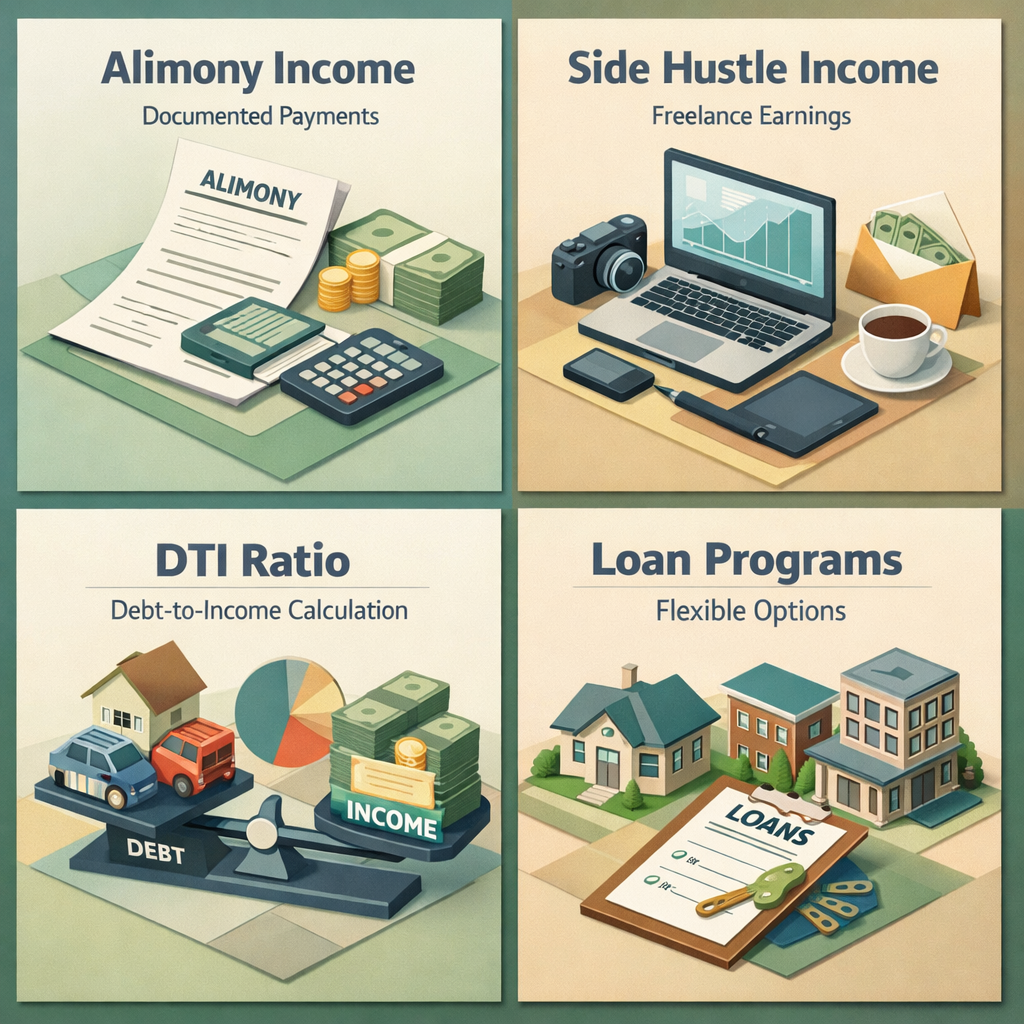
Once lenders have calculated your qualifying income, they use it to determine your debt-to-income (DTI) ratio. This is the percentage of your gross monthly income that goes toward monthly debt payments, including your proposed mortgage payment. It's the most critical number in the affordability equation.
Most conventional loan programs prefer a DTI ratio at or below 43%, though some programs may allow higher ratios with compensating factors like strong credit scores or significant cash reserves. FHA loans can sometimes accommodate DTI ratios up to 50% or slightly higher in certain cases, depending on the lender and loan program.
Here's a simplified example of how this might work in practice:
- Monthly alimony received: $1,500 (documented and continuing for 3+ years)
- Average monthly net income from side hustle (2-year average): $2,000
- W-2 employment income: $3,500
- Total qualifying monthly income: $7,000
- Maximum monthly debt at 43% DTI: $3,010
- Existing monthly debts (car loan, student loan): $800
- Available for mortgage payment: approximately $2,210
This is a general illustration. Your actual numbers will vary based on your lender, loan program, credit profile, and the documentation you provide. Still, this framework gives you a starting point for understanding how calculate mortgage affordability with alimony and side hustle income plays out in real terms.
Loan Programs That May Be More Flexible With Mixed Income Profiles
Not all mortgage programs treat non-traditional income the same way. Depending on your financial profile, some loan types may offer more flexibility than others.
Conventional Loans
Fannie Mae and Freddie Mac guidelines allow alimony and self-employment income to be used for qualification, provided documentation requirements are met. Conventional loans typically require strong credit scores and a clean financial history, but they can be a solid option for borrowers with well-documented mixed income sources.
FHA Loans
FHA loans are backed by the Federal Housing Administration and are often more accessible to borrowers with lower credit scores or higher DTI ratios. They can also accommodate non-traditional income sources, though the same documentation rules apply. FHA loans may be worth exploring if your credit profile is still developing.
Non-QM (Non-Qualified Mortgage) Loans
For borrowers whose income doesn't fit neatly into standard guidelines — particularly those with significant 1099 income or complex financial situations — non-QM loans may offer an alternative path. These programs often allow bank statement loans, where lenders use 12 to 24 months of bank deposits rather than tax returns to determine qualifying income. This can be especially helpful for self-employed borrowers whose tax deductions significantly reduce their documented net income.
Non-QM loans typically come with higher interest rates and may require larger down payments, so it's important to weigh the trade-offs carefully before choosing this route.
Practical Steps to Strengthen Your Mortgage Application With Mixed Income
If you're planning to apply for a mortgage with a combination of alimony and side hustle income, a bit of preparation can go a long way. Here are some practical strategies that may improve your chances of approval:
- Build a consistent paper trail: Ensure that alimony payments are being deposited directly into your bank account and that the deposits appear on your statements regularly. Lenders look for consistency, not just total amounts.
- Maintain clean tax returns: While deductions lower your tax bill, they also reduce your qualifying income. Consider speaking with a tax professional about striking the right balance between deductions and documented income, especially in the years before you plan to buy.
- Keep your DTI low: Pay down high-balance credit cards and avoid taking on new debt in the months before your application. Even small reductions in your monthly obligations can meaningfully improve your DTI ratio.
- Improve your credit score: A higher credit score can unlock better loan programs and interest rates, and may also give lenders more flexibility when evaluating non-traditional income.
- Gather documentation early: Don't wait until you've found a home to start pulling together tax returns, 1099 forms, bank statements, and your divorce decree. Having these ready can speed up the process significantly.
- Work with an experienced lender: Not all loan officers have deep experience with complex income scenarios. Look for a lender or mortgage affordability broker who regularly works with self-employed borrowers and understands the nuances of affordability calculation with alimony and 1099 income.
●Conclusion
Navigating a mortgage application with alimony and side hustle income might feel complicated at first, but it's far from impossible. Lenders have clear frameworks for evaluating these income types, and borrowers who understand the rules ahead of time are in a much stronger position to qualify. The key is documentation, consistency, and choosing the right loan program for your specific situation. Whether you're a first-time homebuyer, a seasoned homeowner looking to refinance, or a real estate investor expanding your portfolio, knowing how to calculate mortgage affordability with alimony and side hustle income puts you in control of your financial future. If you're ready to explore your options, consider connecting with a knowledgeable lending professional who can help you map out the best path forward based on your unique income profile.