
Buying a home is one of the most exciting financial decisions you'll ever make. But when your income comes from non-traditional sources like alimony or a part-time job, the mortgage qualification process can feel a little more complicated than expected. The good news is that lenders do recognize these income types — they just need to be documented carefully and meet certain criteria. Understanding how to calculate mortgage affordability with alimony and part-time job income can put you in a much stronger position when you sit down with a lender. This guide walks you through everything you need to know, from how lenders define qualifying income to the debt-to-income ratios that drive affordability decisions.
Why Income Type Matters in the Mortgage Qualification Process
When a lender reviews your mortgage application, they're not just looking at how much money comes into your bank account each month. They're evaluating whether that income is stable, reliable, and likely to continue for the foreseeable future. This distinction is especially important for homebuyers who rely on alimony payments or part-time employment as a primary or supplemental source of income.
Lenders typically follow guidelines set by agencies like Fannie Mae, Freddie Mac, the FHA, and the VA. Each of these agencies has its own rules about what types of income can be counted when determining how much mortgage you can afford. Non-traditional income sources aren't automatically disqualified — but they do require additional documentation and often need to meet specific continuity requirements before a lender will include them in your qualifying income calculation.
Understanding the distinctions between income types can help you set realistic expectations and prepare your application more effectively. Let's look at how alimony and part-time income are each treated by mortgage lenders.
How Lenders Count Alimony as Qualifying Income
Alimony — also referred to as spousal support or maintenance payments — can be counted as qualifying income for mortgage purposes, but only under certain conditions. Most lenders and loan programs require that the alimony payments have been received consistently and that they're expected to continue for at least three years from the date of the mortgage application. This continuity requirement is one of the most important factors lenders look at.
To document alimony income, you'll typically need to provide:
- A copy of the divorce decree or legal separation agreement that outlines the terms of the alimony
- Bank statements or deposit records showing that payments have been received regularly
- In some cases, a letter from your attorney or the paying party confirming the continuation of payments
It's worth noting that lenders may also look at the financial stability of the paying party, since your income stream depends on their ability to continue making payments. If the alimony is court-ordered and documented clearly, most conventional and government-backed loan programs will allow it to be included in your gross monthly income figure.
One nuance to be aware of: if you are the party paying alimony rather than receiving it, that obligation typically counts as a monthly debt in your debt-to-income ratio, which could reduce the loan amount you qualify for.
Using Part-Time Job Income to Qualify for a Home Loan
Part-time income is another area where homebuyers sometimes feel uncertain about their mortgage prospects. The encouraging reality is that part-time employment income can often be used to qualify for a mortgage — as long as it meets lender requirements for consistency and history.
Most mortgage guidelines require that part-time income be documented with a two-year history of receipt. This means lenders will typically ask for two years of W-2 forms, tax returns, and recent pay stubs to verify that the income has been consistent. If you recently started a part-time job, it may be harder to count that income immediately, though some lenders may consider it if you can demonstrate a clear pattern of employment in the same field.
Part-time income is usually averaged over the two-year history period to arrive at a monthly income figure. For example, if your part-time earnings totaled $18,000 over two years, a lender might count approximately $750 per month as qualifying income. This average helps lenders account for any seasonal variation or changes in hours worked.
Key documentation for part-time income typically includes:
- Two years of federal tax returns (all pages)
- Two years of W-2 forms from the part-time employer
- Recent pay stubs showing year-to-date earnings
- A verification of employment (VOE) from the employer confirming part-time status and likelihood of continued employment
If your hours or earnings have been declining over the two-year period, lenders may be more cautious about including the full averaged amount. Stability or an upward trend in earnings tends to work in your favor.
How to Calculate Mortgage Affordability With Alimony and Part-Time Job Income
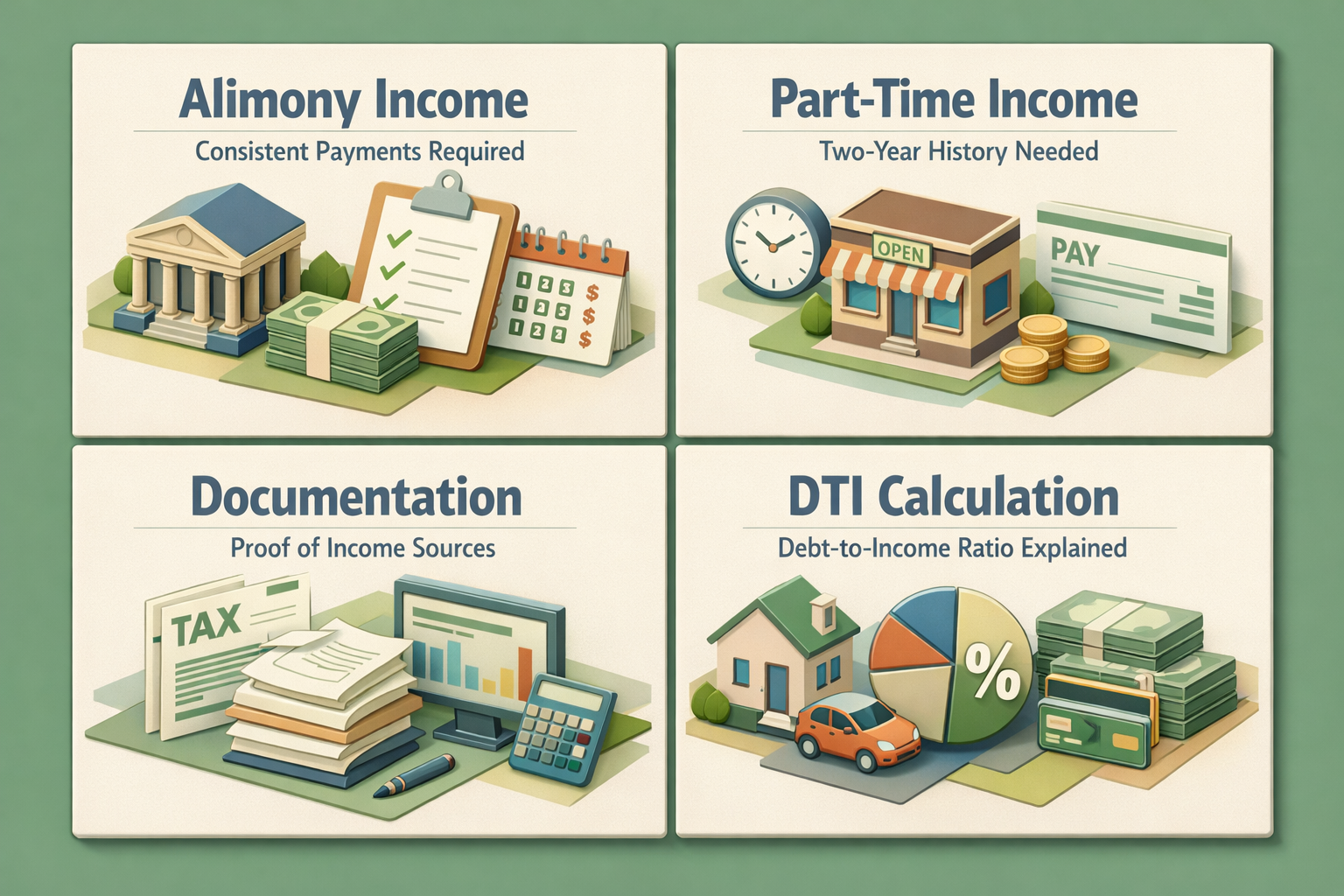
Once you understand how lenders define and document your income sources, you can start estimating how much home you can afford realistically. The core calculation lenders use is called the debt-to-income ratio (DTI), and it compares your total monthly debt obligations to your gross monthly income.
Most conventional loan programs prefer a DTI of 45% or lower, though some programs may allow slightly higher ratios depending on compensating factors like strong credit or a larger down payment. FHA loans may allow DTIs up to around 50% in certain cases, but approval ultimately depends on the full picture of your financial profile.
Here's a simplified example of how the calculation might work for a borrower with combined income sources:
- Monthly alimony received: $1,200
- Averaged monthly part-time income: $750
- Total gross monthly qualifying income: $1,950
If your lender allows a maximum front-end DTI of 31% for housing costs, your estimated maximum monthly mortgage payment (including principal, interest, taxes, and insurance) would be approximately $605. If the back-end DTI limit is 45%, your total monthly debt payments — including the mortgage, car loans, student loans, credit cards, and any alimony you pay — should ideally not exceed $877.
These figures are illustrative and individual results will vary based on the lender, loan program, credit score, down payment, and local property tax rates. Using an online mortgage affordability calculator with inputs for your specific income sources can give you a more personalized estimate. When learning how to calculate mortgage affordability with alimony and part-time job income, working directly with an experienced loan officer is often the most reliable path to an accurate number.
Strengthening Your Application Beyond Income Documentation
Income is a critical piece of the mortgage puzzle, but it's not the only factor lenders weigh. There are several other elements you can work on to improve your overall application, especially when your income profile is less conventional.
Credit Score and Credit History
Your credit score plays a significant role in determining both your eligibility for different loan programs and the interest rate you'll be offered. A higher credit score can sometimes offset concerns about income type or stability. It's worth reviewing your credit reports before applying and addressing any errors or overdue accounts well in advance.
Down Payment Amount
A larger down payment reduces the loan-to-value ratio, which lowers lender risk. Some lenders may be more flexible with income documentation requirements when the borrower brings a meaningful down payment to the table. If you have savings, gifts from family, or other assets you can liquidate, a stronger down payment could improve your chances of approval.
Cash Reserves
Many lenders look favorably on borrowers who have reserves — money left over in savings or investment accounts after the down payment and closing costs are paid. Reserves signal financial resilience, which matters when income sources are variable or non-traditional.
Debt Reduction
If your DTI is borderline, paying down existing debts before applying could make a meaningful difference. Even eliminating a small monthly obligation like a credit card or personal loan can shift your ratio enough to qualify for a higher loan amount or a more favorable rate.
Choosing the Right Loan Program for Your Income Profile
Not all mortgage programs treat non-traditional income the same way. Understanding your options can help you find the best fit for your specific situation.
Conventional loans backed by Fannie Mae and Freddie Mac generally have clear guidelines for counting alimony and part-time income, and they tend to work well for borrowers with solid credit and documented income histories.
FHA loans are often a popular option for first-time homebuyers and those with more modest income levels. FHA guidelines allow alimony and part-time income with proper documentation, and the program's lower down payment requirements can be a significant advantage.
VA loans, available to eligible veterans and active-duty service members, also recognize alimony and part-time income under their residual income and DTI guidelines. VA loans often have competitive terms and no mortgage insurance requirement, making them worth exploring for those who qualify.
Non-QM (non-qualified mortgage) programs may offer more flexibility for borrowers whose income profiles don't fit neatly into conventional or government-backed guidelines. These programs typically come with higher interest rates and stricter terms, so they should be evaluated carefully with the guidance of a knowledgeable loan officer.
Speaking with a mortgage professional who has experience working with diverse income situations can save you time and help you avoid applying for programs you're unlikely to qualify for.
Practical Steps to Take Before Applying for a Mortgage
Preparation is one of the most powerful tools you have when approaching the mortgage process with a non-traditional income profile. Here are some practical steps to consider before you submit your application:
- Gather all income documentation early. Collect your divorce decree, alimony payment records, W-2s, tax returns, and recent pay stubs before you meet with a lender. The more organized your paperwork, the smoother the process will be.
- Calculate your own DTI first. Add up your monthly debts and divide by your estimated gross monthly income (including alimony and averaged part-time income). This gives you a realistic baseline before a lender runs the numbers.
- Get pre-qualified or pre-approved. A pre-approval letter shows sellers that you're a serious buyer and gives you a clearer picture of your purchasing power. It also helps you identify any issues that might need to be addressed before you find a property you love.
- Work with a lender who understands non-traditional income. Not all loan officers have the same experience. Seek out a lender who regularly works with borrowers receiving alimony or earning part-time income, as they'll be better equipped to guide you through the documentation requirements.
- Be consistent with your income sources. Gaps or irregularities in your alimony receipts or part-time paycheck history can raise questions during underwriting. If possible, maintain a steady record in the months leading up to your application.
Understanding mortgage affordability alimony part-time income dynamics before you apply helps you walk into the process with confidence rather than uncertainty.
●Conclusion
Navigating the mortgage process with alimony or part-time job income might feel daunting at first, but it's absolutely manageable with the right preparation and guidance. Lenders have established pathways for recognizing these income types, and with thorough documentation and a clear understanding of how debt-to-income ratios work, many borrowers in similar situations successfully qualify for home financing each year. The key is to approach the process proactively — gather your paperwork early, understand your numbers, and connect with a knowledgeable mortgage professional who can help you find the loan program that fits your unique situation. At LoanWise, we're here to help you move forward with clarity and confidence on your path to homeownership.