Buying a home is one of the most meaningful financial steps a person can take — and having a disability income shouldn't stand in the way of that goal. Whether you receive Social Security Disability Insurance (SSDI), Supplemental Security Income (SSI), or long-term disability payments through a private insurer, these income sources may count toward mortgage qualification. The key is understanding how lenders view these payments and how to calculate mortgage affordability with a disability income before you ever step foot in a lender's office. This article walks you through the process clearly and practically, so you can approach homeownership with confidence.
Why Disability Income Is a Legitimate Source for Mortgage Qualification
Many people assume that disability income won't be taken seriously by mortgage lenders. That assumption is incorrect — and in some cases, it may actually discourage eligible borrowers from applying at all. Under the Fair Housing Act and Equal Credit Opportunity Act, lenders are prohibited from discriminating against applicants based on disability status. More importantly, disability income may be treated just like any other verified, stable income stream when it's properly documented.
Common forms of disability income that lenders may consider include:
- Social Security Disability Insurance (SSDI): A federal program for individuals who've paid into Social Security and can no longer work due to a qualifying disability.
- Supplemental Security Income (SSI): A needs-based program that provides monthly payments to disabled individuals with limited income and resources.
- Long-term disability benefits: Employer-sponsored or privately purchased insurance that replaces a portion of your income when you cannot work.
- Veterans' disability compensation: Monthly, tax-free payments from the Department of Veterans Affairs (VA) for service-connected disabilities.
Lenders will typically look at whether your disability income is expected to continue for at least three years. For SSDI, a benefits verification letter from the Social Security Administration often serves as proof of continuity. Private disability policies may require a review of the plan document to confirm how long benefits will last.
The Core Formula: How Lenders Determine What You Can Afford
To understand how to calculate what you can afford with a disability income, you need to know how lenders think about borrowing capacity. The central concept is your debt-to-income ratio (DTI) — a comparison of your gross monthly income against your total monthly debt obligations.
The DTI calculation works like this:
- Add up all your monthly debt payments: proposed mortgage payment (principal, interest, taxes, and insurance), car loans, student loans, credit card minimums, and any other recurring obligations.
- Divide that total by your gross monthly income (before taxes).
- Multiply by 100 to get a percentage.
For example, if your total monthly debts would be $1,200 and your gross monthly disability income is $3,000, your DTI would be 40%. Most conventional loan programs typically prefer a DTI at or below 43%, though some government-backed programs may allow slightly higher ratios depending on compensating factors.
There are actually two DTI numbers lenders consider: the front-end ratio (housing costs only divided by gross income) and the back-end ratio (all debts divided by gross income). Lenders often prefer a front-end ratio no higher than 28% and a back-end ratio no higher than 36% to 43%, though these thresholds can vary by loan program and lender.
It's worth noting that SSI income is sometimes grossed up by lenders. Because SSI benefits are not federally taxed, some lenders may increase the stated income by a factor — often around 25% — to reflect its tax-free nature. This can meaningfully improve your qualifying power, so it's worth asking your lender how they handle non-taxable income.
Step-by-Step: Calculating Your Own Mortgage Affordability
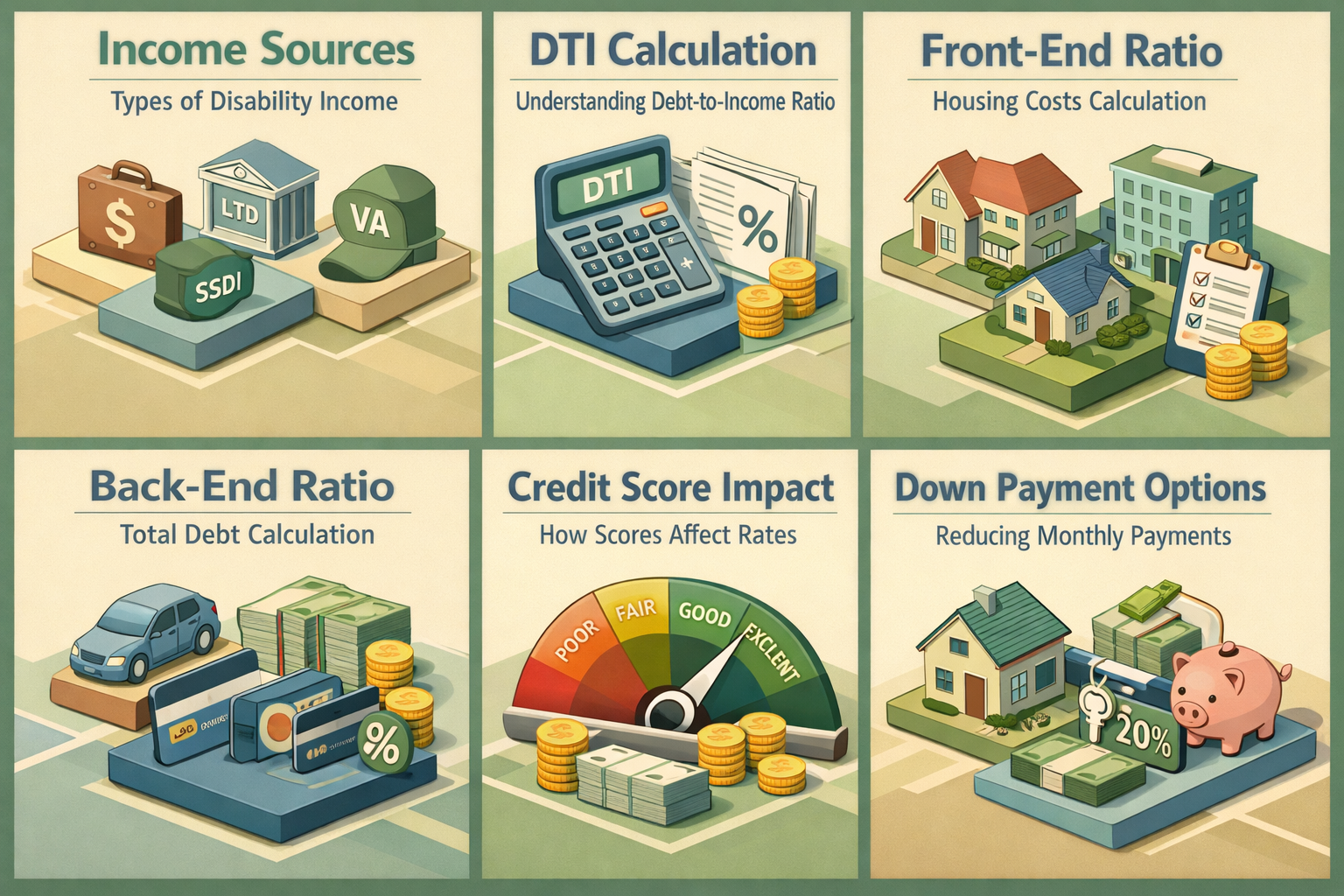
You don't need to wait for a lender to run the numbers. Here's how you can estimate your own mortgage affordability using your disability income:
- Step 1 — Determine your gross monthly income: Add up all sources of disability income you receive each month. If you also have part-time employment, rental income, or spousal income, include those as well.
- Step 2 — Apply the front-end ratio: Multiply your gross monthly income by 0.28. This gives you the maximum monthly housing payment most conventional lenders prefer. For example, $2,500 x 0.28 = $700 in monthly housing costs.
- Step 3 — Subtract taxes and insurance: Your housing payment includes principal, interest, property taxes, homeowners insurance, and potentially private mortgage insurance (PMI). Subtract estimated taxes and insurance to find the amount available for principal and interest alone.
- Step 4 — Use a mortgage calculator: Enter the remaining principal-and-interest amount into an online mortgage affordability calculator. Adjust for current interest rates and your desired loan term (typically 15 or 30 years) to see what home price range you might qualify for.
- Step 5 — Check your back-end DTI: Add all your current monthly debt payments to your estimated housing cost and divide by your gross monthly income. Make sure this figure stays within the lender's acceptable range.
This process gives you a working estimate, not a guaranteed approval figure. Lenders will also factor in your credit score, down payment size, and the type of loan program you're applying for.
How Credit Scores and Down Payments Affect Borrowing Power
Beyond income, two other major factors shape how much home you may be able to afford: your credit score and how much you can put down. These elements work together with your income to determine both your eligibility and the interest rate you might receive.
Lenders use credit scores to assess the risk of lending to you. Generally speaking:
- A score of 620 or above may qualify you for a conventional mortgage, though individual lender requirements can vary.
- FHA loans, backed by the Federal Housing Administration, may accept scores as low as 580 with a 3.5% down payment, or potentially as low as 500 with a 10% down payment.
- VA loans, available to eligible veterans and their families, often have more flexible credit requirements and no down payment mandate.
A higher credit score typically results in a lower interest rate, which directly reduces your monthly payment and improves your affordability. Even a small improvement in your rate — say, moving from 7.5% to 7.0% — can translate into meaningful savings over the life of a loan.
On the down payment side, putting more money down reduces your loan balance, which lowers your monthly payment and may eliminate the need for PMI. If you're receiving disability income and have limited savings, programs offering down payment assistance may be worth exploring. Some state housing finance agencies and nonprofit organizations offer grants or forgivable loans specifically for low-to-moderate income buyers, which could include those relying on disability benefits.
Loan Programs That May Work Well for Borrowers With Disability Income
Choosing the right loan program can make a significant difference in affordability. Several options may be particularly well-suited to homebuyers relying on disability income:
- FHA Loans: These government-backed loans are often more accessible because they feature lower down payment requirements and more flexible debt-to-income standards. Disability income — including SSI and SSDI — may be counted as qualifying income if it's properly documented and expected to continue.
- VA Loans: If you're a veteran receiving VA disability compensation, this income may count toward mortgage qualification. VA loans also come with no required down payment and no PMI, which can significantly lower your monthly costs.
- USDA Loans: For buyers in rural or suburban areas, USDA loans offer no down payment options and competitive rates. Disability income may qualify under their income guidelines.
- Fannie Mae HomeReady and Freddie Mac Home Possible: These conventional loan programs are designed for low-to-moderate income borrowers and may allow disability income as a qualifying source. They also offer reduced PMI costs compared to standard conventional loans.
Each program has its own income documentation requirements, so working with a lender familiar with disability income can help ensure your application is structured correctly from the start.
Documentation Tips to Strengthen Your Application
One of the most important things you can do before applying for a mortgage is organize your documentation. Lenders need to verify that your disability income is real, stable, and expected to continue. Providing clear, complete paperwork from the start can help speed up underwriting and reduce the chances of delays or denials.
Here's what you'll typically need to provide:
- Social Security award letter or benefits verification letter: This official document from the SSA confirms the amount and start date of your benefits. If your SSDI or SSI doesn't have a defined expiration, it's often treated as ongoing income.
- Private disability insurance policy documents: These help lenders confirm how long benefits will last and under what conditions they could be reduced or ended.
- Recent bank statements: Showing consistent deposits matching your stated disability income reinforces the stability of your income stream.
- Tax returns (if applicable): SSDI may be taxable depending on your total income, so lenders may ask for recent returns to verify what you've reported.
- Proof of any additional income: Part-time work, rental income, or spousal income should also be documented to present the strongest possible financial picture.
If your disability income is set to be reviewed or may change in the future, be upfront with your lender. Many underwriters are accustomed to working with disability income and know how to evaluate these situations fairly.
●Conclusion
Homeownership is an achievable goal for many people living with disabilities — especially when you understand how lenders evaluate disability income and how to calculate mortgage affordability with a disability income on your own terms. The process starts with knowing your gross monthly income, applying basic DTI ratios, and exploring loan programs designed to support lower-to-moderate income borrowers. From there, organizing your documentation and working with a knowledgeable lender can help move your application forward with fewer surprises. If you're ready to explore your options, speaking with a licensed mortgage professional who has experience with mortgage affordability disability income scenarios could be your most valuable next step. You've earned the right to ask — and the right to own.