More Americans than ever are earning income outside of a traditional nine-to-five job. Whether you're driving for a rideshare company, freelancing as a graphic designer, or running an online shop on the weekends, that extra income could play a meaningful role in your path to homeownership. But here's the thing — lenders don't always treat 1099 income the same way they treat a regular paycheck. If you've been wondering how to calculate mortgage affordability with 1099 income from a side hustle, you're not alone. This guide breaks down exactly what lenders look for, how income is calculated, and what steps you can take to put your best financial foot forward.
Why 1099 Income Is Treated Differently by Mortgage Lenders
When you work for an employer, your income is predictable and easy to verify through pay stubs and W-2 forms. Self-employment income, however, tends to fluctuate from month to month — and that variability is what makes lenders cautious. A 1099 form simply reports income paid to you as an independent contractor or freelancer, without any taxes withheld at the source.
Because self-employed borrowers often write off business expenses to reduce their taxable income, the number that shows up on a tax return may be much lower than what was actually earned. Lenders typically use your net income — after deductions — rather than your gross earnings to determine borrowing power. This is an important distinction that many side hustle earners overlook when they start estimating what they can afford.
For mortgage qualification purposes, most lenders want to see that your 1099 income has been consistent and ongoing. A one-time windfall or a brand-new freelance gig is unlikely to help your application much. Stability and continuity matter deeply when it comes to self-employment earnings.
The Two-Year Rule and What It Means for Side Hustle Earners
One of the most common requirements that lenders apply to self-employment income is the two-year history rule. Most conventional and government-backed loan programs — including FHA and Fannie Mae guidelines — typically require borrowers to show at least two years of self-employment income before it can be used for qualification purposes.
This doesn't mean you need to have been doing your side hustle for exactly two years to the day, but lenders generally want to see two consecutive years of tax returns that reflect the income. If your side hustle is newer than that, lenders may still consider it under certain conditions — particularly if you have a strong employment history in the same field — but approval is less certain.
Here's why this matters for your affordability calculation: if your side hustle income cannot be counted, your qualifying income drops, which directly reduces the loan amount a lender may be willing to offer. Planning ahead and building a track record of documented 1099 income could significantly expand your homebuying options down the road.
- Two years of federal tax returns are typically required to verify self-employment income.
- Business profit and loss statements may also be requested for the current year.
- CPA letters or accountant statements can help confirm that your business is active and ongoing.
How to Calculate Mortgage Affordability with 1099 Income from Side Hustle
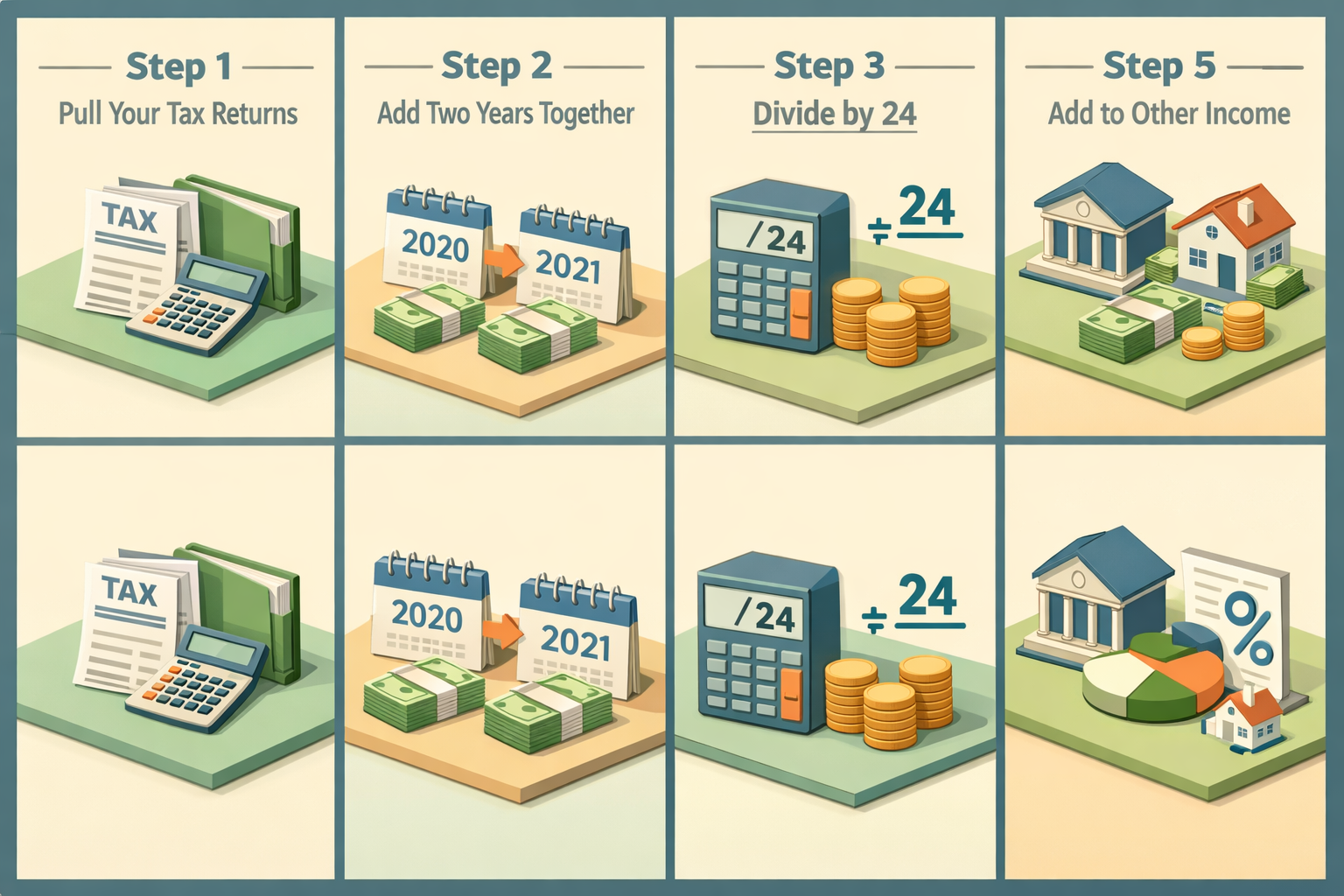
Understanding how to calculate mortgage affordability with 1099 income from side hustle starts with knowing how lenders average your earnings. Rather than using a single year's income, most lenders will take your net self-employment income from the past two years and average it out on a monthly basis. This averaged monthly figure is what gets plugged into their debt-to-income (DTI) ratio calculations.
Here's a simplified breakdown of the process:
- Step 1 — Pull your tax returns: Look at your Schedule C (for sole proprietors) from your last two federal tax returns. Find your net profit after business deductions.
- Step 2 — Add the two years together: Combine your net profit from Year 1 and Year 2.
- Step 3 — Divide by 24: This gives you your average monthly self-employment income as seen by the lender.
- Step 4 — Add to other qualifying income: If you also have a W-2 job, add your salaried income to this monthly figure for a combined qualifying income.
- Step 5 — Calculate your DTI: Divide your total monthly debt obligations (including the proposed mortgage payment) by your combined monthly income. Most lenders prefer a DTI at or below 43%, though some programs allow higher ratios with compensating factors.
Let's say your Schedule C shows a net profit of $18,000 in Year 1 and $24,000 in Year 2. That's a combined $42,000 over two years, or $1,750 per month from your side hustle. If your salaried position pays $4,000 per month, your total qualifying income could be approximately $5,750 per month — a meaningfully higher figure that could open the door to a larger loan amount.
Keep in mind that certain deductions, such as depreciation, may actually be added back into your income by lenders, since they don't represent real cash outflows. This is known as an add-back, and working with a knowledgeable loan officer can help you identify every advantage available in your tax return.
Debt-to-Income Ratios and How Side Hustle Income Affects Your Buying Power
Your debt-to-income ratio is one of the most critical factors in any mortgage approval. It tells a lender how much of your monthly income is already committed to debt payments, and it's the primary tool used to determine how large a mortgage you might qualify for.
There are actually two DTI figures lenders look at: the front-end ratio, which includes only your housing costs (mortgage principal, interest, taxes, and insurance), and the back-end ratio, which includes all monthly debt obligations combined. Most conventional loan programs prefer a back-end DTI of 43% or lower, while some programs — particularly FHA loans — may allow ratios up to 50% or even slightly higher with strong compensating factors like excellent credit or substantial reserves.
When your side hustle income is properly documented and can be counted toward qualification, it raises your total income base — which in turn lowers your DTI percentage. For example, even an additional $500 to $1,000 per month in verified 1099 income could shift your DTI from a borderline number into a clearly approvable range, potentially making the difference between approval and denial.
This is why it's worth working with a mortgage professional who understands self-employment income. They can help you understand exactly how your 1099 earnings will be treated and model different scenarios before you formally apply.
Documentation You'll Need to Verify Your Side Hustle Earnings
Preparing your paperwork in advance is one of the smartest things you can do when applying for a mortgage with 1099 income. Lenders will want to see clear, consistent evidence that your side hustle income is real, stable, and likely to continue. Here's what you'll typically need to gather:
- Two years of personal federal tax returns (all pages and schedules, including Schedule C)
- Two years of 1099 forms from any clients or platforms that paid you
- Year-to-date profit and loss statement, especially if you're applying mid-year
- Bank statements showing regular deposits consistent with your reported income
- Business license or registration, if applicable
- CPA or accountant letter confirming the nature and continuity of your self-employment
It's worth noting that some lenders offer bank statement loans or other non-QM (non-qualified mortgage) products that allow borrowers to qualify based on 12 to 24 months of bank deposits rather than tax returns. These programs can be especially helpful for side hustlers whose tax deductions have significantly reduced their net reported income. However, these loan products typically come with different rate structures, so it's important to weigh the trade-offs carefully with a trusted loan advisor.
Strategies to Strengthen Your Mortgage Application as a 1099 Earner
Even if your 1099 income is solid, lenders may want additional assurance that you're a low-risk borrower. The good news is there are several proactive steps you can take to build a stronger application:
- Maintain clean, consistent records: Keep detailed records of all 1099 income, expenses, and receipts. Organized documentation reassures lenders and speeds up underwriting.
- Avoid reducing income too aggressively through deductions: While deductions lower your tax bill, they also reduce your qualifying income. In the year or two before applying for a mortgage, you may want to consult with a tax professional about the trade-off between tax savings and mortgage qualification.
- Build up cash reserves: Lenders look more favorably on borrowers who have several months of mortgage payments saved in reserve. This is particularly important for self-employed borrowers whose income may be seen as less predictable.
- Improve your credit score: A higher credit score can compensate for some of the perceived risk associated with variable income. Paying down revolving balances and keeping accounts in good standing are reliable ways to boost your score before applying.
- Consider a larger down payment: A down payment above the minimum can reduce your loan-to-value ratio, which may give lenders more confidence and potentially result in better rate offers.
Working with a mortgage lender who has experience with self-employed borrowers and non-traditional income types can make a significant difference. They'll know which loan programs are the best fit and can help you structure your application in the most favorable way possible.
Loan Programs That May Work Well for Side Hustle Income Borrowers
Not all mortgage programs treat 1099 income the same way. Depending on your financial profile, one loan type may suit you better than another. Here's a quick overview of options worth exploring:
- Conventional loans: Backed by Fannie Mae or Freddie Mac guidelines, these loans can accommodate self-employment income with two years of documentation. They tend to offer competitive rates for well-qualified borrowers.
- FHA loans: Backed by the Federal Housing Administration, FHA loans are often more flexible with credit scores and DTI ratios. They also allow self-employment income with two-year documentation and may be a good entry point for first-time homebuyers with side hustle income.
- Bank statement loans (Non-QM): These products allow income to be verified through 12 or 24 months of bank statements rather than tax returns. They're particularly useful when write-offs have lowered net income significantly. Rates may be slightly higher than conventional loans.
- 1099-only loans: Some specialty lenders offer programs that qualify borrowers using only their 1099 forms rather than full tax returns. These are a growing niche in the non-QM space and may benefit gig economy workers whose income is well-documented but heavily deducted on paper.
Choosing the right program depends on your full financial picture — including your credit score, existing debt, down payment, and how long you've been earning 1099 income. A qualified mortgage advisor can run the numbers across multiple programs to find the most beneficial fit for your situation.
●Conclusion
Knowing how to calculate mortgage affordability with 1099 income from a side hustle puts you in a much stronger position as a homebuyer. Yes, the process is a bit more involved than it is for a traditional W-2 employee — but it's absolutely manageable with the right preparation. Document your income carefully, understand how lenders average your self-employment earnings, and don't underestimate the value of working with an experienced mortgage professional who knows how to present your full financial story. Your side hustle is a real asset. With the right approach, it could help you afford more home than you thought possible.
Ready to explore your options? Connect with a LoanWise mortgage specialist today to get a personalized affordability estimate based on your unique income profile.