
Buying a home is an exciting milestone, but for freelance photographers, the path to mortgage approval can feel a little more complicated than it does for salaried workers. If you receive 1099 income instead of a traditional W-2 paycheck, lenders will evaluate your finances differently. The good news is that knowing how to calculate mortgage affordability with 1099 income from freelance photography puts you in a much stronger position before you ever walk through a lender's door. This guide breaks down exactly how the process works, what lenders look for, and how you can prepare to qualify with confidence.
Why 1099 Income Presents Unique Challenges for Homebuyers
When a lender reviews a W-2 employee's mortgage application, the income verification process is relatively straightforward. Pay stubs and employer letters paint a clear picture of stable, predictable earnings. For freelance photographers, however, income may vary from month to month depending on client bookings, seasonal demand, and business expenses. That variability is one of the main reasons lenders scrutinize self-employed income more carefully.
As a 1099 worker, you're considered self-employed in the eyes of most mortgage lenders. That means they won't simply look at the total amount your clients paid you. Instead, they'll typically review your net income — the amount left after legitimate business deductions are subtracted. This is an important distinction, because many freelance photographers write off a significant portion of their gross earnings through deductions like camera equipment, editing software, studio rentals, and marketing costs. While those deductions lower your tax bill, they may also reduce the qualifying income lenders use to assess your application.
Understanding this dynamic early on helps you make smarter decisions about how you file your taxes and how you present your financial profile to lenders.
How Lenders Calculate Qualifying Income for Self-Employed Borrowers
Most conventional lenders follow guidelines that require two years of self-employment history to use that income for qualifying purposes. This two-year track record helps demonstrate that your freelance photography business is stable and likely to continue. In some cases, lenders may consider one year of self-employment if you previously worked in the same field as an employee, but this varies by lender and loan program.
To determine your qualifying income, lenders will typically request:
- Two years of personal federal tax returns (Form 1040)
- Two years of business tax returns if you operate as an LLC or S-Corp
- All Schedule C forms associated with your freelance business
- Year-to-date profit and loss statements
- Bank statements, sometimes spanning 12 to 24 months
From your tax returns, lenders will generally add back certain non-cash deductions — such as depreciation — to arrive at a more accurate picture of your actual cash flow. They'll then average your net income over the two-year period. If your income has been declining year over year, some lenders may use the lower of the two years as a conservative measure.
For example, if your Schedule C shows a net profit of $55,000 in year one and $65,000 in year two, a lender might average those figures to arrive at approximately $60,000 in annual qualifying income, or $5,000 per month. That monthly figure becomes the foundation for your debt-to-income (DTI) calculation.
DTI Calculation for Self-Employed Borrowers Explained
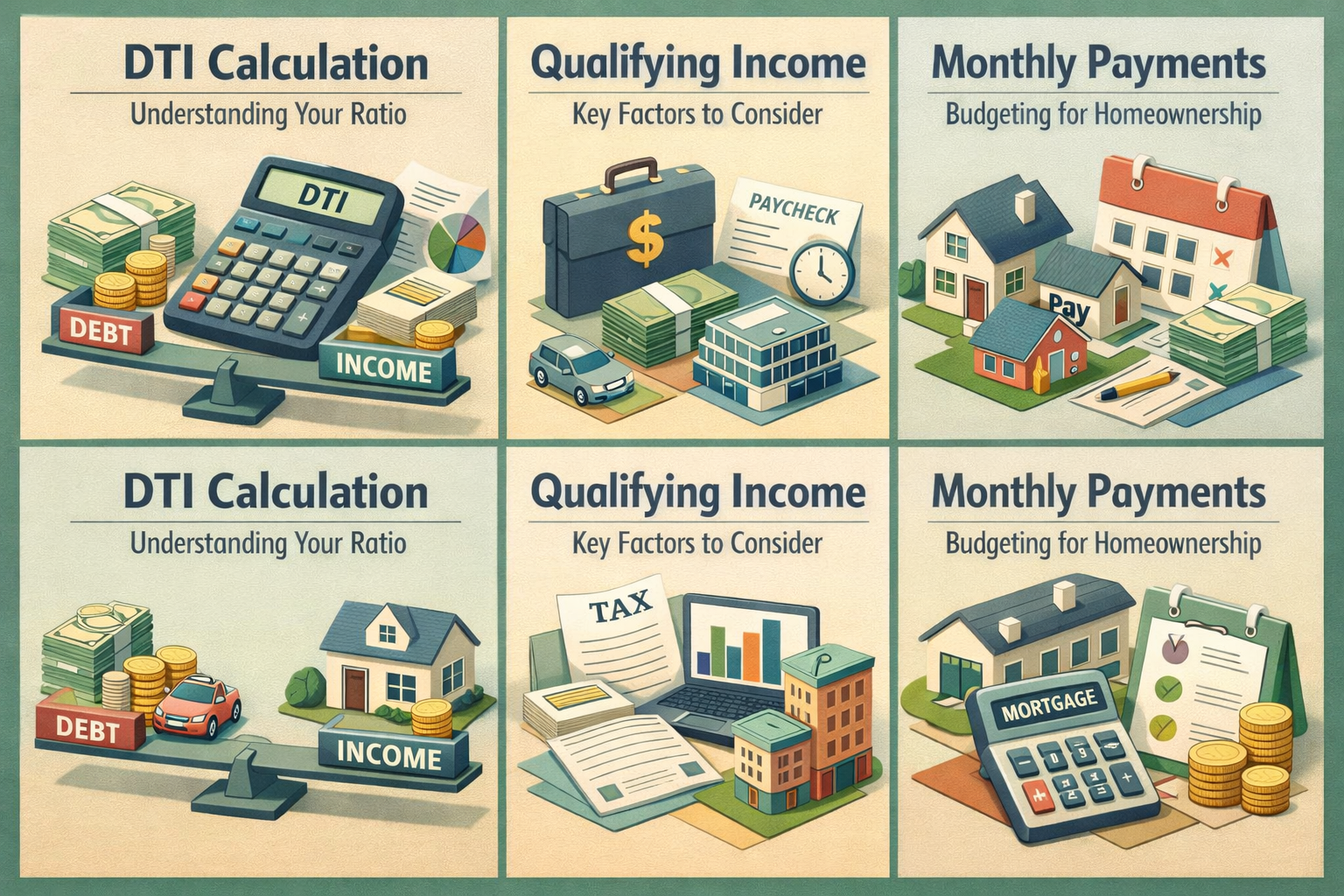
Your debt-to-income ratio, or DTI, is one of the most important numbers in any mortgage application. It measures the percentage of your gross monthly income that goes toward paying monthly debt obligations. Lenders use DTI to evaluate whether you can comfortably manage a new mortgage payment on top of your existing financial commitments.
The DTI calculation for self-employed borrowers works the same way it does for salaried applicants — but because your income figure is derived from tax returns rather than pay stubs, getting that number right is critical.
Here's how the basic DTI formula works:
- Front-end DTI: Proposed monthly housing payment (principal, interest, taxes, insurance, and any HOA fees) divided by gross monthly income
- Back-end DTI: All monthly debt payments (housing + credit cards + auto loans + student loans + other obligations) divided by gross monthly income
Most conventional loan programs prefer a back-end DTI of 45% or lower, though some lenders may go higher depending on compensating factors like strong credit scores or larger down payments. FHA loans may allow slightly higher DTI ratios in certain circumstances.
Using the earlier example — $5,000 per month in qualifying income — if your proposed mortgage payment (including taxes and insurance) is $1,400 per month and you have a $300 car payment and a $200 student loan payment, your back-end DTI would be:
($1,400 + $300 + $200) ÷ $5,000 = 38% DTI
That ratio would likely be considered acceptable by most conventional lenders. The key takeaway is that your net qualifying income directly controls how much home you can afford, which is why maximizing that figure — through careful tax planning and documentation — matters so much for freelance photographers.
Estimating How Much Home You Can Realistically Afford
Once you understand how lenders calculate your qualifying income, you can begin estimating a realistic home purchase price. Learning how to calculate mortgage affordability with 1099 income from freelance photography is largely about working backward from your approved monthly income figure.
Here's a simple framework to get started:
- Identify your average net monthly income from the past two years of tax returns
- Multiply by the maximum DTI your lender allows (commonly 43% to 45%)
- Subtract your existing monthly debt payments
- The remaining figure represents the maximum monthly housing payment you may qualify for
From that monthly payment figure, you can use a mortgage calculator to estimate how large a loan that payment could support, based on current interest rates and your anticipated loan term. Keep in mind that property taxes, homeowner's insurance, and — if applicable — private mortgage insurance (PMI) or HOA fees will eat into that number, reducing your total principal and interest budget.
As a general rule of thumb that many financial professionals suggest, your total housing costs might ideally stay at or below 28% to 30% of your gross monthly income. For a freelance photographer earning a qualifying income of $5,000 per month, that could translate to a housing budget of roughly $1,400 to $1,500 per month. Of course, your specific market, down payment size, and credit score will all influence the final numbers.
Loan Programs That May Work Well for Freelance Photographers
Not all mortgage programs treat self-employed income the same way. Knowing which loan types might be a good fit for your situation can save you time and frustration during the application process.
Conventional Loans
Conventional loans backed by Fannie Mae or Freddie Mac are available to self-employed borrowers, but they typically require thorough income documentation through tax returns. If your tax write-offs significantly reduce your qualifying income, a conventional loan may allow you to borrow less than you'd hoped for.
FHA Loans
FHA loans are government-backed and may be more flexible with DTI ratios and credit score requirements. They could be worth exploring if you're a first-time homebuyer or if your credit profile isn't quite strong enough for conventional financing. FHA loans do require mortgage insurance premiums, which affect your monthly payment.
Bank Statement Loans
Bank statement loans — often classified as non-QM (non-qualified mortgage) products — allow lenders to use 12 to 24 months of bank deposits to determine qualifying income instead of tax returns. This can be a significant advantage for freelance photographers whose tax returns show lower net income due to deductions. These loans may come with higher interest rates, but they offer an alternative path to homeownership for self-employed borrowers.
Asset-Based or 1099-Only Loans
Some specialty lenders offer programs that use 1099 forms directly, without requiring full tax returns. These products are designed specifically for independent contractors and freelancers and may be worth exploring with a mortgage professional familiar with non-traditional borrower profiles.
Practical Steps to Strengthen Your Mortgage Application as a Freelancer
Preparation is everything when you're applying for a mortgage with freelance income. The stronger your financial profile, the more options you'll have — and potentially, the better the terms you'll receive. Here are some steps that could meaningfully improve your application:
- Work with a tax professional: A CPA familiar with self-employed borrowers can help you balance legitimate deductions against the qualifying income you'll need for a mortgage. Claiming fewer deductions in the one to two years before applying may help increase your documented income.
- Build strong cash reserves: Lenders often view significant savings as a compensating factor for self-employed borrowers. Having several months of mortgage payments in reserve may help offset concerns about income variability.
- Protect your credit score: A higher credit score can offset some of the perceived risk associated with self-employment. Pay down revolving debt and avoid opening new credit accounts in the months leading up to your application.
- Document your income thoroughly: Keep organized records of all contracts, client invoices, and bank deposits. A clear paper trail reinforces the stability and legitimacy of your freelance business.
- Demonstrate consistent or growing income: Lenders are more comfortable when income trends upward. If your photography income has been growing year over year, highlight that trajectory in your documentation.
- Work with a lender experienced in self-employed borrowers: Not every lender handles 1099 income the same way. Partnering with someone who regularly works with freelancers and independent contractors can make a meaningful difference in your experience and outcome.
●Conclusion
Understanding how to calculate mortgage affordability with 1099 income from freelance photography isn't just an exercise in math — it's about taking control of your financial narrative before lenders write it for you. By knowing how your qualifying income is determined, how DTI ratios work, and which loan programs align with your situation, you're far better equipped to navigate the homebuying process with realistic expectations and a clear plan. Whether you're purchasing your first home or looking to upgrade as your photography business grows, the right preparation and the right lending partner can help turn that goal into a reality. At LoanWise, we're here to help self-employed borrowers find the right mortgage fit — reach out today to explore your options.